
Room to Run: Tim Partington on One Vision, a Greenfield Start and Trusting Your Team
20 November 2026· AFQY News
Watch this interview on camera
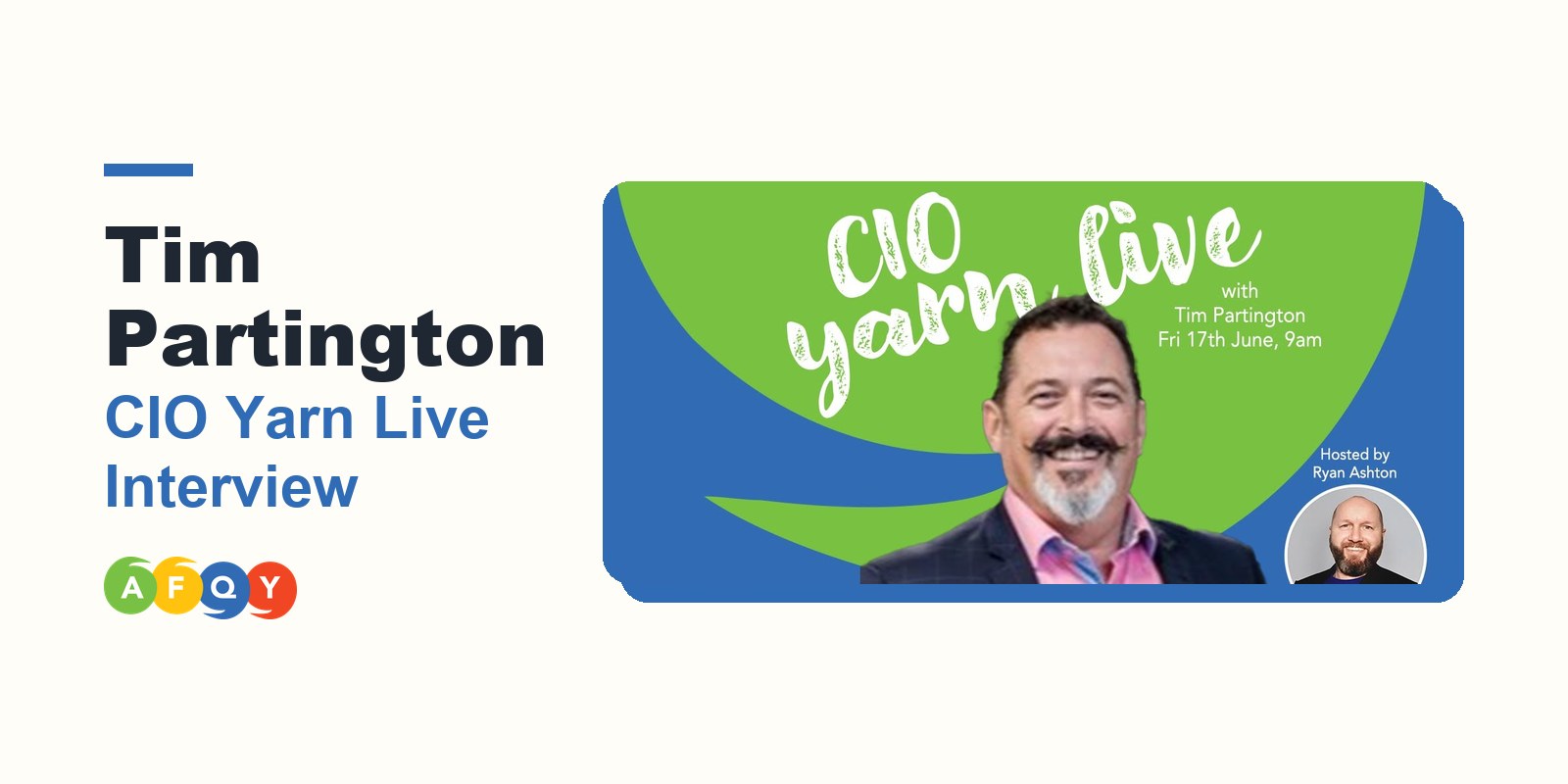
This article is written for the 2022 interview. On Tim Partington’s first day at McDonald’s, a colleague about six foot five, with bright red curly hair, a beaming smile and badges down his arms, took him into the team as “the new wombat” and showed him the ropes. Years later, running technology for a training organisation, he said the lessons of that welcome still lived with him.
He told that story on 17 June 2022, as the guest on CIO Yarn Live, AFQY’s weekly on-camera interview with a New Zealand technology leader. He was then a technology leader at Skills Consulting Group, a not-for-profit that grew out of an industry training organisation. It was the show’s eleventh episode. Every guest got the same three questions: one on culture, one on technology, and one asking for a single lesson. The host was AFQY’s Ryan Ashton.
This piece comes from the archive, the last of the eleven interviews kept there, so read it as a picture of June 2022. COVID, as Partington put it, had been affecting everyone for a couple of years. Partington is now Chief Information and Technology Officer at Southbase, which he joined in 2026. What he said about one vision, about knowing your role and about trusting a team still stands up.
TL;DR
- Tim Partington’s test of a great culture was everyone on the same page from top to bottom, with one consistent vision. A big ship can move five degrees, he said, but it cannot do U-turns.
- Partington worked at McDonald’s in Australia for four years, from the age of 15, and credited it with teaching him teamwork, knowing your role, and how to make a new starter’s first days a great experience.
- In 2022 Skills was going through a separation under the vocational education reforms known as RoVE, with many of its learners moving to Te Pūkenga. Partington used the moment to reset the technology strategy and set up what he called a new greenfield business.
- In 2022, Skills Consulting Group was shifting to a full Azure stack running largely Microsoft applications, while keeping its existing infrastructure and applications to support the learners moving to Te Pūkenga.
- Partington’s lesson for his 20-year-old self was to trust your team earlier: support people, give them a safe space to explore, and give them room to run.
- Partington hired for aptitude and attitude, on the view that skills can be trained, and his closing advice to leaders was to be kind and a little more caring in how they lead.
Meet the person, not the suit
Ryan opened with “G’day mate”, because his guest was, in Partington’s own words, “a transplanted Aussie”. He had moved to New Zealand 25 years before. He loved it, he said, and it was his home.
AFQY introductions start outside work: meet the person, not the suit. Partington said he was married, with two adult daughters, both Kiwis. He loved motorcycling and rode all sorts of bikes. He was president of a New Zealand motorcycle owners’ club, and had done a lot of his commuting by bike.
Ryan had introduced him as the guest with the special moustache. Nature built it that way, Partington said. He had often worn a goatee. Then his wife asked him to grow a beard, so he did, and she liked it kept.
Everyone on the same page
The first question was what mattered to him about culture, and how he actively shaped it. Partington said people often go looking for a way to create a fresh culture, or ask whether culture is driven by leadership, or how to build culturally diverse environments. His own test was plainer. A great culture is everyone on the same page, from top to bottom. That means a consistent vision and a consistent approach to delivery, to customer service and to people, with everyone aligned to it.
He credited a really good comment he had heard on culture: make sure the underlying messaging is all the same.
New people, he said, are adopting a new family, one with a singular vision of what it is there to do. Everyone understands the why. “If everyone’s working cohesively with the why then you’ve got a really strong environment,” he said, and people feel the culture is strong because everyone is heading in the same direction.
That still leaves room to push. “It’s okay to challenge the edges,” he said. The picture he often used was of a great big ship.
"We can move the ship five degrees but we can't do U-turns."
The job, he said, is to keep the ship heading the same way with everyone on board, allowing for each person’s input and without being dogmatic about the direction. Someone who joins is joining because that is the vision and that is the plan, not only to do a job, and comes on as a big part of it.
Ryan offered the Kiwi way of saying it: all paddling the waka in the same direction. He also noticed that Partington had the same Darth Vader mug he normally uses himself.
Under the fashions of workplace culture, Ryan said, sits a small core of human things that make any team work: trust, integrity, competency and empathy. Slides and bean bags do not make a culture. The vision is the layer that makes a culture particular to one organisation.
Partington took the point about alignment further. For a good or great culture everyone has to be aligned, he said, whether that is the departments that provide services to the client-facing and people-facing roles, or the business units themselves. Ryan’s example came from his years in technology sales: a handover sheet, gone through with the client in the room, so the delivery team had everything it needed.
Don’t mess with the bun guy
Ryan asked for an example from his own background. Partington said he hoped every person carries the memories and experiences of their career forward, keeps the good points and learns from them. His own went back to McDonald’s in Australia, where he worked for four years, from 15 to 19.
“The culture and teamwork that I learned from working at McDonald’s was incredible,” he said. It taught him how to be efficient with time, how to work as a team and how to communicate. Under those sat three plain questions: what is your role, what is your purpose, and why are you here?
"If it's to work on the grill then you don't mess with the bun guy."
The bun guy has his job to do. Partington carried that into leadership: allow people to do what you have asked them to do. If you have given them the training and the skills, he said, “you’re not there to micromanage them, you’re there to be part of a bigger team.”
He worked the hardest and had the best fun of his life in those years, he said. Then there was the first day, and the colleague he called the embodiment of Ronald McDonald, with all the badges, tags and qualifications, who made his early days such a great experience.
The lessons he took from it were about bringing people in. Make onboarding a great experience. Set people up for success. Make sure they have what they need. And keep it going: “It shouldn’t just be a one-off.”
Ryan’s own version was a job at Gap in London, where each shift ended with staff writing down something a colleague had done well for them. He came to see what it did for a team.
The most entrepreneurial bunch
Talk of how different workplaces do things led Partington to the two countries he knows best. Before he moved to New Zealand he had travelled back and forth implementing an ERP system across a number of sites.
“It struck me that the Kiwis were the most entrepreneurial bunch of people that I’d ever come across,” he said. He had come from larger corporates and Americanised companies. The New Zealanders he met thought very differently. They kept asking how to do a thing differently, how to create a unique selling proposition, and how to do it efficiently and cost effectively.
It was the stark difference he saw between the two cultures. Seen from overseas, he said, the Kiwi way can look a little less corporate, with a key intent to drive a real positive outcome.
Ryan put it down to number eight wire: New Zealanders did not have everything, so they made what they needed.
A greenfield start
The second question asks what technology the guest is working on, as far as they can share. Partington began with the organisation. Skills Consulting Group, he said, was a not-for-profit that germinated as an industry training organisation, or ITO. In 2019, he said, the Government announced the merger of the country’s 16 polytechnics and institutes of technology under the Te Pūkenga umbrella. Under the reforms known as RoVE, Skills had to separate. He likened it to the separation of Chorus and Telecom.
The Tertiary Education Commission’s update that September recorded the Skills Organisation’s training arrangements moving to Te Pūkenga and to several private training establishments, with the last due to move on 1 October 2022.
Partington saw an opening in it. “That provided us with an opportunity to reset our tech strategy,” he said, “and as a result I’m in the fortunate position of really setting up a new greenfield business.”
Te Pūkenga would take on a large number of Skills’ students, he said, and others were moving to other receiving organisations. So Skills was keeping its existing infrastructure and applications to support Te Pūkenga’s platform going forward. For itself, still as a not-for-profit, it was establishing a new technology stack to serve its people, its students and its companies.
That meant shifting to a full Azure stack, running a large degree of Microsoft applications. He listed student management systems, learning management systems and employee assistance programmes. The new stack, he said, let Skills reset its delivery platforms, operate well and build a platform for the future.
The applications were there for a reason. Skills was all about people skills, he said, and the supporting systems were needed so that it lived up to its vision of being an organisation that helps people grow, from apprentices through to sales executives, with vocational guidance as well. It added up, he said, to an opportunity for growth.
He gave a sense of the reach. Skills covered 22 trades and 14 countries, he said, and he described it as the largest certified agile provider in, basically, the southern hemisphere. It delivered vocational guidance and employee assistance programmes through brands that did not carry the Skills name. Among those he listed were brands for sales training and career guidance, and IMNZ, the Institute of Management New Zealand.
He named his technology challenge. Skills had acquired a lot of new companies, private training establishments, over the previous couple of years, he said, and each came with its own technology stack. One of them he called an incredible company, with some great things in its environment. The work was to incorporate the good from each and keep the focus on the right technology, for an efficient and economical delivery model for clients and students.
Trust your team earlier
The third question asks every guest what lesson they would give their 20-year-old self. Partington began with thanks. He would not be where he was, he said, without the teams and individuals who had given him guidance and support and helped deliver outcomes for clients and customers.
"Trust your team earlier. Make sure that they're being supported when you're a leader and that you're providing them with a safe space to be free, be dynamic, explore what they need to explore."
The other way, he said, is to try to corral and constrain. His McDonald’s days had been regimented, and they shaped his early days as a leader. What he had learned since was to let people be far more flexible and far more dynamic.
He pointed to the people around him. “The team that I’ve got with me on the Skills journey is incredible,” he said. They were doing an amazing job, and they needed room to run. His advice in five words: “give people room to run.”
Room for mistakes
Ryan turned the question around. What happens when someone breaks that trust?
Partington started with the nature of it. Was the thing done in genuine sincerity, in line with the culture and where the organisation was going, with an intent that was true of heart? “You’ve got to give people room to make mistakes as long as the intention was pure,” he said. Malice was a different matter, and there he took a firm line, as Ryan did.
He then put it another way. Trust rests on the behaviours everyone is asked to sign up to, and he named four: transparency, empathy, honesty and integrity. A person who breaks trust has broken one of those covenants, he said, and has made their own decision.
It took him to hiring. He had always believed in employing people with “the right aptitude and the right attitude”. Skills can be trained, he said. The other two a person has to bring, or the team will not drive the same culture.
People, people, people
Asked for a closing remark, Partington thanked Ryan for the morning. With COVID affecting everyone over the previous couple of years, he said, his mind was on one thing.
"For me it's about people, people, people."
People need to focus on being kind, he said, on being caring and on looking after their people. He asked for one thing: “try and be a little bit more caring in your approach to how you lead everyone.”
“That is beautiful,” Ryan said. The show ended with two goodbyes: ka kite anō, and the classic Aussie one, see you, mate.
What it means
This was a conversation about one organisation in one year of change. The advice in it is tied to neither. Give people one vision and make sure they know the why. Be clear about each person’s role, then leave them to it. Make the first day great and keep it up. Trust the team early, leave room for mistakes made with good intent, and lead with care. None of it waits on a new platform.
Two of the lessons
- Culture is everyone on the same page. One vision that people understand, from top to bottom, with the same approach to delivery, customers and staff.
- Trust your team earlier, and give people room to run. Back people, make it safe for them to explore, and resist the urge to corral them.
There are 18 more lessons from this conversation, kept for AFQY Tech Leaders. Join the AFQY community as a Tech Leader to read the rest and discuss them with other Tech Leaders.
Sources
- AFQY on YouTube: CIO Yarn Live, Tim Partington, 17 June 2022
- CIO: CIO50 Awards New Zealand 2023, Tim Partington, Skills Consulting Group
- Southbase: Tim Partington, Chief Information and Technology Officer
- Tertiary Education Commission: TITO transitions nearing completion, September 2022
- Management magazine: IMNZ joins Skills Group, June 2018