
Practise Observation: Shayne Hunter on Office Hours, Doing the Dishes and Connection
20 November 2026· AFQY News
Watch this interview on camera
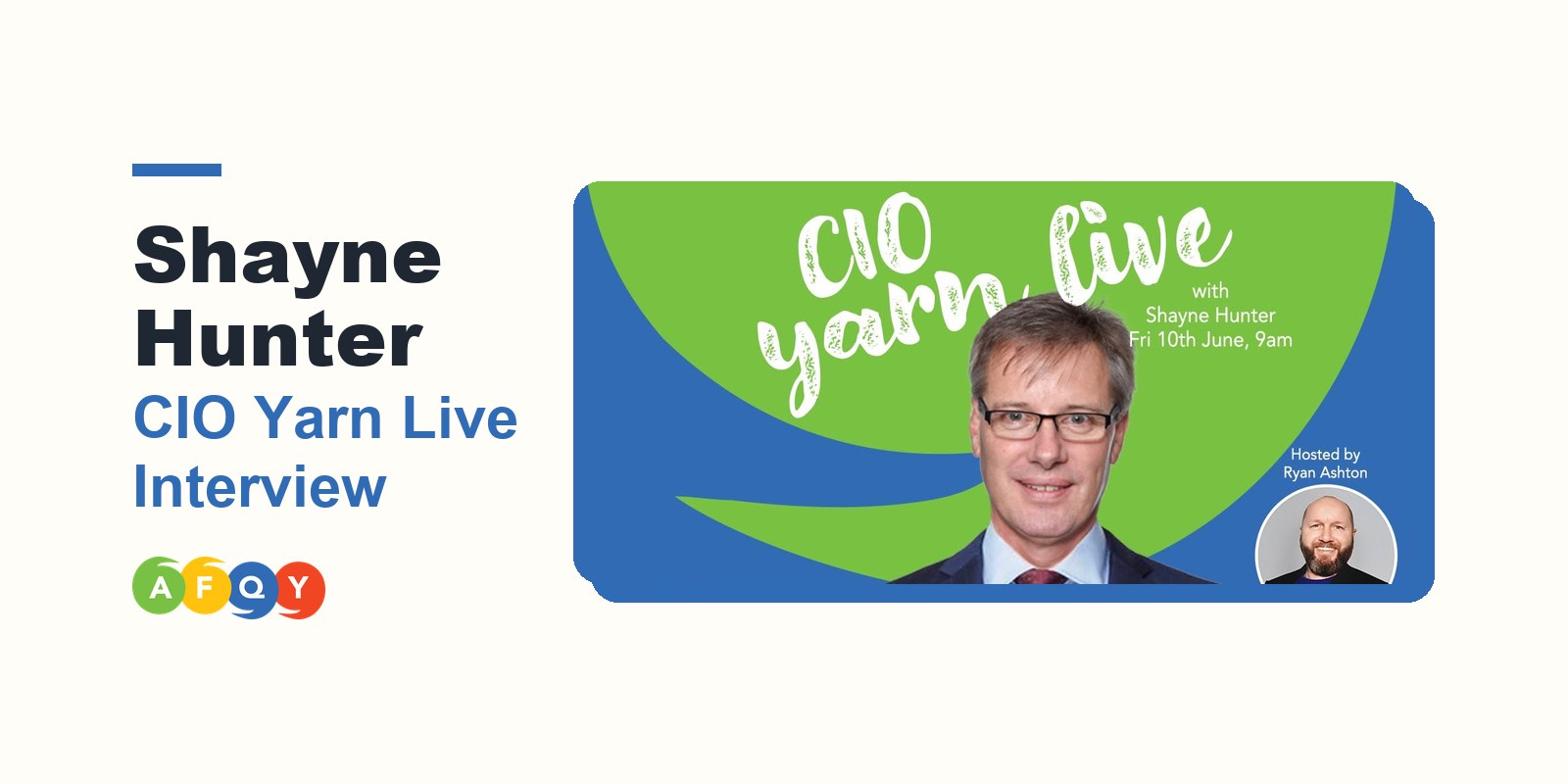
This article is written for the 2022 interview. Shayne Hunter had a practice he called office hours. He took a meeting room, blocked a couple of hours out of his diary, and anyone on his team could come and see him about anything. People came to tell him what they were working on, to bring ideas, and to name the barriers in their way along with suggestions for getting past them. He said he had really enjoyed it.
He described it on 10 June 2022, as the guest on CIO Yarn Live, AFQY’s weekly on-camera interview with a New Zealand technology leader. He was then Deputy Director-General for Data and Digital at the Ministry of Health, and also the data and digital lead for Health New Zealand, the national organisation that was three weeks from taking over from the country’s 20 district health boards. It was the show’s tenth episode. Every guest got the same three questions: one on culture, one on technology, and one asking for a single lesson. The host was AFQY’s Ryan Ashton.
This piece comes from the archive, so read it as a picture of June 2022. The country was in its third year of COVID-19, and the health system was about to be reorganised. Hunter is now Chief Digital Officer at RHCNZ Medical Imaging Group, the radiology provider. What he said about staying close to a team and learning to observe still stands up.
TL;DR
- Shayne Hunter, then Deputy Director-General for Data and Digital at the Ministry of Health, held “office hours”: a couple of hours blocked out in a meeting room when anyone on his team could come and talk to him about anything.
- When Hunter started in the Ministry of Health role he spent up to an hour at a time with team members while they did their jobs. He called these sessions apprenticeships, and said he did not know how anyone could lead a team without knowing what its people do.
- Hunter’s other culture habits included a weekly email with a personal opening, an equity lead to build equity by design into the team’s thinking, giving people the chance to stretch, and doing the office dishes.
- On technology, Hunter said the job was to join up the health data sources the country already had, and to extend the platforms built for COVID-19 to other communicable diseases.
- One of Hunter’s goals on taking the Ministry of Health role was to have digital funded and seen as adding value, not as a cost.
- Hunter’s one lesson was to practise observation: sit back a bit longer, think about it from the other person’s perspective, and ask what is not on your radar. His closing message was to stay connected.
Meet the person, not the suit
Ryan began with a memory. Hunter had been a guest at AFQY’s very first event in lockdown, two days into New Zealand’s first lockdown, and Ryan had never forgotten him saying his email had gone from an average of 120 to 750. Hunter said he remembered that day in 2020: emails arriving every two seconds, at a rate he had never seen in his life.
His career started at IBM. His background is computer engineering, and what interested him was the application of technology. He left IBM and spent seven years in start-ups in the music industry. He had a vision, he said, and an entrepreneurial spirit.
One of those businesses let people phone up and listen to music before they bought it. It took hundreds of thousands of calls a month, he said, and it was well ahead of the technology of its day. He turned it into a data business: it could show what time of day people called, how long they listened and which tracks they listened to.
After other work in the music industry he moved into consulting, and then became chief information officer for Capital & Coast, Hutt Valley and Wairarapa district health boards before joining the Ministry.
Outside work, the thing was music. He had played in a band for a while: percussion, a bit of rhythm guitar and harmonica, some backing vocals, and the tambourine or the cowbell depending on the song. He had fun, he said. To relax he listened to music on a hi-fi he had invested in, from a collection he put at about 9,000 CDs.
His taste was broad, he said: jazz and its variants, and rock. He had seen the Dave Matthews Band in Australia and at four venues in the United States. His favourite was the Gorge, on the Columbia River in Washington state, where he got three days of the band and, he said, they never played the same song in the three days. His favourite song was “Gravedigger”, a Dave Matthews solo song. Ryan found it on YouTube and asked whether the harmonica was coming out. Hunter told him there was no harmonica on that one.
The other love was motorbike touring with his wife. Their biggest ride was close to 3,500 kilometres, over every pass in the South Island and right down to the Catlins. He called it a fantastic trip. Ryan, who is from Dunedin, said the Catlins are all the more beautiful for being little known.
The people in health
Before he answered the first question, Hunter had a message for everyone who works at a keyboard a lot. You might go for a run and go to the gym, he said, but most people do no work on their neck, and over time it loses its agility. Neck stretches are important.
Turning to culture, he started with the people who work in health. They are the most giving of their time, he said, and the most caring, and that is an important part of the culture of health.
Culture: who we are, how we operate, how we grow
The first question was what he does to build a good culture across a diverse team. Hunter had made notes. He said he liked to think about culture in three dimensions: who we are, how we operate and how we grow.
His list:
- Purpose is a must-have. People need to understand the organisation’s purpose and to have their own.
- Honesty, integrity, trust and respect, which he called fundamental. IBM had great values, he said, and respect for the individual was one of the most fundamental of them: you treat everybody with respect, including when you are frustrated.
- A culture that is inclusive, open and transparent.
- Empowerment. When everything rises to the top for approval and nobody knows whether they can act, people do not feel empowered, and he said that undermines what the organisation wants to achieve.
- Recognition. He thought it important that a culture recognises people’s contributions, and that people are happy to give each other a shout-out.
- Diversity and fairness. He liked diversity in a workforce, and said everyone deserves parity in roles and equal opportunity in career development.
He had also made a note about prioritising learning, and looking at how to accelerate it. “I had a different job every 18 months and every job was a stretch,” he said of his time at IBM. The company had a philosophy he said he believed in: you will always leave the organisation a better person than when you came in, whether you were there for six months or 26 years.
If people are constantly challenged and given opportunities, he said, the winner is both the organisation and the individual.
Office hours and apprenticeships
Then he turned to what he did about it.
Office hours came first. He had held them as chief information officer at the district health boards, where he had an office, and he carried them into the Ministry, where he took a meeting room. Anyone could come, about anything. A concern was welcome as long as it was raised constructively. “I like solutions, not just problems,” he said.
What he had really enjoyed was the connection with people at the coalface. He had quite a big team, and he said it is very easy to sit and operate with your senior managers and not be connected to what is going on.
The second practice was one he did particularly when he came into the Ministry role. He called it the apprenticeships. He would spend up to an hour with someone while they did their job. One manager took him around her entire team of database administrators, speed-dating style, so he could find out what each of them was doing.
"I don't know how you can lead a team of people if you don't know what they do."
A leader does not have to understand every bit of detail, he said, but does need to be accessible and to understand each person’s role. It was also interesting getting to know people. The conversations were not all about work.
Stretch, equity and the dishes
Delegation was a big thing for him. Giving people the opportunity to stretch, he said, was an important part of the culture he tried to build.
He backed people into those opportunities. It is easy to say someone is really busy and caught up in their role, he said. Ask people how they would solve the issue of replacing themselves, and a team that is working well will usually solve it. That frees the person to grow.
He had brought an equity lead into his part of the organisation, because the group had decided that equity by design needed to be built into all of its thinking. He called the equity lead fantastic. The work had people thinking about equity generally, not just for Māori but across the board, and he had really enjoyed watching the team embrace it at all levels. He was proud of what the team had done.
A weekly email went out to the team. He liked to write something quite personal at the start of it, and he liked people to tell their own stories in it. He thought of it as something that informs people and gets them engaged and connected in what the group is all about.
And he did the dishes. Why make everyone else do them, he asked. He could stack and unstack a dishwasher. It was not every day, but it was something he liked to do.
Ryan called it a golden list. The dishes took him back to learning to manage bars, where his manager had him serve the team their drinks and mop the floor himself while they enjoyed them. The leader, Ryan said, is the person at the bottom of the tower holding everyone up.
Hunter agreed completely. He would talk to the cleaners too, he said, and he encouraged anybody to get out among people.
"I can't do it without people. I can't be successful without people. No one can."
Technology: what was on the list
The second question is about technology, and in June 2022 that meant starting with the shape of the health system.
Hunter explained it for viewers. Twenty district health boards and a number of shared services organisations were merging into one national organisation, Health New Zealand, alongside a Māori Health Authority, under new legislation. The Ministry was moving to be more of a policy and strategy shop. Almost all of his people were moving to Health New Zealand, which was to come to fruition on 1 July.
The change put a huge emphasis on equity and access to care, he said. The transition, and the transformation after it, would take a number of years.
He said he had an awesome team and had really enjoyed leading them. They had a massive amount of work on. Standing up the new organisations, reorganising the Ministry and putting all the technology in place for them to operate was, he said, a big deal. Then he ran through the rest:
- Extending what was built through COVID-19. COVID is one of many communicable diseases, he said, and the question was how to use those platforms for the others. Monkeypox (now called mpox) was the latest, and it was going through the formal process that would let it be managed under a public health regime.
- Joining up health data. The task, as he put it, was to join up the different data sources the country already had, and he said a programme of work had been set up for it.
- A new immunisation solution, and new screening solutions for breast, bowel and cervical screening, all to be rolled out.
- A big programme on how contracts and payments are managed.
- Work on what the team called digital enablement, emerging technology and innovation, and a lot of work on data.
Data and digital had received quite significant investment in his time in the role, he said, and that was a team effort. One of his goals when he came into the role had been to get digital into a space where it was funded and seen as adding value, not as a cost.
The technology then available, which he called the Lego blocks that can be bolted together, was quite amazing. He expected clinical, medical and information technology to merge much more over the next few years.
Day one, and a smaller target
Ryan asked how the joining of the district health boards would work in practice.
Hunter’s key message was that not a lot would change on day one. The system is massive, with thousands of people who go about the business of delivering care, and it cannot be changed overnight.
The key focus, he said, was continuity of service and workable foundations that the system could then build on. There would be no single big switch on 1 July, he said. The system would be taken forward from those foundations.
Ryan raised security, and the pros and cons of any choice of design. Hunter said the team was very conscious of the security risks, and that health is a big target. He wanted to take the target off its back.
You would not build one big single system as a cyber target, he said, and there were plenty of other reasons not to build one either. The approach was standards, interoperability and a system that is more of an ecosystem from a technical point of view.
Ryan likened it to building in compartments, and to zero trust: expect someone to get through, and be able to pick them up and stop them going further. Hunter agreed, and said the team would be very thoughtful.
One lesson: practise observation
The third question asks each guest what they would tell their 20-year-old self. Hunter said he could have picked from more than a handful. He said he did not think you grow as a person if you do not learn, or learn if you do not make mistakes.
The one he wrote down was practising observation. It does not necessarily come naturally to people, he said. It is easy to jump to conclusions, to listen narrowly, and to be the person who always has something to say.
So the practice is to sit back and think about what is not on your radar, and what you are missing. That runs from noticing that someone is having a bad day to asking whether you understand what they really want. He said it can determine success, in the outcome you are after and in the relationship.
"Sit back a bit longer, observe, think about it from their perspective, take a broader view."
It has to be practised, he said. You might say today that you will be observant, but will you always be? It has to become habitual. He had learned it over the years, and he encouraged everyone to think about it.
The prompt had come from someone he had known for many years and had not seen for years. That person’s post on LinkedIn posed a question: what if you had only known it when you were younger? Hunter sat back, thought about it, and decided it was such a good point. That post, he said, was what triggered him to be much more observant, and to practise it.
Ryan connected it to active listening. There is no rule, he said, that you must start speaking the moment the other person stops. You can say that what they said is important and that you want a moment to think it through.
Stay connected
Asked for closing remarks, Hunter went to connection.
"I'm a believer in the power of connection."
He encouraged people to take the opportunity to connect with other people. There is a lot of one plus one equals three in it, he said, the sum of the many parts.
Then came a plug for AFQY that Ryan said was unexpected and not organised. Hunter had first seen AFQY announced on LinkedIn, thought it a great idea, and wondered when it would come to Wellington. Bringing people together and creating those connections is a great thing, he said, and it fitted his message to people: stay connected.
Ryan thanked Hunter and his team for everything they had done for the country through COVID-19: keeping the health system running, so that people could get to it when they needed to and the people who work in it could operate it.
What it means
More than four years on, the organisations in this conversation have changed, and so has the technology. What Hunter said about leading people has not dated. Keep a couple of hours open for anyone who wants them. Sit with people while they do their work. Do the dishes. Before you answer, look for what you are missing. None of it waits on new technology. Any leader can start this week.
Two of the lessons
- Practise observation. Sit back a little longer and ask what is not on your radar. Keep at it until it is a habit.
- You cannot lead people if you do not know what they do. Spend time beside people at their work. The detail can stay with them, but their role should be clear to you.
There are 26 more lessons from this conversation, kept for AFQY Tech Leaders. Join the AFQY community as a Tech Leader to read the rest and discuss them with other Tech Leaders.
Sources
- AFQY on YouTube: CIO Yarn Live, Shayne Hunter, 10 June 2022
- Pulse+IT: Capital & Coast CIO appointed to head data and digital for MOH, January 2019
- Ministry of Health: Healthy Futures (Pae Ora) Act 2022
- RHCNZ Medical Imaging Group: About, executive team
- Decipher Group, archived copy: RHCNZ welcomes new Chief Digital Officer
- AAP press releases: Enlitic's Ensight goes live at RHCNZ, May 2026