
For Generations to Come: Sue McLean on Being Human, Shared Data and Letting Go
20 November 2026· AFQY News
Watch this interview on camera
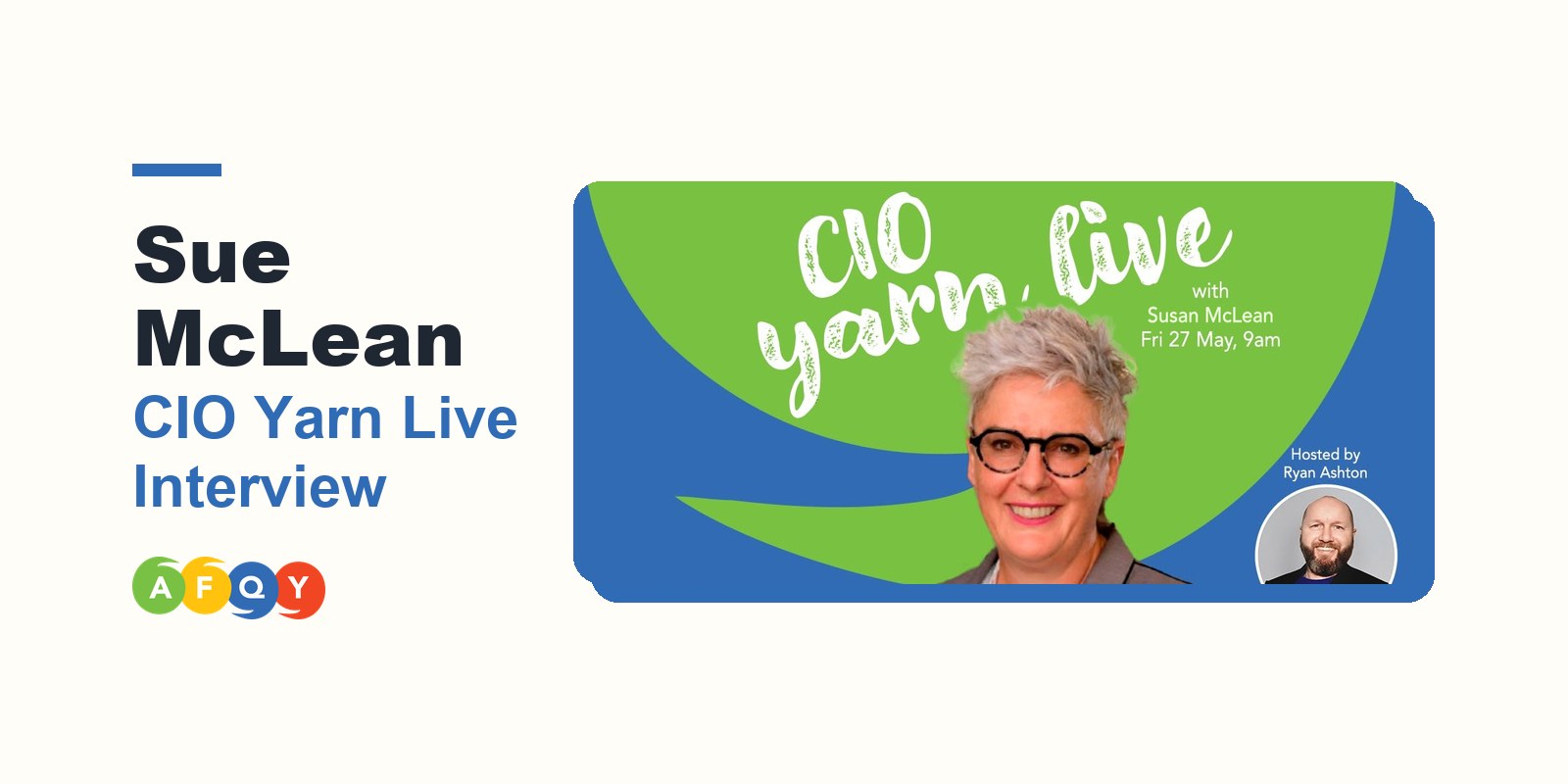
This article is written for the 2022 interview. Sue McLean had a test for the environmental data platform her council was building: when can I teach my mokopuna, my grandchildren, to fish in Porirua Harbour? When the platform could answer that, she said, the team would have created something pretty special.
She set out that test on 27 May 2022, as the guest on CIO Yarn Live, AFQY’s weekly on-camera interview with a New Zealand technology leader. She had been Chief Technology Officer at Greater Wellington Regional Council for two and a half years, and about a month earlier had become its General Manager, Corporate Services. It was the show’s eighth episode. Every guest got the same three questions: one on culture, one on technology, and one asking for a single lesson. The host was AFQY’s Ryan Ashton.
This piece comes from the archive, so read it as a picture of May 2022. The show usually ran over video call. This time the two sat side by side on the deck of the council’s building in Wellington, with Cuba Street behind them. Ryan thanked Bill Moses, who had been booked for that morning and had moved to the next slot. What McLean said about being human at work, about sharing what you build and about not needing every answer still stands up.
TL;DR
- Sue McLean, then General Manager, Corporate Services at Greater Wellington Regional Council, said culture starts with recognising that people bring their whole lives to work, and telling them “we’ve got your back”.
- In 2022 Greater Wellington was building an environmental data platform with Environment Canterbury, starting with water data and working from what Environment Canterbury had already built.
- The benchmark for Greater Wellington’s environmental data platform was one plain question: when can I teach my mokopuna to fish in Porirua Harbour?
- McLean called Porirua Harbour an intergenerational problem. She wanted modelling that could compare planting options and bring iwi into the conversation.
- McLean wanted Greater Wellington’s environmental data platform to be something any council could tap into, including small regions with IT teams of fewer than ten people. Her method was to start small, build in steps, tell people what the team was doing and invite them in.
- McLean’s one lesson: a manager or leader does not have to have all the answers. Hire the talent, ask them the questions and work on the answer together.
Meet the person first
AFQY introductions start outside work, so that viewers meet the person before the job. McLean lived at Mākara, on Wellington’s west coast. That made the region important to her, she said, and working for its regional council was “a pretty sweet deal to get”.
She had been the council’s Chief Technology Officer for two and a half years. She said she had taken it on a magnificent journey, and had now handed that over to her colleague Ross Lynch. Her new job, corporate services, came with a portfolio she said was too large to list.
Home was a 30-acre block with a mountain bike track on it. The tracks are high grade, she said, and “it’s about creating something for other people to use”.
She has two children. One was in Slovakia at the time. The other was living on the land with six puppies, and McLean offered a puppy to any viewer who wanted one. Then there was Basil, her dog, kept in what she called “the lifestyle that he’s accustomed to”. She is the youngest of six children, and said that taught her to be an extrovert.
McLean said she wanted to take the pressure off her managers. “I want to take the pressure off them. They don’t have to manage all the time.” Ryan’s phrase for it was a human manager.
Bring your whole human to work
The first question was how she actively creates a culture that builds belonging and a team. For McLean it came down to being human, and bringing your whole human to work.
Humans have emotions and feelings, she said, and things going on at home. Someone is waiting on a building consent that has come back with another question, which means another month. There is no time at work to deal with it, and it stays on their mind through the working day. Greater Wellington had people with family in Ukraine, people with family going through cancer, and people who had lost their life savings in a construction collapse. They came to work every day.
A leader’s part, she said, is to recognise that, and to play to the strengths each person has as a human. The message is “we’ve got your back”: we will listen to you, and we will create a safe space.
She had one more thing for leaders to recognise. Some people, she said, are in effect paying to come to work.
"They're putting their kids in daycare. They're paying for the privilege to come and work with you. So just recognise that."
Ryan called it good new-school leadership. When a leader works that way, he said, people respond better, give more, and are eager and enthusiastic where they might have been forced.
A platform with one question to answer
The second question asks each guest about the work that excites them. “One of the things that I do as a manager is hire really smart people,” McLean said, and a lot of them were working on what she called a wicked problem: how to create an environmental data platform that the council could ask questions of.
The benchmark was the fishing question. Answer that, she said, and the team had created something pretty special.
She was not out to build a platform of her own from nothing. What was cool about it, she said, was that Greater Wellington was copying one from somebody else. It was working very closely with Environment Canterbury, known as ECan, and its technology chief Doug Talbot. The two councils were looking at what ECan had built and making it work for both organisations. The one that benefits most from that shared mahi, she said, is the environment.
She described it as something like a digital twin of water data, to start with. Other environmental layers would be built on top, so that modelling could be run through them.
Porirua Harbour was her example. McLean said the harbour had layers of sediment with toxins underneath, so that removing the sediment would bring the toxins to the fore. The team wanted a system it could plug modelling into. What would traditional planting on the hills around the harbour do? Would more modern planting speed the process up, and would it be the best for the long term?
The council’s partners and its community, she said, did not want a quick answer. They wanted a sustainable one, a long-term one, that would be meaningful for generations to come.
"This is an intergenerational problem that we're trying to solve."
So the aim was a system, “with a little s” as she put it, that gave the council the chance to ask deep intergenerational questions.
She wanted grandchildren, anybody’s grandchildren, to look back at Greater Wellington in 2022 and ask: “What did they do about the water quality? What did they do about air quality? What did they do about climate change? What did my ancestors do?” And she wanted them to see the names of the people on this project, and say they did something “pretty wicked”.
Ryan said those children might one day be at school studying what was done in these years.
McLean called it serious work, humbling, and a privilege to be part of.
No room for a big ego
Work like this, McLean said, takes collaboration. “It doesn’t work if you’ve got a big ego.”
She could not have thought of a better council to work with than ECan. “They’re just so open to collaboration with us, which is just magnificent.” ECan’s people were sitting in Greater Wellington’s building, in another city, working on it.
Ryan said New Zealanders are better known for doing it themselves than for collaborating, and called this a beautiful example. What if another regional council wanted to join?
They would be welcome, McLean said. Otago Regional Council is dear to her heart, because she went to school in Dunedin. So is Environment Southland. She was born in the Catlins.
The whole point, she said, was “creating something that anyone can tap into”. She said she felt for the smaller regions and districts. They had the same wicked problem as large catchments like Greater Wellington and Canterbury, without the big IT teams. Some had fewer than ten people, she said, for problems Greater Wellington had 50 to 70 people for. A small catchment could raise only so much from its ratepayers.
She counted it a privilege that Greater Wellington had enough people in its region to build something that can be used across New Zealand, and that benefits all of New Zealand, wherever you live.
Data was part of it. Back in her Inland Revenue days, in 2013, she said, the talk was of data as the new water. It still is, she said, and it is still the problem to solve. Informed decisions need a New Zealand-wide understanding of the data, and predictive modelling needs the separate pieces brought together and shared.
Ryan’s version: think about the problem you are trying to solve, not about who gets the acclaim.
When someone else wants to fix the same problem, McLean said, “I just invite them in”: come and join, and help solve it together as a team.
Her team had looked around to make sure it was not cutting across anyone already doing the work. Then, as the work went on, they told people about it. McLean described herself as very collaborative and communicative about what the team was trying to achieve. Others then put their heads up and said they were doing the same thing. “Keeping this close to your chest is not helpful,” she said. A lot of people turned out to be working on the same problem, and there were a lot of synergies.
There was a flip side, she said. Try to build one big system and you end up with a monolithic, multi-year project. “We’re starting small, we’re starting iteratively, we’re using agile practices, agile mindsets,” she said. The team was building a feature backlog, and a solution that could pivot, change and grow.
The one lesson: you do not need all the answers
The third question asks every guest what they would tell themselves 20 years ago. McLean had her answer ready. As a manager and a leader, she said, you do not have to have all the answers.
"It's hiring the talent and then asking them the questions and working on the answer together."
It had really hit home about ten years before, she said, that she did not have to have every answer or come up with everything herself. That was when she started hiring really talented people. With six people on a leadership team, she said, you have your talent in the room, and that is much better than one mind trying to come up with an answer.
Her ICT leadership team at Greater Wellington, she said, were the best at challenging what she wanted to do, and would gently coach her. Letting the ego go, she said, “was probably the hardest thing and the best thing for my career”. “I sleep better at night now,” she said, because she knows a problem is shared with other people.
Ryan heard two lessons in it: you do not need every answer, and letting go of ego when you are challenged, which he said is not easy. Seven minds, the six on the team and the leader, reach a better outcome together.
Iwi in the conversation
With time left, the conversation went back to the harbour. Ryan explained digital twins for viewers new to the term: a virtual representation of a physical asset, or of a supply chain, that can be used to simulate what would happen. For the harbour, he said, sensors would feed data in, and the council could simulate one kind of planting against another.
McLean said the key thing was that the council could engage with iwi in that conversation and ask for their opinions and their ideas, because the environment is theirs. She wanted to understand more traditional ways of managing the environment, and to model the options based on different views. Some might take longer, she said, and be more sustainable for the long term.
Ryan said a twin can turn complex data feeds into a story that people outside technology can follow. The two agreed the point was less the technology than getting more meaningful questions into the data.
Ryan asked whether the fishing question had an answer yet. Not yet, she said.
Ryan said a tool like this could help other councils with intergenerational problems of their own.
Take more time to listen
For her closing remarks, McLean went back to culture. A lot of Greater Wellington’s culture, she said, was around listening.
"We listen to the forest, we listen to the rivers, we listen to what the environment is telling us."
The council’s response to what it heard, she said, went into a long-term plan.
A manager, she said, must do the same: listen to the market, to the people, to the surveys you run and to the daily conversations you have. Her advice was to take more time to listen and less time talking.
Ryan had the old rule for it: two ears and one mouth, used in that ratio.
What it means
The technology is only part of this conversation. McLean’s test for a data platform was a question a grandparent would ask. Her way of building it was to start from someone else’s work, start small, say what the team was doing and invite others in. Her lesson for leaders was to hire talented people and put the questions to them. Her closing advice costs nothing: listen more than you talk. None of that has dated.
Two of the lessons
- You do not have to have all the answers. Hire talented people, put the questions to them and work out the answer together.
- Some problems span generations. Plan the work so it can answer questions that span generations.
There are 26 more lessons from this conversation, kept for AFQY Tech Leaders. Join the AFQY community as a Tech Leader to read the rest and discuss them with other Tech Leaders.
Sources
- AFQY on YouTube: CIO Yarn Live, Susan McLean, 27 May 2022
- Computerworld: NZ Fry Up, new CTO appointments, May 2022
- CIO: CIO Leadership Live with Sue McLean of Greater Wellington Regional Council, April 2022
- CIO: CIO Leadership Live with CIO/CTO Doug Talbot of Environment Canterbury, May 2022
- Te Aka Māori Dictionary: mokopuna
- Wikipedia: Mākara