
A Learn Game, Not a Blame Game: Andrea Black on Being Yourself and Backing Your Team
20 November 2026· AFQY News
Watch this interview on camera
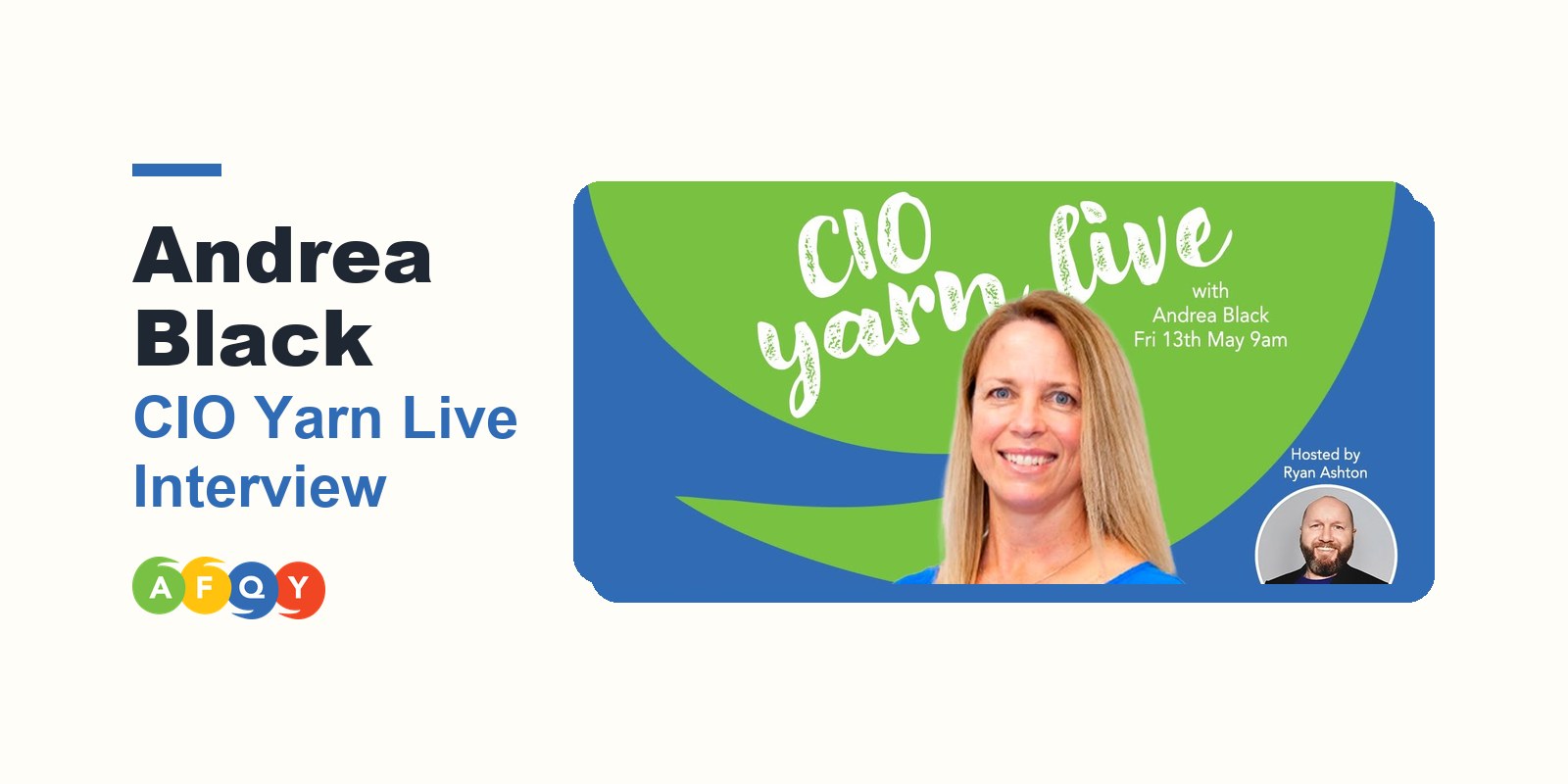
This article is written for the 2022 interview. Andrea Black made a point of not saying she was the CIO. She said she led the technology team. She ate her lunch in the team’s common area, counted herself successful when her team was, and held that when something needs fixing it is never a blame game. It is always a learn game.
She said all of that on 13 May 2022, as the guest on CIO Yarn Live, AFQY’s weekly on-camera interview with a New Zealand technology leader. Black had led the technology team at LIC, the Waikato-based agritech and herd improvement co-operative, as its Chief Information Officer, a role LIC appointed her to in 2019, starting in January 2020. When she joined the show she was enjoying a break from work, at home near Hamilton with her horses. Every guest got the same three questions: one on culture, one on technology, and one asking for a single lesson. The host was AFQY’s Ryan Ashton.
This piece comes from the archive, so read it as a picture of May 2022. There was a frost in Waikato that morning. The world was starting to open up again, and Black expected the way people work to keep changing for a couple of years yet. What she said about being yourself, backing your team and learning from the hard days still stands up.
TL;DR
- Andrea Black’s biggest lesson is to be true to yourself. She is the same person at work as she is at home, and says that takes confidence and knowing why you are doing what you do.
- Black holds that culture is personal. A leader can take advice from experienced people, she says, and then has to lay their own style across it.
- Black introduced herself as leading the technology team, not by her title. At LIC she ate lunch in the team’s common area, and she measured her success by the team’s.
- LIC connected cow wearables to MINDA, its herd management system, on a very short time frame. Black said the team hit the deadline ahead of time.
- Black ranks people and process ahead of technology in any project, and says that sometimes a leader has to call a stop and slow down in order to speed up.
- Black’s rule when something needs fixing is to fix it first and learn from it afterwards: a learn game, not a blame game. People grow, she says, when they can make mistakes and are supported through them.
Meet the person, not the suit
AFQY introductions start outside work: meet the person first. Black has lived in Waikato for about 25 years and calls it her second home. The reason is horses. She has ridden competitively all her life, did much of her competition work in Waikato when she was younger, and to her the region is horsey central.
She comes from a sheep and beef farm in north Taranaki, 3,000 acres about an hour north of New Plymouth. Officially it is in the south King Country, she said, but the family always called themselves north Taranaki. A farm there has been in the Black family for generations, she said, and it is staying in the family. She loved the life there, and went to boarding school.
Sport has run through her life, she said, and horses are the main passion. She has an old-timer she has had for 17 years, coming up 18, and a young one she got the year before and was looking forward to training. She loves thoroughbreds that have finished on the track, and brings them on as sport horses. When a viewer asked what breeds she rides, she said thoroughbreds again: they are extremely athletic, and she likes the personality.
Home is a 10 acre lifestyle block just outside Hamilton, set up with an arena and lights. The lights were having a rest. On her break she could ride in the autumn sunshine during the day.
From livestock sales to building servers
Ryan asked about her path, for any young person wondering whether they could achieve what she has. They still can, he said.
Black’s training was the work itself. She came off the farm loving farming and unsure what she wanted to do. She was competing with her horses most weekends, and spent the first six months at home on the farm. Then she started at Wrightson, now PGG Wrightson, on an internship. Her first year’s salary, as she remembers it, was about $9,000.
Her first job there was livestock clerk. She went out to the livestock sales and recorded the sales and purchases.
Technology was not a subject at her school. At that stage, she recalled, there were computers that had to be booted up in sequence, and dot matrix printers. She got into it at Wrightson, through systems the company was bringing in. She is a logical thinker, she said, and it went from there: computer technician, building servers, engineer. At that point she made a decision about whether to stay on the tools or take a different path.
She moved around with Wrightson. She started in Taranaki, had a second posting in her early twenties among a really fantastic community of young people, then went to Wellington, where she got into the technical side. The horses brought her back to Waikato: riding in Wellington meant a long trip to get anywhere. She was quick to add that she loves going down there, and that Wellington’s bluebird days are amazing.
Back in Waikato she spent a year with a company going through the deregulation of the energy industry. She counts that year among her big learnings, and said the lessons from it put her in good stead throughout her career. Then came 10 to 12 years on the vendor side, with what she called a few of the biggies, among them Gen-i, which became part of Spark. She worked in service and engineering roles, then in more relationship-based ones.
Then she joined Genesis Energy and stayed six years. She started by looking after the service desk and desktop teams, moved up to operational manager, and up again into a general manager role. From there she made the shift to LIC.
She has a view on hiring. Companies look for qualifications, she said, and then: “I think we need to look a little bit broader than just those quals.” Employers should look at how people want to work, and at whether they have the capacity to adapt and learn. With the attitude and the ability to learn, she said, the technical side is the simple thing to learn.
Ryan agreed. Technology leaders had been talking with tertiary institutions about this when he started in the industry in 2005, he said, and courses of 16 weeks or three months now get people into work much sooner.
Culture is personal
The first question: as a leader, what do you do to actively build culture, and what have you seen work?
Black’s answer began with a definition. She thinks “culture is really personal”. It is about who you are as a person and what you bring to the table. No one person is the same, and that, she said, is what builds the magic when you work with people and with teams.
One of the lessons she learned early is how much authenticity matters: bringing yourself to work as you are. She does not keep one self for home and another for work.
"I am who I am and I try to be that person at work and at home."
She described herself as a single person, a single entity, wherever she is. It is also about drawing people into your circle, she said, and working with like-minded people.
She learned how that works in practice early in her management career. Ahead of a conversation with a team member, she asked someone really experienced for advice. What she took from it has stayed with her: you can take the advice you want from people, but you have to lay your own style across it and be really true to yourself. That shines through, she said, in your integrity.
That is why she calls culture personal. People are all so different: introverts and extroverts, those who like the details and those who like the big picture. There are so many nuances in how people lead, she said.
Ryan said he loved hearing it. His own nickname, Ryan the Lion, sits on his LinkedIn profile for the same reason: people have nicknames with their families and team mates, and he would like the masks that used to be part of corporate life removed. He had never put a label on the idea, he said, and Black had given him one. The textbooks set out best practice, and a leader still has to apply themselves to it.
Culture is also cause and effect, Black said. It depends on the circumstances you are in, the company and the team you are working with, and a leader has to change some things a little to suit. Some workplaces take readily to change. In others trust comes from what you do: actions speak louder than words.
A viewer’s comment about personality came up on screen, and it took Black back to her first job at the livestock sales. That job, she said, taught her to talk to a full range of people. She talked to farmers about what was going on, normally starting with the weather, and also to bosses and accountants. It gave her a raft of people she can relate to in different ways. There are times, she said, to temper the outer layer of your personality. You still have to be really true to who you are, and let that shine through.
Ryan offered his own way of putting it. The words he uses at the rugby club are not the words he uses in the workplace. He is the same person, with a different tone out of respect for the audience. It is not about changing who you are, he said, but about meeting the audience.
Black agreed. As you learn your audience you need to read the room, she said. You also need to push the room a little at times, to bring more of your true self into it.
The team is the engine room
Black had more to say on culture, and it was about respect. In her last role, people would open a conversation by saying they knew she was really busy. Her answer was that she was busy doing different things from what they were doing. The big thing for her is respect for people’s roles and what they do. The engine room is the team: the people who get the work done. Her part was the broad view of what was happening, and creating the rumble strips, as she put it, for what the team needed to do.
It is why she chose her words with care. She did not say she was the CIO. She said she led the technology team. Words are really important, as a good friend of hers says, and subtle changes like that one matter to people. She has never been big on titles. She sees herself as a person trying to do her best for the team of people around her.
"It's not about me succeeding. I'm successful if my team is successful."
What she gets out of it, she said, is seeing those successes for people: the aha moments, and the really cool things they have done.
Ryan said he had found the same thing from the other side. When he lets go of a task so that others can do it, they often do it differently and get a better result, and then he looks for the next thing to let go of.
Black is very aware, she said, of how many smart people are in the room with her. So the job is to build that team around you, empower it and build the communication. It was something she had picked up from someone else, she said.
One of the big things she worked on at LIC was assumptions. Do not make them, she told people. If there is something you are not sure of, ask the question. An assumption left alone leads to rumours, and people can arrive at a worst case when the conversation was heading in the other direction. Challenge yourself to ask, she said, and ask from a level of respect.
To make the asking easy she tried always to be available. It was as simple as sitting in a common area in the tech space and having her lunch there. There can be a stigma around a title such as CIO, she said, and she wanted to break down those barriers and the hierarchical view that goes with them. In her view of a team, people are equals. Leaders are there to look at the big picture and offer guidance on where the team needs to be. The team brings a lot more to the table on the technical side, and on how things get done.
Ryan loved the lunchroom habit. It makes a leader visible as one of the team, he said, and that makes room for collaboration and for the realness she had been talking about.
Cow wearables, and people before technology
The second question asks each guest about technology projects: the curliest and the coolest, as Ryan put it.
Black started wide. COVID was changing the world, how people work and how they use technology, and she expected it to keep changing for the next couple of years: the pendulum had swung one way, would come back, and would settle at some stage. LIC, she said, was doing what any company was doing: focusing on what is really important to it and going to cloud native technologies. That was pretty standard.
Then dairy. Wearables on cows, which she said people call cow Fitbits, tell a farmer things such as a cow’s temperature and how many steps she is doing. LIC has a very well known product in MINDA, its herd management system. LIC integrated some of the wearables technology into MINDA, and had a very short time frame to do it. The teams were fully immersed in other work, so people were pulled off to do it. They hit the deadline ahead of time, she said, and had a minimum viable product out early.
It was a different way of working, she said, and that was one of the cool things about it. She came back to a familiar trio: people, process and technology. The technology is the easy part: it is supposed to do what it says on the tin. Process is how you enable things to happen, for a team or for a company. People is how you bring them together to get things done. The project was cool technically, a product LIC could put out in the market. The way the team did things differently was pretty awesome too, she said, and so was the direct connection to farmers, the customers.
Her next example was from Genesis: an upgrade of the billing platform, done with outside service providers, which adds complexity. Black looked after the testing team. Working out what was needed from a testing perspective was demanding, and there were hours through weekends and weekdays to pull in the test cases and get a cohesive upgrade and test plan in place. It went really well, she said. They also hit the handbrake a couple of times along the way.
The gnarly one, her word, was an internal upgrade project at LIC. LIC was modernising: moving from COBOL-type technologies that had been around for 20 to 25 years into cloud technologies. A data company has a lot of data coming in, Black said, and during a move like that it has to be maintained in two places, while the product still has to deliver at peak demand for customers.
The project was big, a four-year piece of work, and people needed to remember what they were trying to achieve, and why. It was paused and broken right back down to the basics of what they were trying to do. Then they got it across the line.
Testing mattered a great deal, she said, and so did quality. It also came down to how the project was run as a company, and how subject matter experts were brought into the team. She did not want to speak of business and technology as two sides.
The upgrade went live into peak season, which took a lot of management, and she said the team did a fantastic job. The result was a cohesive product that can be supported. You do not build a thing and call it done, she said. You have to support it as well.
Her summing up: it is process and people. Technology is what you do with it and how you use it, which is why she always puts it as the smallest of the three. People and process are the big stuff, and the success piece.
Ryan tied it back to the first question. Testing sits in process, he said, and the people part is culture again.
One lesson: be true to yourself
The third question asks every guest for the biggest lesson they would share, meant as mentoring for people starting out.
Black said there had been quite a few, and chose the one she had already raised. She is a people-centric leader, she said, and not a technology-centric one. She understands technology, she has come off the tools, and she knows how to join the dots. The biggest lesson for her is “being true to yourself and your authenticity”.
At times, she said, that will feel like swimming against the tide, and that is an uncomfortable place to be. You have to have some confidence in yourself, and understand why you are doing it and what you are trying to achieve.
Her example was the LIC upgrade. With pressure coming down to go faster, she had to call the handbrake and say that they had to stop. Sometimes, she said, you have to slow down to speed up. As she told the story she made a point about words again: technology is part of the business, and she wanted to keep it there.
Backing yourself, she said, means understanding yourself: why you are doing things, how important they are, and the outcome you expect. There is never a single factor in what is going on. Something happens and you adjust. Her way through is to be flexible, with a level of inflexibility at a very high level about where the work needs to land. Underneath that the work can diverge, so long as it comes back at certain points.
Authenticity and integrity are huge for her. They make up who she is, she said, and since everyone is different, the point is being able to show up and say what you are going to do.
A learn game, not a blame game
There was a second lesson wrapped around the first. When something is not going right, Black said, be the first person to say there is a problem and that something needs to happen. Things left alone have a way of coming back. So front up.
She fronts up, she said, because of how she sees people. At the end of the day, she said, “everyone comes to work to do the best job”, the best they can. Choosing where you work matters too, she said. Find the culture fit, because with that kind of support around you, those discussions can be had.
She was lucky, she said, to come from an operational background.
"It's never about what's gone wrong. It's like, right, what do we need to do to fix it."
The breaking down comes afterwards: how did this happen, and are there common things here that need fixing? People in the throes of it are doing their best, and the main aim is to get things working again. It is never a blame game, she said. It is always a learn game. If the same thing keeps happening, that is a different discussion. Otherwise the questions are what can be learned and how to do it better.
Then she went to her horses, taking care to say that she does not apply horse training to people. A rider has four levels of ask, she said, and starts very soft. Once the horse is doing what was asked, it is the horse’s job to maintain it. The rider has to let the horse make the mistake of stopping, and then comes the correction.
The principle is the one she takes to work. Give people the ability to learn and grow and to make some mistakes, and be there to support and correct them. That is how a person grows, she said, how you get future leaders, and how you grow the support around you. Most people know when they have done something wrong. You want them to be able to put their hand up and say so, and then the question is what happens next. A learn game, not a blame game, she said again, and incredibly important.
Ryan had not heard the phrase before. He said he would use it and quote her on it. Coming through a hard moment together, he added, is a bonding opportunity for a team.
The hard times shape you
Asked for closing remarks, Black said you never quite know what is going to happen. Looking back over her working life, she said it is the hard times that shape you into the person you are today.
"It's not the wins, it's the losses that shape you."
They stay with you for a long time, she said. Her advice was not to give up. There is so much opportunity, in New Zealand and in a world that was starting to open up again, for whatever you want to do. Look for the place that is going to suit you culturally. Things are changing and evolving, nobody knows what the end game looks like, and technology will be needed to get there. It is a great industry to be in, she said.
Ryan added that the culture of a place is what keeps a team and attracts one. Then he wished her a good ride that afternoon, and signed off in te reo Māori: ka kite anō.
What it means
Very little in this conversation depends on the technology of 2022. Say what you lead, not what you are called. Sit where your team sits. Take advice, then make it your own. Fix the problem first and learn from it afterwards. Let people make mistakes, and be there when they do. None of it needs a budget.
Two of the lessons
- Be true to yourself. Be the same person at work as you are at home. It takes confidence, and knowing why you are doing what you do.
- Make it a learn game, not a blame game. Fix the problem first. Afterwards, look at how it happened and what can be learned, without hunting for fault.
There are 28 more lessons from this conversation, kept for AFQY Tech Leaders. Join the AFQY community as a Tech Leader to read the rest and discuss them with other Tech Leaders.