
See the Person: Steve James on Trust, Getting Food to People and the Lunch That Shaped Him
20 November 2026· AFQY News
Watch this interview on camera
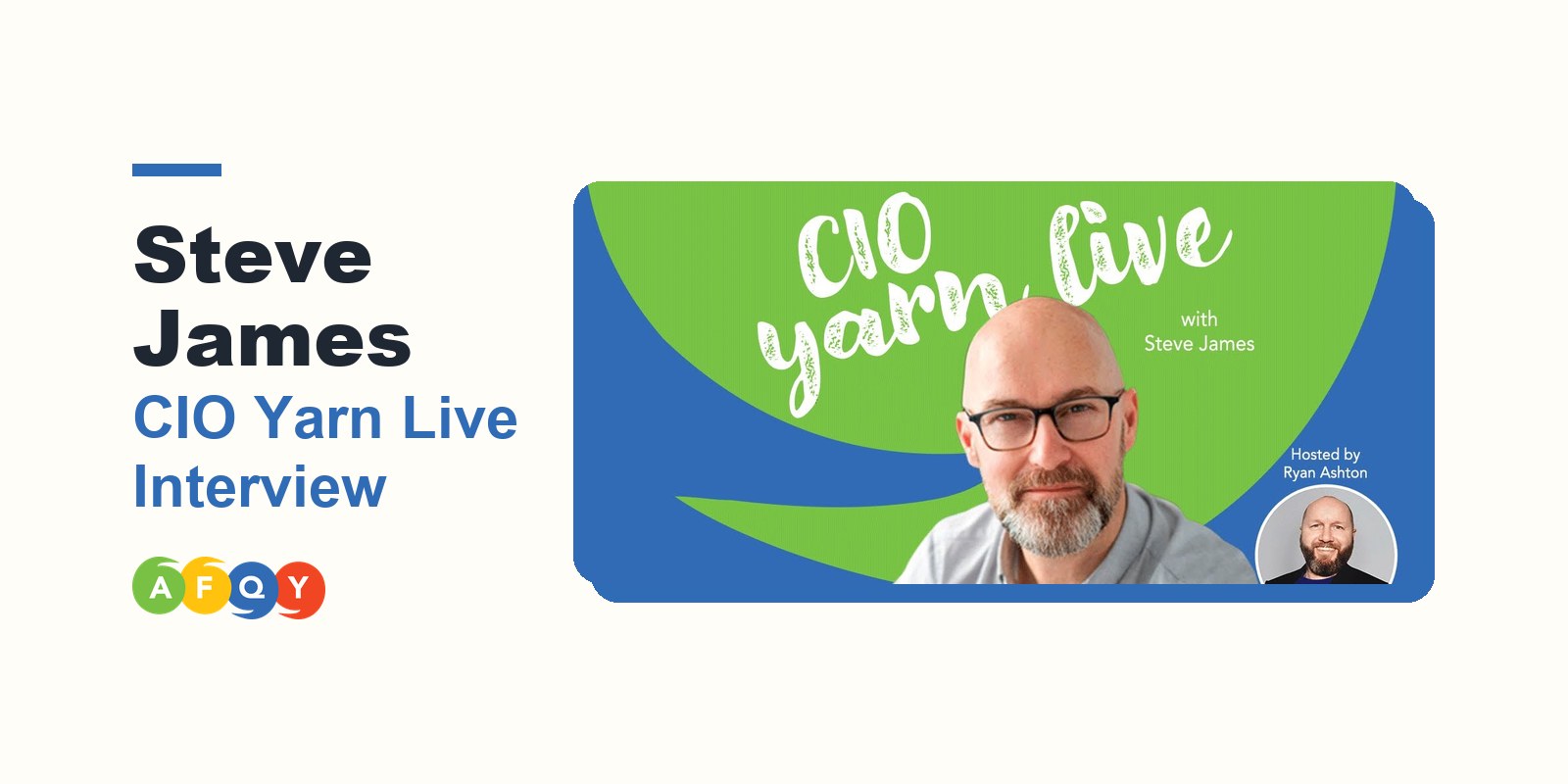
This article is written for the 2022 interview. Early in his career, a general manager took Steve James out to lunch and gave him a message he has carried ever since. Everyone makes mistakes. We still trust you. And we would like you to tell the story to every new recruit who joins us.
He told that story on Friday 1 April 2022, as the very first guest on CIO Yarn Live, AFQY’s weekly on-camera interview with a New Zealand technology leader. He was then Head of Technology at Woolworths New Zealand, whose supermarkets traded as Countdown. The show set its pattern that morning. Every guest would get the same three questions: one on culture, one on projects and technology, and one asking for a single lesson. The host was AFQY’s Ryan Ashton, who opened by promising that the date was not a joke.
This piece comes from the archive, so read it as a picture of April 2022. New Zealand was two years into COVID. James stayed with Woolworths New Zealand. In 2023 he was promoted to General Manager of Technology and placed sixth in the CIO50 New Zealand list. What he said about trust, about one clear purpose and about backing people still stands up.
TL;DR
- Culture, for James, starts with the leader knowing who they are and saying plainly what they value. A team that believes its leader will change with them.
- He has used Patrick Lencioni’s Five Dysfunctions framework in his last three roles, starting from trust. A leadership day opens with three questions that have nothing to do with work: where you were born, where you sit in your family, and your biggest challenge growing up.
- In the first COVID lockdown Countdown relearned that it was a grocer first. Technology work faced one test: will it get food to people? If yes, go. If no, pause.
- Moving long-standing systems into Azure made the digital team quicker and showed what each area costs. His rule for anything new, from computer vision on the bread shelf to scan-and-go payment: technology has to make someone’s life better.
- His one lesson came from a general manager who backed him early in his career and told him he had lost no mana. Real empowerment, he said, means allowing people to fail, then asking what they learned and how they will fix it.
- His closing challenge to technology leaders: keep working on diversity even though it is hard, and learn to be an ally to people who have not had the same opportunities.
Meet the person, not the suit
AFQY introductions start outside work. “Meet the person, not the suit,” as Ryan put it.
James had been in technology for about 30 years. His way into technology was an offer of training, not a degree. Someone knew someone who knew someone, who asked whether he wanted to try it and said they were happy to train him. The rest, he said, is history.
He started at an internet service provider, where his first job was resetting the 28.8 external modems to kick users off so that other people could get on. Did they make that noise, Ryan asked. They did.
From there he moved through technology delivery and implementation roles, into project management and service delivery, and then into technology management, some of it overseas and across several industries. What he loves, he said, is leadership: the positions where you can really bring out the best in a team. He was loving every minute of it.
At home he has three children, one cat and one wife. He is a casual gamer when he can find the time, and in April 2022 he was about 120 hours into Assassin’s Creed Valhalla. He used to play alongside his son, who has long since overtaken him. His son plays Destiny 2 and is ranked fairly highly internationally.
His other joy was older. He grew up an arcade kid, and he had recently built a small emulation system at home. A podcast was working through the games of his childhood. He would listen, find the original artwork, read up on the history of a game and then play it, with the memories of staying up all night flooding back.
He and Ryan compared notes on growing up before the internet. If a friend did not turn up, James said, you waited an hour and then went somewhere else. When the money ran out, you rode your bike. His children ask how he survived. It was awesome, he tells them.
Know yourself first
The first question was where culture fits in his plans, and what he does to build it in his team. James said the starting point comes before the team. It is understanding a lot about yourself.
Methods found in books only go so far. The true heart of cultural change is being authentic, a word he knows is overused: being yourself in a real way, so that your team believe you. A team that believes its leader does not wonder whether it is being put through a course or steered toward a KPI. They can say: you have been very clear what your values are, you have communicated those values to us, and we can see you are trying to help us operate in our values. That, he said, is when you can have some real change, as opposed to moving a needle from here to there, ticking the box and moving on.
Understanding yourself is hard. He said it takes a lot of work to reach the point where you can confidently communicate who you are, and have people respond to it.
Start from trust
James is a big fan of Patrick Lencioni’s Five Dysfunctions framework. It has been around a while, and he had used some version of it with his teams in his last three roles, with great success. He likes that it is not a script to follow word for word, with boxes to tick. It is, he said, “something that I find has real soul, and it focuses on connection and trust in your team as the basis”.
Start from a place of building trust in the team, he said, and you will have a lot more success than by rolling out a big methodology, because you are bringing people on a journey. As trust builds, people get to know each other. They find they can talk about something awkward and help each other through it. The team is not being dragged through a programme. They are contributing, and building the journey with you, which he finds a lot more satisfying.
Ryan asked for a practical example. James described a day with his leadership team, five or six people. Before the list of items to get through, the day opens with what he called a sharing session. “Don’t let that put you off,” he said. Each person answers three questions that have nothing to do with work:
- Where were you born?
- Where were you in your family: which number child, and did you have siblings?
- What was the biggest challenge you faced growing up?
He was careful about when to use it. Read the room first, he said. It is not something he would recommend a new leader walk in and drop on a team, because the psychological safety has to be there. When it is, the results show. He has set aside 20 minutes and found people still sharing an hour later, which he takes as a good signal that they are starting to trust each other. If someone would prefer not to share, he parks it, and works with that person to understand what about the situation feels uncomfortable.
The point is that nobody has to become something else when they walk through the door at work. Most of us slip into a meeting voice, he said, the one that has your family asking, after a work call, what that voice was. Breaking down that barrier matters to him: “I’m a real person and you’re a real person.” There will be conflict, because conflict is good. But it is conflict between real people who have made a connection, not between a boss and a team, or between one colleague who is right and one who is wrong.
Ryan said James was talking his language. Connection is what AFQY is about, and it is what “meet the person” is for.
Culture when the team is remote
Two viewers sent in questions during the show. The first asked how to keep a positive culture when much of the team works remotely, and not consistently.
James began with a recognition: everyone handles remote working differently. He does his best thinking in a room with people, a whiteboard and ideas flying. Some people are machines when they work remotely. Others find it hard. So his job, as he sees it, is to help his leaders identify who needs what. He was comfortable calling the result an inconsistent policy. One person needs one thing and another needs something else, and the team is open to being flexible because people’s needs differ.
Then he listed what he does to keep the positivity up:
- Regular connection points, where people come together for no other purpose than to talk. Sometimes big things come out of those conversations, and sometimes not.
- Healthy banter. A chat channel, on Slack or elsewhere, for memes, jokes and the colleague who posts that they are off for a run. It reminds people there is something going on outside their own little world, whether that world is an office or a home.
- Something that breaks the cycle of all work and all home. His is inspirational videos on YouTube, which he called his guilty pleasure. One of them, about the impact Muhammad Ali had on the world outside his boxing career, he has shown to a lot of people. “It just reminds me that there is more to life than sitting in front of my computer,” he said, and that we should be trying to make an impact on the world. Sharing it with the team helps others step out of the same cycle.
The leader who saw the person
The second viewer question came from a former colleague: who has had the biggest impact on you during your career, and what was it about them that was meaningful?
James said the two of them were thinking of the same person: a head of technology they had both worked for at a very large company, and someone James speaks of with great feeling.
This was the leader who started him on the path he had just been describing. He was the head of technology, James said, and what interested him was people. You would go into a conversation with a problem you needed help with, and walk out having learned something about yourself. James and his colleague would meet for coffee afterwards and ask each other what had just happened.
"There is power in seeing the person rather than the role or the task."
James has made the idea his own. He was not trying to become a copy of his old leader. For him, seeing the person is the start. The next step is to help that person take what they have learned about themselves and get the outcome they want. He credits the approach to his former leader. “He was a beautiful soul,” he said.
Ryan said it almost sounded like a set-up: a first guest who wanted to talk about connection and people.
A grocer first
The second question asks each guest about their current projects: the challenges, the wins and the lessons. James started somewhere other than technology.
Countdown is a technology-enabled business, he said. But in COVID, and especially in the first hard lockdown, it had to relearn that it was a grocer first. He stressed that this was his personal view. The government had defined supermarkets as an essential service, and the job became very plain: get food from here to your table, so your family can eat.
That did a couple of things for the technology teams. It connected them in a very real way to the outcome they were working toward, where the work could otherwise look like building widget A and then widget B. The value was food reaching the people who needed it, including people who could not get out of their homes.
It also gave technology a single, laser focus. Nothing had to be re-prioritised, because the business was clear. Each piece of work met the same question: is this going to get food to people? If yes, go. If no, pause it. The teams delivered some things very quickly, and James said the business became a lot more agile, in the lower-case sense of the word.
Out of the back room
On the technology itself, the big move was the core platforms going into the cloud. A long-standing business has long-standing systems, and James described legacy services sitting in a single room somewhere, chugging away. A lot of that had been moving into Azure, and he called the move really successful. He listed what it had changed:
- the digital team had become a lot quicker, and could iterate a lot faster
- costs were much easier to see and could be attributed to the right area, so the business could tell whether an area was profitable
- “people can go on holiday and not get called up at three in the morning” because they are the only one with a login to an old server.
Above all, it had moved the team away from keeping the lights on and toward better questions: how do we make our business better, and how do we get food to people quicker? Everyone is doing cloud, he said, and for Countdown it had been very, very successful.
The other big area was online shopping. The online grocery business was 15 years old, and competition was arriving fast, with other players disrupting the market. So the technology had to make the experience as seamless as possible: you get what you want, in the time frame you asked for. He gave two directions. One was ultra convenience, such as ordering something and having it within 30 minutes. The other was provenance: a customer being able to trace their food all the way back, and know that this banana was on a tree in Ecuador three weeks ago. A lot of work was going into that.
Ryan recognised the digital twin idea the two had been discussing before the show: a virtual picture of a supply chain that shows where every shipment is, and can order from somewhere else when a ship is late. James said he wanted to know more, and they agreed to pick it up afterwards.
Technology has to make someone’s life better
The project James was exploring, not yet fully rolled out, was computer vision. He was clear about what it was for. It was not about tracking faces, or following people through supermarkets. “That’s not something that we’re into,” he said.
His example was a camera pointed at the bread section. An algorithm watches how quickly the bread is going down, predicts that the shelf will need refilling in 30 minutes, and sends a message to someone out the back, so the bread is ready the moment there is space for it. It sounds simple, he said, but it could be rolled out through the whole store. Nobody has to walk the aisles looking for gaps, and no customer has to report that the tomato sauce has run out. An empty shelf is a lost sale, and with bread it keeps the fresh loaves out. “We see huge gains from that,” he said.
The team likes to try lots of new technologies, and James said being part of a larger group is a boon for that: a big machine turning out lots of ideas and finding out which ones work. Then he gave the rule every idea has to pass.
"The technology has to make someone's life better. So either it has to make the customer's life better, or it has to make maybe our checkout operator's life easier or safer, and therefore better for our customers."
Computer vision could be used in a whole lot of areas, and he said they were just at the beginning of that journey.
The other big one was contactless payment, the scan-and-go kind, which COVID had accelerated for everyone. It was already in some stores, with pretty good uptake. The ideal, he said, is that shopping in a bricks and mortar store feels almost like shopping on the website: you pick the things you want, put them in your trolley and leave. He pointed to Amazon as the leader in this, and said the Countdown model was different. It is not a literal walk in and walk out. There is still a transaction on the way out the door, but with no self-checkout and no checkout operator in the middle. The customer is fully in control from end to end, which suits the people who like that, and the store can still make it a great experience.
It also frees up people in the stores. Not to remove jobs, he said, but to do roles of higher value: interacting with customers, and keeping the stock looking great.
Ryan, who had spent three and a half years working around digital twins, said James had been describing one without using the name. He gave the example of a large sports stadium that uses computer vision to see where crowds are arriving, and moves staff to the right gates and counters. A supermarket restocking bread as shoppers come in is the same picture, he said, and in five years it would be everyday and low cost.
One lesson: the lunch
The third question asks every guest for their biggest lesson. Ryan explained where the question comes from. Years earlier he had worked on a summit for chief information officers, and its advisory council had asked for speakers who were peers, talking about real projects, including the parts that did not go to plan. Put it on the table, with candour, and turn it into a lesson. He told James the series would be shared with teachers, university lecturers and schools, so the audience ran from old hands to students wondering what technology is all about.
James chose a specific story, and kept the company names out of it.
Very early on, he found himself managing a large piece of work, and in particular the relationship between the two parties to it. His job was to help both sides to a great outcome, and to the payments set out in the commercial terms. The work taught him a practical rule he has kept. On large commercial matters a handshake is where you start, and then you follow it up in writing. “Easy lesson to say, hard to learn,” he said. It was all sorted out in the end.
The bigger lesson came at lunch. The general manager of the company took him out, and James recounted what he said. Everyone makes mistakes, and I would hope that you learn from them. We want to keep you in the company, and we are going to keep putting you out front. He asked one thing: that James tell the story to all the new recruits, because it would help them and it would remind him. Then came the part James has carried ever since. The company would completely trust him to keep working with it. In the general manager’s words, as James told them, “you haven’t lost any mana with us”.
At the time he was just glad. Looking back, he saw how much he had been given: a leader who supported and empowered him, and whose message was that trust survives a mistake. It only means you made a mistake, and making a mistake is human. He also learned that confidence works best with some process alongside it.
What empowerment takes
That lunch is where the way James leads comes from. True empowerment, he said, is rare in his experience.
"Everyone will say they want an empowered team, but an empowered team is quite scary, because you really have to allow them to fail."
When something does go wrong, his questions are short. Have you learned from that? Can you tell me how we are going to fix it? If the answer is yes, “that’s happy days”.
The other half is accepting that people will do things in a way he might not, “because guess what, they’re not you”. That is good, he said. That is why you hired them.
He wants diverse thinking on his teams: people who do things in a different way, who openly challenge him, and who can openly fail and be supported through it. That is what makes people feel truly empowered. It is a big lesson, he said, and one he works at every day. When his instinct is to suggest his own way, the people on his team tell him they have it, this is what they do, and he says okay and steps back. He thinks it makes him better as a leader, and makes his teams better.
His side of the bargain is to front up. When something does not go well, he is the one who answers for it to the rest of the business. That, he said, is his job: to protect his team, so that they can take pragmatic risks and do what he employed them to do, which is to be awesome at the thing they are good at.
A viewer wrote in that a mistake is only a mistake if you do not learn from it, and it was read out as a great comment. James went back to the lunch once more. He was probably in his twenties at the time. The general manager, he said, was being very intentional. He was not brushing the matter aside. He had chosen to see something in James that James could not yet see in himself, and to bring it out. You need to look for the gold in people, James said, and “sometimes the gold is not immediately obvious”. He is very thankful for it, and very grateful for the position he is in.
Be an ally
Asked for closing remarks, James turned to something he said is ever present for him. He is conscious that he is in a privileged position and has enjoyed some success, and that technology needs far more diversity than it has. He did not want to preach. What he keeps asking himself is how he can be an ally to people who have not had the same opportunities, and how he can kick a door down for them.
His challenge to other leaders was direct.
"I would challenge you to work on this and to not give up."
Finding people who bring that diversity takes effort, and he said that is no reason to stop: “it is hard, but it’s valuable”. Think about it, he said. Go and find the people who can help you, and the organisations already working on it. He is still learning himself, and he challenged the audience to do what he is doing: unlearn some old habits, and relearn healthier ones.
Ryan wondered aloud how to help without overstepping. James came back to the idea he said he is trying to hold on to: being an ally, not a saviour. The natural inclination is to jump in and save the day, he said. The better course is to be an ally, and to learn how. There are books, there are podcasts, and behaviour can change. He is still working out the best way to do it.
The conversation ended on the thought of always learning. Ryan thanked James for an amazing first session, confirmed there had been no April Fool’s joke, and signed off the first CIO Yarn Live in te reo Māori: ka kite anō.
What it means
More than four years on, some of the technology in this conversation has become everyday. Scanning as you shop is familiar, and a move to the cloud is no longer news. The rest has not dated. Know what you value, and say so. Start with trust. Give a team one clear purpose and the priorities sort themselves. Keep trusting someone after a mistake, and ask them to teach it. None of that waits on new technology.
Two of the lessons
- See the person, not the role or the task. A leader who is interested in you first, and in your problem second, changes how you see yourself.
- Real empowerment means letting people fail. Then ask what they learned and how they will fix it. If they can tell you, trust them to carry on.
There are 26 more lessons from this conversation, kept for AFQY Tech Leaders. Join the AFQY community as a Tech Leader to read the rest and discuss them with other Tech Leaders.