
The Children Test: Russell Jones on Culture, Leading Change and Not Scoring Own Goals
20 November 2026· AFQY News
Watch this interview on camera
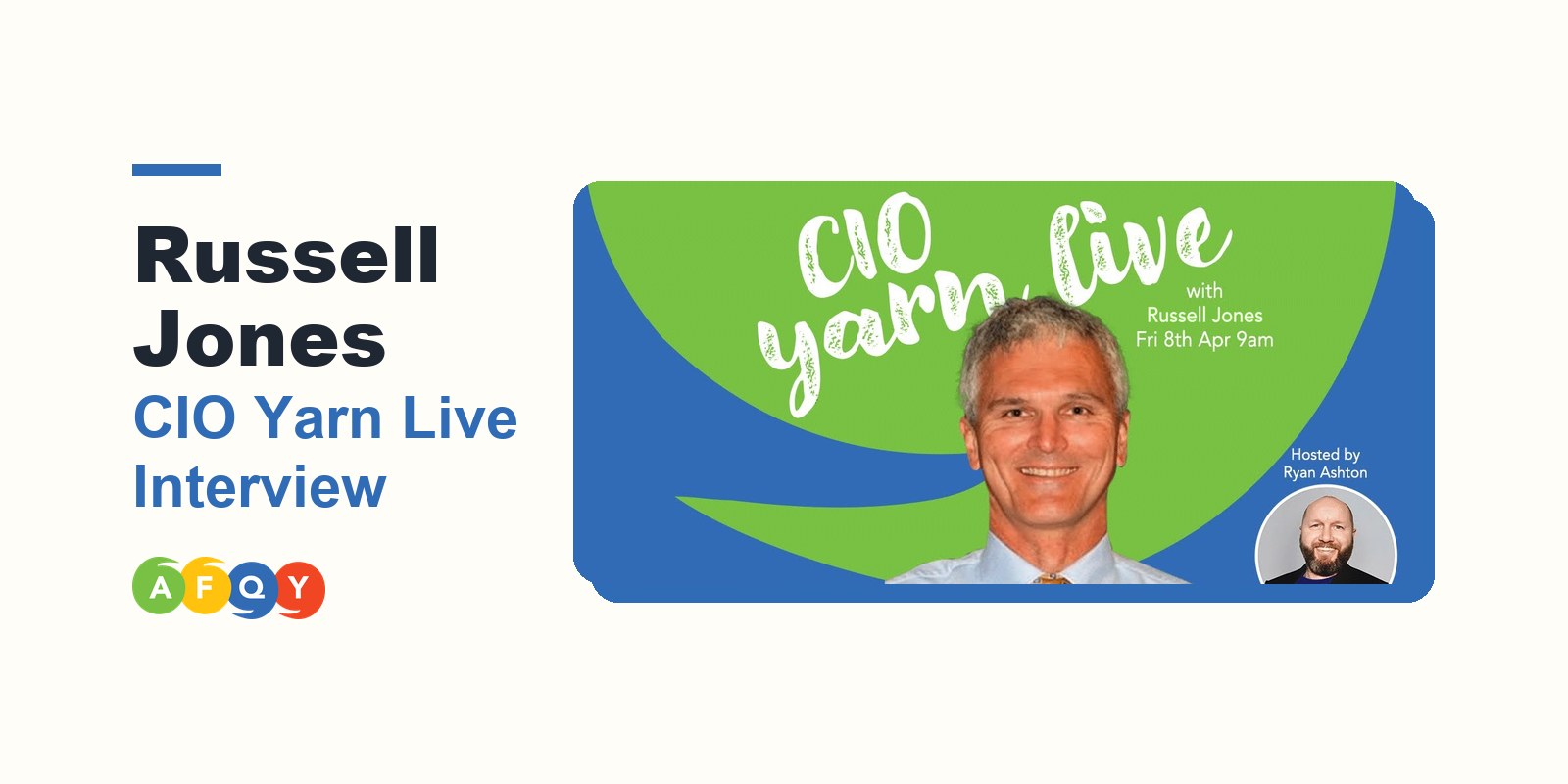
This article is written for the 2022 interview. Russell Jones has a one-question test for the culture of a workplace: would you encourage your children to come and work for the company? If you would, he said, the place probably has a great culture. If you would not, it is worth sitting down to work out what stops you, and then doing something about it.
He set out that test on Friday 8 April 2022, as the guest on CIO Yarn Live, AFQY’s weekly on-camera interview with a New Zealand technology leader. It was the show’s second episode. Jones was then working as a technology consultant and adviser. He had left BNZ the previous October, where he was Executive, Technology and Operations. Before that came about a decade at ASB, where he rose from chief information officer to lead retail banking and topped the CIO100 list in 2017. Every guest got the same three questions: one on culture, one on technology, and one asking for a single lesson. The host was AFQY’s Ryan Ashton.
This piece comes from the archive, so read it as a picture of April 2022. Jones was between two banks. From May 2022 he was acting Chief Information Officer at Westpac New Zealand, and the bank appointed him to the role that November. In June 2026 Westpac New Zealand appointed him its Chief Data, Digital and AI Officer. What he said about culture, about leading change and about the everyday disciplines of running technology has not aged.
TL;DR
- Jones tests a culture with one question: would you encourage your children to come and work for the company? If not, he works out what stops him and addresses it.
- He thinks culture has been over-complicated. His definition is a great place to work: somewhere people want to come every day, learn and grow, put in discretionary effort and feel part of a winning team.
- When leading change he puts his effort into the 60 percent in the middle. About 20 percent of people follow from the start, about 20 percent will not, and the rest can be moved a couple at a time.
- At Carter Holt Harvey from the late 1990s his team rolled out more than 60 SAP deployments across 33 businesses and seven divisions in New Zealand and Australia. The 300 or so engineers it trained were spun out as Oxygen, which he said was making a profit within three or four years.
- His lesson for running technology is discipline and hygiene: run vulnerability assessments on time, patch quickly, know who owns what software and keep system records current. “Don’t score own goals.”
- His lesson for changing technology is honesty: look at the data as it is and put your hand up early, because bad news does not get better with time.
Meet the person, not the suit
AFQY introductions cover the person as well as the job. Jones began with family and the pool. He is married with two daughters. Both were at university and had left home that year, so the household was getting used to an empty nest.
Outside work he swims, a lot. He told viewers he was taking up the presidency of New Zealand Masters Swimming, and was very excited about it.
His degree was a technical one, in computer science, and he fitted accounting, economics, law and statistics around it. He found them interesting then and has found them really useful ever since.
The first 25 years of his career were in manufacturing, and the most recent 15 or so in financial services. They are two very different industries, he said, and the values he learned from the discipline of manufacturing have stayed with him. He has lived and worked in Africa, Europe, the United States and Asia, and he calls New Zealand home. The accent is Zimbabwean, plus a few other things. He grew up in Zimbabwe and went to university in South Africa.
South America is the gap on the map. He has not lived or worked there and has not yet visited, though his work for International Paper once included the technology side of a large merger and acquisition transaction. A trip is in the plan for the next couple of years.
He already knows the swimmers. Brazil is always strongly represented at masters meets, he said, and at the couple of World Masters Championships he has been to, his group ended up spending time with the Brazilian team and having a lot of fun.
Masters swimming is officially a pool discipline under FINA, which he described as the global swimming organisation. It starts at age 25, where he said other masters sports start at 35. That makes for strong fields. The younger age groups often include Commonwealth and Olympic swimmers, current or recently retired. At one meet in Perth, Jones lined up in a heat with six Olympic swimmers.
Ryan, a rugby man, said he would have loved the same chance: a game with or against the All Blacks, the way club players once could in the amateur days.
A great place to work
The first question was culture: what has he done, and seen work, to shape one?
Jones started by agreeing that culture matters, with a nod to the popular line that culture eats strategy for breakfast. Then he said he thinks it has been over-complicated. With all the measurement systems being put in place around culture, he said, you can lose sight of what you are trying to do.
He offered his own definition, at the risk of oversimplifying. Culture is creating somewhere that is a great place to work. Is it a place you want to come to every day, or work for from home? Are you learning and growing as a person? Do you like the work, and does it challenge you? Will you be better for it, and able to move on in your career because of the environment around you?
Then the test.
"The test that I always try and apply is: would you encourage your children to come and work for the company?"
If you would, the company probably has a great culture. If you would not, he said, it is worth thinking about what would prevent you recommending it, and then trying to address that.
Surveys and action plans can be overdone, he said, when you can ask the questions and talk to people. Look at what they are saying. Listen to the issues they raise and the things that would make the place better, then go away and address them. Keep monitoring, and do it again.
His definition takes in everything else that makes a great place to work, diversity and inclusion among them. It comes down to whether this is somewhere you want to come every day, where you are prepared to put in a bit of discretionary effort, and where you feel part of a winning team. In every role he has held, he said, that has been the aim.
Ryan agreed about surveys. People answer a survey very differently from the way they talk, he said, and a conversation one to one brings out both the challenges and the positive insights.
Jones added a point about measurement. What gets measured gets done, so if a company keeps running a survey, people eventually respond to it and the score goes up. That is why the comments matter. With the right safety and anonymity around them, he said, the real trick is to read the comments, then put actions around them or follow up and dig into them.
The 60 percent in the middle
Sometimes a leader joins a new team or a new department and has to drive change. Jones said he has always broken that situation down the same way.
About 20 percent of people will follow you from the start, because they instinctively like you or support you. You do not have to worry about them. About 20 percent will not follow, whether the reason is you, the message, the change or their view of authority, and you probably cannot shift them.
With the first group as a following wind, the focus goes on the 60 percent in the middle. Move a couple of people every day, or a couple every week, and that is how things begin to move.
Two cautions came with the model, both learned over the years. Do not lean on the wonderful things the first 20 percent tell you, because they would probably say them anyway. And do not get upset, or decide you are failing, when the daggers come from the other side, as they will. The work is to influence the middle: the people who will give you the benefit of the doubt and an open chance to change things.
Ryan said the second caution was new to him and worth keeping. A leader needs the resilience to expect pushback, and not to be surprised or hurt by it. It fitted his own picture of a bell-shaped curve of people, with a few at each end and most in the middle.
Jones then tried the model on the show’s own audience. A fifth, he guessed, had logged on because they knew him and wanted to be supportive. The 60 percent in the middle were easing into the day and catching up on email. Distract a couple of them, he said, and the morning could be counted a success.
From punch cards to paper machines
The second question is about technology. Guests usually talk about a current project. Jones was consulting, so Ryan invited him to reach as far back as he liked.
He went back to the beginning. The first great technological revolution of his career, he said, was the move from punch cards to typing on the keyboard of an Apple II.
His earliest experiences of being amazed by technology came at Sappi, the South African paper company that gave him a scholarship to university. He spent a lot of time in and around paper mills, walking under paper machines and plugging in what was then called process control and SCADA, as digital controls arrived on very large machines.
He gave the scale. Some paper machines are eight metres wide, and the paper runs through at 1,200 to 1,500 metres a minute. It is wound into reels of 20 and 30 tonnes, which are later cut down into sheets. His honours thesis was on how to get those sheets out of a 20-tonne reel economically, efficiently and optimally.
What impressed him was the measuring and the control. Scanners read paper moving at that speed for its thickness, the amount of light passing through it and its water content. The parts of a machine that may be 300 metres long are then sped up so the paper is pulled through at the right rate: not so slowly that it trips up and breaks, and not so fast that it rips.
“I think I’m a closet engineer,” he said. The machines had worked that way for 200 years. Digitisation has added efficiency and quality over the last 20 or 30 years, but before that it was all analogue and mechanical, and he called the machines amazing feats of engineering. That appreciation, he said, was a big part of the first ten years of his career.
Ryan knew the far end of that chain. In a school holiday job at the Otago Daily Times he put the inserts into newspapers coming off a press two or three storeys high.
Sixty rollouts and a company called Oxygen
The other big project Jones chose was SAP at Carter Holt Harvey in the late 1990s. It was the reason he came to New Zealand. On the way he met Chris Liddell, a former chief executive of Carter Holt Harvey, who convinced him to come and pick up the SAP project.
Over the next four or five years the team rolled out more than 60 deployments of SAP into the 33 businesses and seven divisions of what was then Carter Holt Harvey, in New Zealand and Australia.
The biggest success, Jones said, was what stood there at the end of the programme: around 300 highly trained, highly motivated and very capable SAP engineers. The demand for maintenance on the system was less than a quarter of that number. So the decision was made to spin the project team out into a business, which became Oxygen, with a contract back to Carter Holt Harvey to provide SAP and other technology services.
Oxygen was encouraged to grow its outside business. It signed a first external customer and added many more. Within three or four years, Jones said, it was making a profit and Carter Holt Harvey had dropped to less than half of its workload. Oxygen was later sold to UXC, and has changed hands again since.
Jones took most pride in the people. It was fantastic, he said, to see those people carry on in their careers and blossom into a company that has done great things over 20 years. That week he had seen on LinkedIn that the Oxygen name was to change, to fit the branding of the company that now owns it. He was glad to see names from 20 years ago hopping on to remind people of great stories from that time.
“It’s always fantastic to build or be a part of building something,” he said. He called it a wonderful success for both Carter Holt Harvey and Oxygen.
Ryan congratulated him. Companies want to acquire the business today, he said, because of the work done at the start. Jones said his Oxygen mug was now a collector’s item.
A former colleague who had managed communications for him was among the viewers commenting during the show. Jones thanked her on air for more than three years of help and support.
Run it with discipline, change it with honesty
The third question asks for one key lesson. Jones had a list.
People who work with him, he said, know he keeps a small set of rules that recognise the patterns of corporate life. That was the first lesson: recognise when a pattern is happening and work out the right response. Many things happen repeatedly, so learn good responses, because you will use them over and over again.
Then he turned to the two halves of his career: running things, the business-as-usual side of technology, and changing things, the project side. He had a lesson for each.
On the run side, discipline and hygiene are absolutely important.
"Life is hard enough, and there are so many things that you cannot control, that you owe it to everybody to manage the things that are in your control."
That is basic discipline, he said. It is usually not hard and usually not complicated. It is doing the things that need to be done:
- having vulnerability assessments running when they should be
- patching quickly, so a cyber attack does not land
- knowing who owns what software, and making sure it is up to date
- keeping all the system records, so things can be managed and updated.
"Don't score own goals. It's hard enough winning things. There's enough competition out there."
On the change side, the lesson was to be honest. Look at the data in front of you. Do not try to spin a story from it. Look at it, recognise it and address it. Projects go wrong day by day and task by task, he said, so when something is going wrong, put your hand up and say so. That is how the help arrives and the interventions come early.
"Bad news does not get better with time."
The more open the environment in a project, the better. He wants transparent conversations about how things are going, whether they are working, and whether a date or a milestone will be met. “It’s not a sales job, it’s an engineering job,” he said. Open and honest dialogue is the only way to keep work on track. A problem that began on day one cannot be fixed if the team first hears of it on day 29, with the report due on day 30.
His lessons are pretty simple, he said, and they have worked for him.
Ryan said a great lesson does not need to be complex. The rules reminded him of Gibbs, a character in the television series NCIS who keeps a set of numbered rules, and he suggested calling these the Jones rules. A viewer had already typed the own goals line into the comments.
Ten rules, and an offer to come back
Asked to close, Jones offered a second visit. If there was enough interest, he said, he would run through his rules in a follow-up. He has them down to ten or eleven, and they have been pretty useful.
He finished with thanks: to Ryan for the opportunity, and to the people who had taken the time to listen in. The show, he said, is a fantastic thing for the tech industry. He had enjoyed the previous week’s episode and expected a fantastic one the week after.
What it means
More than four years on, the punch cards, the paper machines and the SAP rollouts belong to their time. The rules do not. Ask whether you would want your own children working where you work. Put your effort into the people in the middle. Do the basics you control, every time. Say it early when something is going wrong. None of it waits on new technology, and all of it can start this week.
Two of the lessons
- Apply the children test. Would you encourage your own children to come and work for the company? If not, find out what stops you and fix it.
- Don’t score own goals. Winning is hard enough. Look after everything that is within your control.
There are 27 more lessons from this conversation, kept for AFQY Tech Leaders. Join the AFQY community as a Tech Leader to read the rest and discuss them with other Tech Leaders.
Sources
- AFQY on YouTube: CIO Yarn Live, Russell Jones, 8 April 2022
- NZ Herald: CHH executive heads overseas, March 2003
- IT Brief: CEO departs as Oxygen top job is moved to Australia, April 2012
- iStart: CSC's UXC acquisition a done deal, February 2016
- CIO: CIO100 2017 #1: Russell Jones, ASB
- NZX: BNZ announces changes to Executive Team, October 2021
- NZX: Westpac NZ appoints Russell Jones as CIO, November 2022
- NZX: Executive Appointments at Westpac New Zealand, June 2026
- Payments NZ: Our Board