
Culture Is an Outcome: Roxanne Salton on People, Lego Blocks and Her Best Investment
20 November 2026· AFQY News
Watch this interview on camera
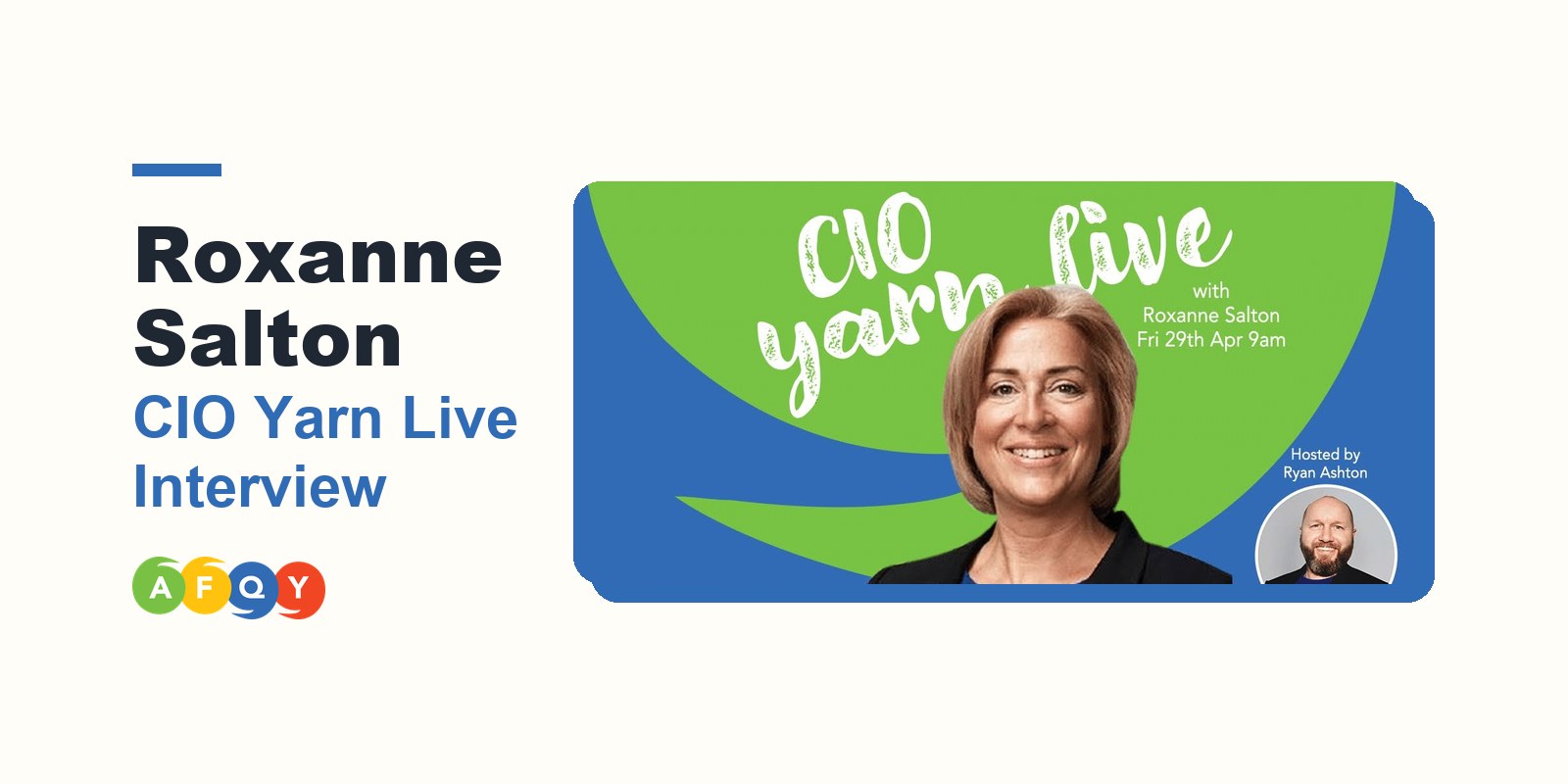
This article is written for the 2022 interview. Most of us, Roxanne Salton said, have a box of Lego stored somewhere. Once the thing is built, nobody wants to build something else with it, so we go and buy a new box. Her point was about technology: before an organisation buys more, it can start reusing the blocks it already has.
She made it on Friday 29 April 2022, as the guest on CIO Yarn Live, AFQY’s weekly on-camera interview with a New Zealand technology leader. She was then Chief Digital Officer at Southern Cross Health Society, the health insurer. The show was in its first month. Every guest got the same three questions: one on culture, one on technology, and one asking for a single lesson. The host was AFQY’s Ryan Ashton.
This piece comes from the archive, so read it as a picture of April 2022. The pandemic, Salton said, had made time feel longer than it had been. Later that year she was placed 20th in the CIO50 NZ Awards. She has since moved to TSB Bank, where she is Chief Digital Officer, and she is a director of Payments NZ. What she said about culture, about keeping technology simple and about investing in yourself still stands up.
TL;DR
- Culture, for Roxanne Salton, is an outcome and not a thing you do: everything a leader and a team do results in the culture they create. It starts with the right people, the right mindset and a trusting environment.
- At Southern Cross Health Society, Salton chose leaders for how they lead people as well as for their skills, and she compared keeping a good culture to a marriage: it takes constant work and has to be the number one priority.
- Salton’s own flavour of culture is work hard, play hard. The people you meet and the advice you give, she said, last well beyond any job.
- In 2022 Salton’s team at Southern Cross Health Society was modernising its technology from what she called monolithic blocks to Lego blocks, and simplifying the number of applications, hoping for systems that would last at least 10 years.
- Salton’s approach to a new technology request is to ask for the business problem first, then reuse what the organisation already has before adding anything. She said she had 900 people with 900 great ideas every day, and that technology is not the issue; proliferation and complexity are.
- Salton’s one lesson is to get personal coaching early in your career. She paid for her own without waiting for an employer to offer it, and called it the best investment she has ever made.
The other side of the coin
Ryan asks each guest to introduce themselves first, then the role and the career. Salton said she had been at Southern Cross Health Society for more than two years, and that it felt like only yesterday.
She had been in digital for about 25 years. Her career began in directory sales, after she came to New Zealand from Canada, and the first product she sold was getting businesses on the internet. In those days she was doing internet cafes, she said, and explaining to companies why it mattered to be online: “although it didn’t make coffee, it was certainly going to help their business sell their products and services a lot better.”
She had been reflecting on those 25 years that week. The world is moving at a fast pace, she said, and she called it an amazing journey. Her work has almost always been in digital, mostly in sales, product development, strategy and transformation. Taking on the technology side of the business was a great opportunity, she said, to see “what the other side of the coin looks like”.
She brings a wide breadth of experience to it. She is learning a lot from the people she works with, and they are learning from her. She enjoys it, and she was looking forward to the future.
The two laughed about the dream of every business person who has asked why technology costs so much and wanted it now: take over the department and get it done yourself. Now, Salton said, when she sees the business coming she recognises them. She was them.
Culture is an outcome
The first question was where culture fits in her plans, and what she does to actively build it.
Salton had reflected on it over time. Culture is a very broad word, she said, and everybody knows you need it to be successful. But what does it mean to build one? Is culture the thing you are building, or the outcome of what you have built?
"Culture is an outcome. It's not a thing you do."
Everything you do, she said, results in a culture that you create. Her approach, never clearer to her than it is now, is that it is about people. “If you get the right people and you get the right mindset and you get the right trusting environment, you will get collaboration, you will get friendships,” she said, and people who work alongside each other for a long time, wanting to support each other and care. That, to her, is where culture comes in.
Culture is something you have to seed, she said. You have to cultivate it and water it consistently. Every behaviour and every mindset brought into the business either builds the culture or takes away from it.
So she starts with picking the right talent, and talent is not only a matter of skills. In technology especially, she said, technical leadership has to be matched with people leadership. An organisation can have great technology, but if its people do not talk to each other, nobody benefits.
The culture at Southern Cross was something she was very proud of. She had picked leaders who were great people leaders, and who could also foster better leadership in themselves and in their teams, so that collaboration, trust and the right environment were created. Then, she said, culture just comes into it. It just happens.
Bringing good people in is one thing. Keeping a good culture takes a lot of hard work, and she had a comparison for it: “it’s a bit like a marriage”. Being married does not mean a couple can lay off and do nothing. “You’ve got to keep working at it, and it is hard, it is really hard,” she said, so it has to be the number one priority.
Work hard, play hard
Every leader, Salton said, brings their own flavour of culture. Hers is work hard, play hard, and she stands by it. “I like to have fun, because we spend a lot of time at work.”
She thinks about waking up one day, much older than she is now, and what she would be asking herself: whether she should have worked harder, or spent more time living. It is important to remember, she said, that the people you meet, the influence you have and the advice you give will last far longer than the job. So the work gets done, and there is a lot of fun in it too.
Ryan picked up on the time people spend at work with a story from early in his own career, about how much of yourself to bring to the office.
Salton said it was a really important point. It is why she is so committed to good leadership, and to what it means to be a good leader. She had always told herself that if she ever found herself in a place where she could influence a lot of people, “it’s on me to make a difference”.
You cannot influence everybody else, she said. You can start with yourself.
"If you start with yourself as a leader and ensure that you're the best possible leader, then all you're doing is creating better leaders under you."
Those leaders, she hoped, go on to create better leaders under them. She calls it paying it forward, and said we need a whole lot more of it.
She has gathered lessons of her own along the way and never forgets them, she said, because they remind her what a good leader looks like. Keep those stories alive, she said, because they are very true today. We need, she added, to foster a better generation.
From monolithic blocks to Lego blocks
The second question is the technology one, and Ryan asked about the challenges and how it was going.
Salton said people in technology would relate. Most large corporates invested in big systems around the year 2000. They were fabulous in their day, she said, and what was good then has to change to the current technologies. Like everybody else, she suspected, Southern Cross was modernising its core systems.
She sketched 20 years in a few sentences. First came the big ERPs and on-premise systems. Then came the move to cloud, to be much more agile. Some say fragile, she joked, but yes, agile. Then, over the last 10 to 15 years, came a proliferation of new software. As the world moved from hardware to software, software became easy to acquire, and applications and platforms multiplied around the core systems. In the old days, she said, something you bought would last 10 or 15 years. Today it lasts barely 12 months.
So some of the core projects at Southern Cross in 2022 were, in her words, “modernising our technology from what we call monolithic blocks to more Lego blocks” and, on the same journey, simplifying the number of applications.
That is not easy, she said, because people want to be enabled. There is a great deal of software out there, much of it free, and people want to use it. Each new tool brings some risk and adds some complexity. “I’ve got 900 people who have 900 great ideas every day,” she said, or great software they would like the technology team to play with. When people then find technology complex and slow, she said, the reason is often that there is more of it than anyone needs.
Much of the work, she said, was moving from older technology to something longer lasting. Most businesses she talked with were doing the same: modernising, and moving away from customised one-off tools towards software likely to be around for a while. She gave Microsoft and AWS as examples.
Where there were nine of something and four of something else, because everybody had had a great idea, her team was consolidating to one technology that would last longer. “It’s not going to be perfect, but it will serve a whole lot of us,” she said, and make life a lot easier. It is easier said than done. That challenge, she said, is what was motivating her technology people: moving to something that will last, she hoped, at least the next 10 years.
Reuse the blocks you have
Ryan said the picture was familiar from his own years in software sales. He offered Microsoft’s Power Apps and other low-code tools as the easy kind of Lego: here is your set of bricks, now make whatever you want.
That, Salton said, is the conversation technology leaders are having with the business all the time, and she saw it as the shift from chief information officers to chief digital officers. There are lots of Lego blocks. The question is which ones to work with, because each block needs support, needs nurturing and needs someone who can work with it. That is not to be taken lightly.
“There’s always a technology to solve your problem. Technology is not the issue,” she said. The issue is how much proliferation a choice creates, and how much complexity the organisation is then supporting. Put more into a funnel that is already full, she said, and you get congestion, and with it the cost of integration and support. When people ask why technology is so expensive, her answer is that the organisation is doing too much.
So the real challenge for technologists, she said, is getting to the conversation that begins “tell me what your business problem is”, and then working out what can be reused from the plethora of solutions already in place. She compared it to thinking green: “why bring something new in when you can reuse what you’ve already got”. If nothing fits, then look to add. Either way, understand the implications of the decision.
Technology, she said, has always been the last to come into the room. The decisions have been made, and the instruction is to just do it. Being part of the conversation up front takes trust: the business needs to know that having technology in the room is an enabler, and that the conversation is about the problem, not about plugging more in. She might have something in her bag of tricks to help, she said. Technologists love that. “They are problem solvers.”
It does not mean the bricks an organisation already has are not good enough.
"Once you've built the thing you don't want to build something else with it, so you just go buy a new box. We need to start reusing the blocks we've already got."
That, she said, is the real challenge for the way forward.
One lesson: invest in yourself early
The third question asks each guest what they can teach from their experience, for someone coming through their career. Salton said she found it a hard one, because she has learned so many great and helpful things. The one she keeps coming back to is getting personal coaching early in your career.
Coaching, she said, usually becomes available once someone is a senior leader, and by then a lot of habits are set. She would like to see coaching for younger leaders, not necessarily inside their own business: a coaching network that is more affordable, so that people learn as they grow and build better habits as leaders from the start, with nothing to unlearn years later.
She came to it by giving her time. She counted herself fortunate to have found Springboard Trust, an organisation that works with school principals. It links principals with partners from business, she said, so that the school and the business learn from each other’s strategies and plans, and learn about leadership. Through it she got access to a network of coaches, mostly executive coaches, and was struck by the insight, experience and wisdom they brought. Why, she asked, is that only there for the most senior leaders, and not for up-and-coming ones? Then we would get better leaders.
So she decided to invest in herself, the way a person invests in a car or a house. “I didn’t wait for a business to say now you can have access to this,” she said.
"An investment in yourself is as important as an investment into your assets or your properties."
It totally changed her leadership, she said. Understanding who she was, and what she represents as a leader, mattered so much that she now passes it on so others can learn from it. Of all the things a person will be told, her advice is this: invest in yourself early as a leader, and you will benefit, and so will the many people who work for you. She called it the most impactful thing she could have done. “It’s the best investment I’ve ever made.” It is not cheap, she said. She hopes it becomes more accessible as more people do it, and said there are great companies already offering it.
Ryan and Salton agreed on why it matters: people invest in everything else, and seldom in understanding how human beings operate.
Then Salton said what it is all for. What fulfils her, more than any job could, is making a difference in someone’s life, even if it is one thing she said that the person carries with them as the piece of advice that stayed. That, she said, is more valuable than anything else you do.
Ryan said it was beautiful.
Never too busy to help
In her closing remarks Salton said that, for her, it is always about giving back. Her team might be busy with work, she said, but she is “never too busy to help somebody out”, whether that means giving counsel or advice, or getting feedback herself. Conversations like this one bring her joy.
She finished on the people she works with. “I think the most creative people in the business are technologists, and we need to really, really harness that,” she said. They would rival any marketers any day, and they are fantastic people. She loves working in the sector: it is exciting, it is fun, it is very challenging and complex, and “life would be boring without it”.
Ryan congratulated her on making technology as simple as Lego blocks.
What it means
More than four years on, nothing in this conversation depends on the technology of 2022. Salton’s questions travel well. Is the culture you have the outcome of what you do every day? Before you buy another box, what could you build from the blocks you already own? And who is investing in the leaders still on their way up, starting with yourself? Each one can be asked on Monday.
Two of the lessons
- Culture is an outcome. It is not a task on a list. Everything a leader and a team do adds up to it.
- Invest in yourself early. Personal coaching at the start of a career builds good habits before others set in. She calls it her best investment.
There are 27 more lessons from this conversation, kept for AFQY Tech Leaders. Join the AFQY community as a Tech Leader to read the rest and discuss them with other Tech Leaders.
Sources
- AFQY on YouTube: CIO Yarn Live, Roxanne Salton, 29 April 2022
- Southern Cross: Southern Cross Health Society appoints Chief Digital Officer, 18 September 2019
- CIO: Foundry announces CIO50 NZ Awards, November 2022
- interest.co.nz: Big rise in TSB annual profit, 25 June 2024
- CIO Summit: NZ CIO Innovation Awards, 2026 judges
- Payments NZ: Our Board
- Springboard Trust: strategic leadership programmes for school principals