
Ready for the Opportunity: Mandy Simpson on Culture, Systems and Skills That Travel
20 November 2026· AFQY News
Watch this interview on camera
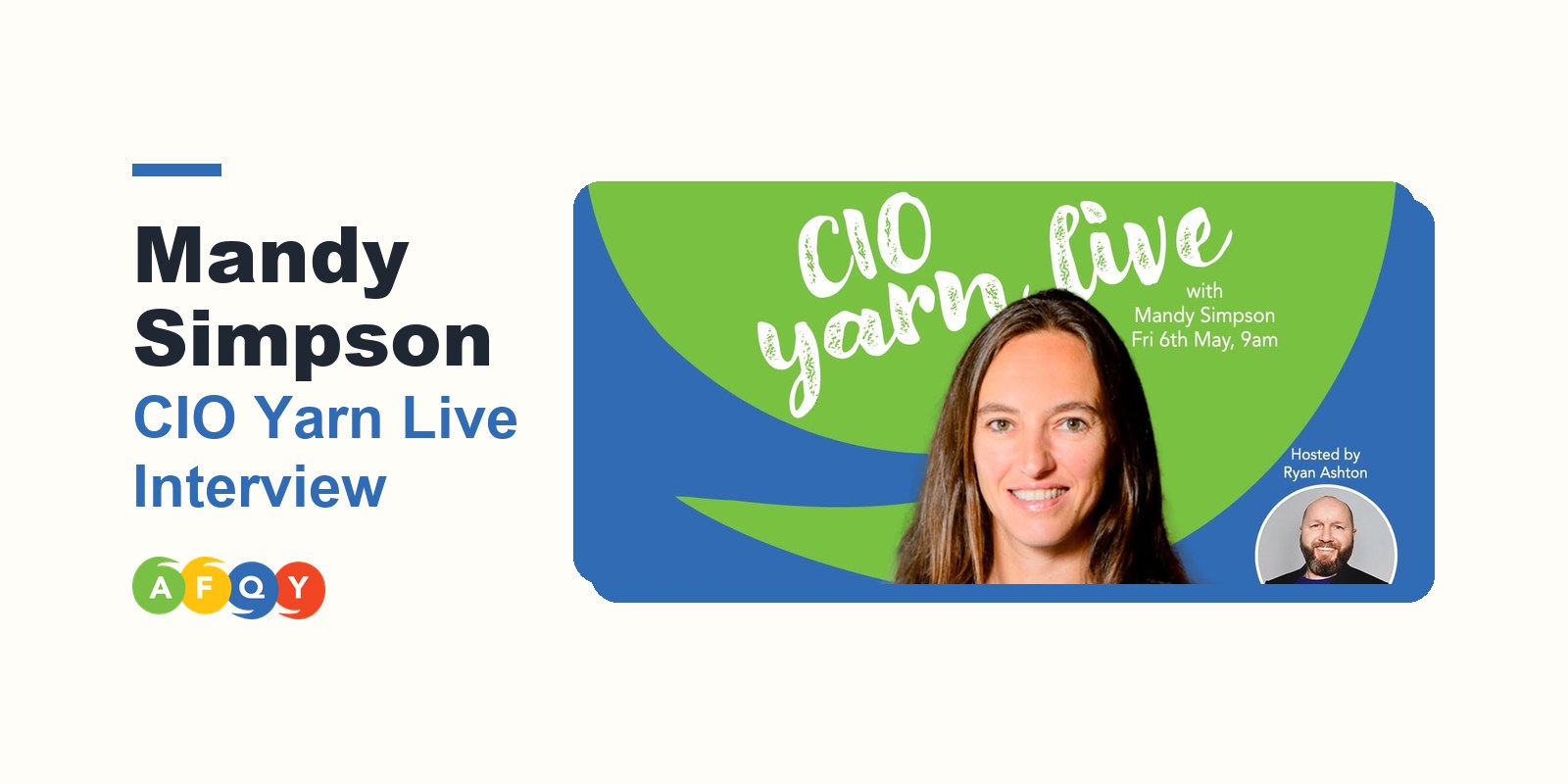
This article is written for the 2022 interview. Mandy Simpson began with a law degree, became a chartered accountant and had been a chief financial officer. In May 2022 she was leading digital at Z Energy. Her advice to anyone wondering about the next job: build a broad set of skills, stay with what you enjoy, and be ready when the opportunity appears.
She gave it on 6 May 2022, as the guest on CIO Yarn Live, AFQY’s weekly on-camera interview with a New Zealand technology leader. She was then Chief Digital Officer at Z Energy, the fuel retailer, and held the No. 1 ranking in the CIO50 New Zealand list for 2021. It was the show’s fifth episode. Every guest got the same three questions: one on culture, one on technology, and one asking for a single lesson. The host was AFQY’s Ryan Ashton.
This piece comes from the archive, so read it as a picture of May 2022. Z was four days from a new owner, New Zealand had just stopped refining its own fuel, and two years of Covid had changed how people worked and drove. Simpson is now Chief Financial Officer at Meridian Energy, a role she took up in September 2025. What she said about culture, about simpler systems and about careers still stands up.
TL;DR
- Mandy Simpson’s one lesson: you do not need to know your next job. Build a broad set of skills, stay with the work you enjoy and be ready, and the opportunities appear.
- At Z Energy in 2022, culture was treated as a verb, “culturing”. Chief executive Mike Bennetts wrote a document on why Z exists, what it stands for and how it works, and job candidates were invited to read it during the interview process.
- Mandy Simpson’s digital leadership team of eight at Z Energy was five women and three men. She said gender-balanced technology teams take really hard work, and that the idea they are impossible is “just not true”.
- Z Energy started with 120 systems, was down to 80 by May 2022 and was aiming for 50. Mandy Simpson said Z Energy would be 100 percent cloud-based by the end of that financial year.
- With New Zealand importing all of its refined fuel from April 2022, Z Energy was building forecasting and scheduling systems, and using artificial intelligence to forecast fuel demand across its network.
- On electricity and hydrogen for transport, Mandy Simpson said there was no time to wait and see which one wins. Her answer was to try every option now.
Meet the person, not the suit
AFQY introductions cover the person as well as the work. Simpson opened with a greeting in te reo Māori, then gave both.
She is originally from the United Kingdom. She had lived in New Zealand for a little more than 15 years, was based in Wellington, and said she was really feeling at home as a Kiwi. She comes from a tiny mining village in the north-east of England, where her grandfather was a coal miner in mines that ran out under the North Sea. She was brought up in Manchester.
She used to be a long-distance runner, a marathon runner. These days she does a lot of kung fu, and she had a grading the next day: she held a black tip and was going for a double black tip. She had been training for six and a half years. The earliest she could become a black belt was later in 2022, she said. Candidates have to be selected, and roughly seven years seems to be the time people take.
What she loves is the discipline and the meditative side of it. Her school opens every class with the same set of line drills. The first 20 to 25 minutes are exactly the same wherever you are in the country.
At home there is a four-year-old beagle. Simpson got her about a year before joining Z, while she was doing a lot of consulting work, so the two had plenty of time together when the beagle was a pup. The result, she said, is a reasonably well-behaved dog.
Ryan asked about her rugby. Simpson went to university at Cambridge. She had played football at school, found that the women who played football at university also played rugby, gave it a try, and turned out to be much better at rugby. She played for Cambridge, and then for Richmond when she went to London. Richmond was a very serious participant in the women’s leagues at the time, she said, and Cambridge played at a pretty high level, with the big Blues match each year. It was amateur sport, fitted around work, and taken very seriously.
The two had worked together at Fronde many years earlier, and Ryan remembered a photograph of her in rugby kit. The jersey was pale blue, she said: Cambridge’s. She played hooker in her Blues match and later moved to halfback. She had recently dug out a black-and-white photograph of the front row going down into a scrum.
Culture as a verb
The first question was what she sees as important in culture, and what she does to shape it in her team. Simpson said she had learned so much about culture since joining Z, which had taken it to a whole new level. The reason was the chief executive, Mike Bennetts, who took a really active interest in the culture of the organisation.
Z’s word for it was “culturing”: a verb, she said, and not something that just happens.
Bennetts wrote a document that says everything about Z: why it exists, what it stands for, its values and how work gets done there. He wrote every word of it himself, Simpson said, and he rewrote it every couple of years. The newest version covered agile ways of working.
Anyone who came to join Z was invited to read the document as part of the interview process, and to talk about whether it was an environment they felt they could belong to and be part of. It was, she said, a very deliberate process.
Networks, allies and a shared voice
Part of that deliberate approach was Z’s staff networks. Ryan had noticed her rainbow lanyard. Simpson was the executive sponsor of Z’s Rainbow Network, which brought Z’s rainbow community and its rainbow allies together as one group. “We stand together on topics that are relevant to our rainbow community,” she said.
Z also had networks for women and for Māori and Pasifika, and was just starting one around neurodiversity.
After two years of everyone working differently, she said, Z wanted to hear the voices of its neurodiverse employees as people came back into the office, or did not, and as the company looked at what flexible working means. The aim was to pay attention to what each person needs, and not to assume that everybody can work the way she can. It is listening to the people around you, she said.
The way to make sure people are heard, she said, is to enable them to form their own network, and to place allies in it who are interested in the area and prepared to help, to listen, and to be the voice in the room when nobody from that community is in the room.
Ryan added his own view: neurodiversity brings something great, new and brilliant that can be harnessed.
There were many more areas Z could cover, Simpson said. These were where it had chosen to start, and there was so much to be done.
Z had spent a lot of time working really hard on gender diversity, and Simpson said she felt so supported there. She had not realised until she arrived “what a difference it makes to be part of a leadership team that has many women in it”. With three other women on Z’s leadership team, speaking on the issues that matter to women was shared between them, and she could talk about the work she was doing.
Ryan called it comfort and confidence in numbers.
It made a huge difference on days like the day of the interview, she said, when a remark about a well-known New Zealand woman was in the news. She could reach out to her peers on the leadership team and know that others were prepared to comment. So was Z’s chair, Abby Foote.
Five women and three men
Simpson often hears the question: why do we still have to talk about gender diversity, isn’t it fixed? There are still things to work on, she said.
She also hears that good gender diversity is impossible in digital and technology teams, because not enough women are interested. That, she said, is “just not true”. It is harder, and you have to work really hard at it.
"My digital leadership team of eight is now five women and three men."
That balance helps bring more diversity into the rest of the team, she said, because women look before they leap. They look at what they would be jumping into. A person who sees an organisation that represents them well is much more likely to join it.
Ryan wondered whether a team should mirror its customers, and asked who buys more petrol, men or women. Simpson did not think Z’s app measured that, or that Z carried that data on its customers at all. Z’s view, she said, was that unless you need to know someone’s gender you should not store it. What she could say was that Z’s customer base is a very diverse one. It is the whole country.
Ryan raised the dream gap: the idea that from about the age of five, girls notice the roles women are not doing and steer away from them. That, Simpson said, is why it is so important for those already in the field to remain visible, to talk to people, and to be out there making sure that the people who want to come and work in this area can and do.
120 systems, then 80, then 50
The second question asks each guest about the technology work they can share. Simpson started with a change of owner. Z was about to be taken over by Ampol, a fuel retailer in Australia and a very similar company to Z. Z does not drill for oil as the international oil majors do, she said. It is a petrol and diesel retailer.
The takeover was due to go through on the Tuesday after the interview, and it did: the deal completed on 10 May 2022. Simpson had been working on it for almost a year and was very excited to see it happening.
A little of her team’s work was integration between the two companies. She described it as light touch: bring together the things that let the two organisations collaborate, and otherwise stay really focused on New Zealand.
One of the biggest pieces of work was simplifying Z’s systems. Z wanted to be nimble and agile, able to move quickly as the market changes, and a simpler set of systems is how it gets there. It started with 120 systems. By May 2022 it was down to 80, and it was aiming at 50. She called it really interesting, detailed integration work.
Z would be 100 percent cloud-based by the end of that financial year, she said, and was almost there already. That had taken a lot of very hard work: a year earlier, Z had been exiting its last lines of COBOL.
Forecasting for an import-only industry
The other big change was to the industry itself. Simpson called it “a once-in-a-generation change in the way that the hydrocarbon industry works in New Zealand”.
The refinery at Marsden Point had closed as a refinery at the start of April 2022, and New Zealand had become an import-only industry. Anyone who wants to sell petrol, diesel or jet fuel in New Zealand now imports it, she said, either themselves or through Marsden Point.
That changes everything about what Z needs to do. In place of large shipments of crude oil there are individual shipments of petrol and diesel. So Z was building forecasting systems and scheduling systems to support the change, and using artificial intelligence to forecast demand for fuel across its entire network.
Doing that during Covid had been fascinating in itself, she said. Everything had changed about where and how people work, how they drive and where they go on holiday. What can be drawn from that data? How relevant is the data from two years ago? What will it look like going forward?
Z had a really good data and analytics team for those questions. It had grown from about three people when she joined to, she thought, 17, with some really serious data engineering and data scientists in it.
The app, electricity and hydrogen
The last piece was the part everybody sees: the app, and the changes in how people buy fuel.
- Pay by Plate gets people in and out of the sites really fast. A driver pulls in, the system recognises who they are and puts their name up on the screen, and they fill up and go.
- Sharetank, which she called world leading, lets a customer buy at the cheapest Z price within 30 kilometres of where they are and spend it at any Z service station.
Z was also moving into selling electricity. Customers could already buy electricity from Z, she said, and Z was starting to put its own branded chargers onto its sites. All of that had to be wrapped into the back end of the app. There was heaps still to do.
Ryan liked Sharetank, because people drive to find the cheapest petrol and then drive back again. Those are carbon emissions nobody needs, Simpson said, and Z did not want people driving around for no reason. Sharetank lets them buy their petrol without the trip.
Ryan asked whether the future was electricity, hydrogen or both. A hydrogen conference had been on at Te Papa that week, Simpson said. Z was represented there, and hydrogen was something it was looking at very closely.
On electricity for transport, she said the use is spread out. Not everybody fills up at exactly the same time. People go home and plug in, and more and more cars can send power back to the grid or to the house from the very large battery in the car. What matters with electricity, she said, is not the total use but the peak use, and battery technology can help smooth the peak.
Hydrogen has an interesting part to play there too. Electricity taken at a time that is not peak use can be used to create hydrogen, and the hydrogen can be used later.
She did not want to predict the future. Both might have a use: electricity for the shorter and lighter vehicle fleet, and hydrogen for the longer, heavier one. The most important thing, she said, is that even if one of them is going to win, there is no time to wait and find out, and then learn ten years down the track that hydrogen was needed as well. All of the options need to be thought about now and tried now. Then whichever one is the answer, it is there while there is still a chance of keeping warming to 1.5 or 2 degrees.
"I'm a huge fan of trying everything we've got."
One lesson: be ready for the opportunity
The third question asks each guest for one lesson from their years in the industry, for the people coming through. Simpson gave the one thing she wishes she had known earlier in her career.
People are told they must have an individual development plan and know their next career step, she said. She started with a law degree and then became a chartered accountant, and for the first 10 to 15 years of her career she wondered what came next. Here is what she worked out.
"What I've realised over time is that if I stayed focused on developing a really broad set of skills, and I stayed focused on what were the things that I enjoyed doing, that the opportunities appear."
So now she concentrates on being ready for opportunities. Fronde was her example. She arrived there as chief financial officer and saw that executive roles call for strong public speaking and strong communication in general, so she spent a lot of time on both.
Some skills, such as teamwork and communication, are useful for everybody. She gets people focused on those, and on how they can take them wherever a career leads, more than on the role they want.
Ryan summed it up: follow your passions, collect your skills and let the opportunities take you to the next part of your career. Definitely, Simpson said.
She took it further for school leavers. She does not want young people to believe that what they choose to do at university will define their entire lives. She loves to tell people that she has a law degree and has never used it, and that she uses what she learned there all the time. “Just because you do one thing at university doesn’t mean you have to do it forever,” she said.
She said the same to her leadership team and the wider digital team at Z about the jobs they have now: what they do today does not define their lives. People can change what they are doing in their 20s, their 30s, their 40s and their 50s. She saw no barriers now to people learning something new and getting on with it.
Ryan’s version: your degree doesn’t define your career. Short vocational courses, he added, now let people retrain in three months.
Right at the heart
For her closing remarks, Simpson began with thanks. Networking is super important in technology, she said, and bringing people together to have a discussion about people first is super important to her. She thanked Ryan for his long support of women in tech and for his continued support of all forms of diversity.
She also valued the chance to come and talk about what Z’s digital team was doing, with so much exciting work done and so much still to be done.
Then she answered a question she said a lot of people ask her: how can you work for a petrol company when you are so passionate about climate change?
"I believe that being right at the heart of this is how you make a change."
This is where the difference gets made, she said. The change cannot be made with the fuel companies against you. You have to be right at the heart and bring those companies with you.
What it means
More than four years on, the particulars belong to 2022. The habits do not. Decide what your culture is, write it down, and show it to people before they join. Give each community in the organisation a network, with allies in it. Count your systems, then cut them. And stop waiting to know the next job: build skills that travel, do the work you enjoy, and be ready.
Two of the lessons
- Treat culture as a verb. At Z it was called culturing: something leaders do on purpose, led from the chief executive’s office.
- Build broad skills, do what you enjoy, and the opportunities appear. You do not need to know the next job. Be ready for it when it arrives.
There are 24 more lessons from this conversation, kept for AFQY Tech Leaders. Join the AFQY community as a Tech Leader to read the rest and discuss them with other Tech Leaders.
Sources
- AFQY on YouTube: CIO Yarn Live, Mandy Simpson, 6 May 2022
- CIO: CIO50 2021, Aotearoa New Zealand's IT innovators and leaders honoured, October 2021
- Meridian Energy: New CFO and executive changes, April 2025
- Meridian Energy: Monthly operating report for March 2026
- NZX: Z Energy Scheme of Arrangement completes, May 2022
- Autofile: Ampol completes Z Energy deal, May 2022
- RNZ: Refining NZ relaunches as Channel Infrastructure, April 2022
- RNZ: Business leaders keen to ensure climate action stays on agenda, September 2020
- Z Energy: Zapping fuel costs and saving time with Z App, February 2024
- Waitomo Group: Ground to be broken on New Zealand's first green hydrogen refuelling site, May 2022