
Nothing Grows in the Dark: Julian Downs on Culture, Chaos Monkey and a Growth Mindset
20 November 2026· AFQY News
Watch this interview on camera
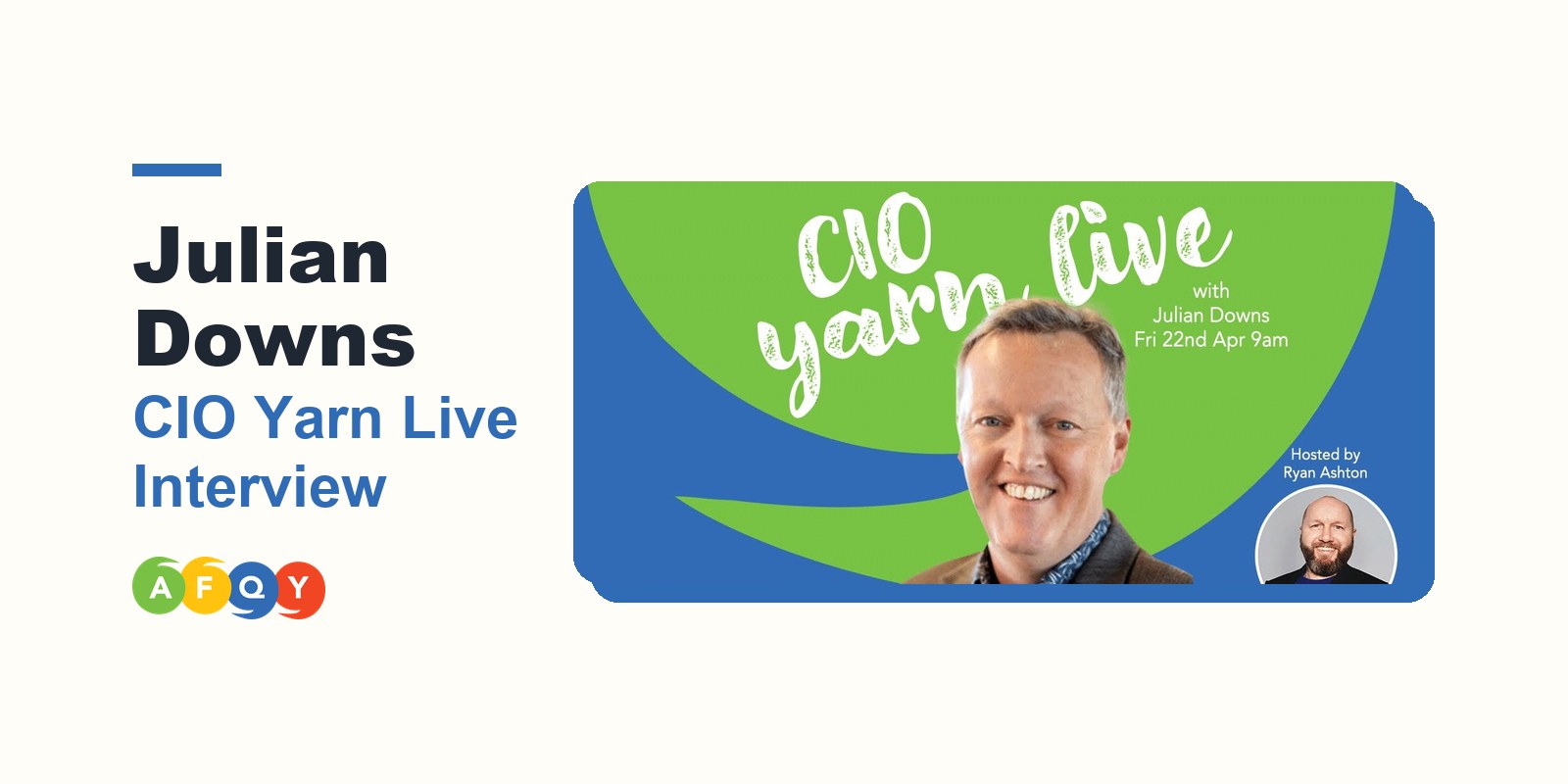
This article is written for the 2022 interview. Julian Downs and one of his colleagues had a way of starting the day. The colleague came from a European culture, and when one asked the other how he was doing, the conversation went along these lines: “Do you want the Kiwi answer or do you want the European answer?” The Kiwi answer, Downs said, is fine mate, how are you. The other answer was the one he wanted.
He told that story on Friday 22 April 2022, as the guest on CIO Yarn Live, AFQY’s weekly on-camera interview with a New Zealand technology leader. He was then GM Technology at TSB, the New Zealand-owned bank, and had been there nine months. The show was in its first month. Every guest got the same three questions: one on culture, one on technology, and one asking for a single lesson. The host was AFQY’s Ryan Ashton.
This piece comes from the archive, so read it as a picture of April 2022. COVID-19 had cut the number of people who could work in a meat works, which Downs knew first-hand from the beef business he ran from his farm in the Wairarapa. What he said about culture, transparency and learning does not depend on the year.
TL;DR
- Julian Downs, GM Technology at TSB in April 2022, called culture foundational: technology is built, run and used by people, and once the culture is in place the rest becomes a lot easier.
- Downs wanted more than “fine” when he asked a colleague how he was: what is going on in life, are you having a good day. The answer sets the context people are working in.
- Transparency builds trust, Downs said. He shared what was going on and why, kept security matters inside clear boundaries, and relied on the thinking of the whole team.
- In April 2022 Downs’s team at TSB was moving data centres to the cloud, using Kong for its APIs and starting to look at Chaos Monkey-style resilience testing, where systems are built to recover by themselves.
- Downs’s way of choosing technology: weigh the architecture and whether people are passionate about it, prove it quickly, then expect something to supersede it within two to three years.
- Asked for one lesson, Downs said to keep a growth mindset: never stop learning and never stop asking questions. He added that nothing grows in the dark, and to park your ego.
Meet the person, not the suit
AFQY introductions start outside work. Downs said he was married with two children and lived on a farm in the Wairarapa. It was 80 acres: bigger than a lifestyle property, he said, and not as large as some other farms.
He had been in technology pretty much all his life. He thought he had started on an Amstrad, and might even have had a ZX81. He had worked in a range of industries: finance for quite a while, and education, local government, energy and consulting.
He said he loved technology, and loved building and creating things. The thread through all of it is finding what you are passionate about. When you find what you love, the rest comes. He told people they would see him smiling when he was enjoying what he was doing, and that was pretty much every day, as long as he was passionate about the work.
The farm began with horses. His wife rode horses, so they bought some land, and then he wondered what to do with the rest of it. He decided to start a business. About 16 years before the interview they began a paddock to plate business: breeding beef cattle and selling the beef themselves, through retail, a farmers’ market and restaurants.
He learned a great deal from having his own business. “I advise it to anybody,” he said. When it is your own money, and you are doing the marketing, the sales and every other job yourself, you start thinking about what is important and why. That applies across any industry, and he had used it a lot as he went into different organisations.
The farm gave him balance as well. When he started, technology was not part of what happened on a farm, so he had manual work to go with the thinking work he did in technology. After a day in front of a computer he could come home and do something else. Any farm has a lot of technology involved now, he said, so that has changed a little.
By 2022 he had scaled the farming back to fit, because technology and TSB kept him plenty occupied. He enjoyed it, and it fitted their lifestyle. Ryan asked where to buy the beef. Online, Downs said, and only in large quantities: a quarter, a half or a whole carcass. You buy a chest freezer.
The business was still teaching him. With COVID-19 reducing the number of people who could be in a meat works, getting meat processed had become a lot harder, and it had shown him how supply chains work.
Culture is foundational
The first question was what part culture plays in running a technology team, and what he does to make sure it is where it should be. Downs said he could talk for hours on it. Culture is foundational, and anybody in a leadership role knows that.
People hear technology, he said, and think the conversation is about making computers go faster. But people are needed to make the technology happen, people use it, and people work with those people. Understanding how they use it, how they change it and how they look after it was the foundation for anything he wanted to do.
He credited a former chief information officer he worked for with a question he reflected on: what does a great day at work feel like? It asks about feeling, and Downs called that fundamental. A team spends so much time together working towards its outcomes, he said, that people need to be having a good day for it to work.
His own take, which he had shared with Ryan a couple of months earlier, was that nobody wakes up in the morning meaning to be difficult. People wake up and think about what they are going to do to achieve what they see as their purpose. So the questions become: how do we empathise with each other, and how do we understand what somebody else is trying to achieve today? Everybody has a different context, he said, made up of what is going on in their world and their life at that moment. That is where culture comes into it: respect for everybody, and empathy for what they are trying to do.
Any organisation and its people depend on getting that right, he said, and he saw it as a leader’s job to make it better.
He described what he did about it. He spent a lot of time talking with his team about what their culture was, what their values were and what they were trying to achieve. He asked himself how to park his title at the door and have a human conversation about what was going on and why. An organisation has its purpose, its outcomes and its structures, he said, and all of them are a lot harder to achieve without the culture. With it, everybody buys into the purpose.
Empathy was a big one for him. When he builds a new piece of technology, he said, somebody is going to test it, somebody is going to do an analysis piece, and at the end of the day somebody is going to use it. “I’m not on an island when I’m doing the build activity,” he said. So he asked who else was involved, what they were trying to do, and how he could make their life easy.
Values, for him, travelled in stories. You tell the stories, and you make sure you keep telling them. And his team knew they could pick up the phone at any time: he would answer the call, the text or the email.
One of his stories was the one about his colleague and the two answers. The usual Kiwi exchange, he said, is how are you doing, fine mate, how are you.
"That hasn't scratched the surface of what anybody is feeling, how they are and what they're doing."
So with that colleague he asked for the non-Kiwi answer. How are you doing? What is going on in life? Are you having a good day today, or a bad one? All of that sets the context in which people are working together and getting things done.
Get those foundations in, he said, and the rest becomes a lot easier. Every workplace will have conflict, disagreements and good times, so get the culture in place.
Transparency, every day
Ryan had seen transparency in the notes for the show, and asked Downs to say more. It mattered a great deal to him, Ryan said: the few naturally transparent leaders he had worked for shared more than he expected to be told, in a way that built respect and made him feel part of it.
Downs called transparency fundamental. It builds trust. You are open about what is going on and why it is going on, the context, and that is part of how you care about people.
He had been at TSB nine months, and with the team he made sure he was constantly transparent. A leader who behaves that way and shows it every day is a small drop in the ocean, he said, and it moves everybody else towards the view that transparency is the way to go.
A bank also has things it keeps private. Security is fundamental to a financial institution, and there are security matters that cannot be shared. Everybody understands those, he said, because they are clear boundaries. On the rest, the team was open about what was going on and why.
He saw this as his role: be transparent and open about the context and the why, then create the environment for his teams to do the best they are able to do. He had a team of people who think, he said, and the question was how to draw on all of them together. “The only way to do that is be transparent.” Hold something back, and the person who might have come up with a suggestion, or a way to achieve something, never gets the chance.
Ryan agreed. Being given the information, he said, was what had let him make a difference, feel good about what he achieved and feel part of a team doing the same.
Why finance, and what the team was building
The second question asks each guest what is happening in their technology world. Downs started with why. He was often asked why a technology person chooses finance, when they could go and work for a Google, an Amazon or another big technology company. His answer was the purpose, and he said he talked about it a lot with his team.
When somebody is paying for groceries at the supermarket, he told his team, the system behind that payment is theirs to look after. The same goes for someone buying a house. Finance, he said, influences a lot of things in New Zealand, and that is why he chose it.
Then the technology. In April 2022 the team was moving data centres to the cloud, which he called a good thing that everybody was doing. It was doing a lot with data, and moving to much more real-time eventing. It had done what he called some really cool stuff with Kong on the API side. And it was about to start something the team was loving: a whole bunch of Chaos Monkey kind of things.
Ryan asked what Chaos Monkey is. Downs placed it in site reliability. In effect, he said, you have a chaos monkey running around in your network doing things at random: pulling a cable out, dropping a server, dropping a database. The system has to heal itself and react. Once you get to that point you end up with a resilient system, because you are “building your systems as though they are going to fail every five seconds”.
He compared it with red teaming in security. A red team tries to get in. This takes the same idea wider than security: a server is taken down, the power goes somewhere, a switch goes off. Everybody knows those things will happen at some point, he said, so the question is how the system reacts. The team was starting to look at what it could do, and would do it in a good, controlled way.
Choose quickly, and expect to replace it
Ryan had been hearing a lot about Kong, the API tool, and asked why a range of organisations were moving to it. Downs said it does what it says on the tin: it is good, it is easy to use, and it brings reliability and scalability.
Then he widened the answer to how he picked any technology. He looked at a range of factors. The architectural qualities mattered. So did the workforce: he wanted people to be passionate about a technology and to know it, because that helped him find people who were able to build with it. A lot of technologies have similar capabilities, he said. So once you have decided on one, run a quick proof, test that it can work, and then start using it.
And allow for it to be superseded. In two to three years, he said, something else will potentially come along. Computing has moved a long way since the ZX81 and the Commodore 64, and Moore’s law has technology changing regularly. So he built the environment expecting things to roll over: make a call, test it quickly, use it for the next two to three years, and be able to switch technologies in and out quickly.
Everybody in technology is passionate about what is new, he said. The leadership job is a balance: bring in the flow of new thinking and keep testing new technology, while running a business that does not want change all the time and has only so much to invest.
The short answer on Kong was that the team evaluated it, judged that it would deliver the availability and reliability the bank needed, tested it, and by April 2022 was starting to do very well with it.
Ryan liked the idea of a road map that assumes a tool might be replaced in three years. His first thought was the work of doing it all again, and his second was that a business case would show the value for the effort.
The lesson: keep a growth mindset
The third question asks every guest for one lesson. Downs said his main one comes back to culture: keep a growth mindset. Schools were teaching it to children, he noted, and he found that really interesting.
“Never stop learning. Never stop asking those questions,” he said. You want to be learning constantly. Technology asks for it: he assumed a tool would be gone within three years, so he would need to learn something new.
Learning does something for a team as well. As people learn, he said, you see their passion for what they want to achieve come through, and they start asking more questions. The questions build empathy. In a conversation, he said, he found himself asking why the other person was thinking the way they were.
Then he came back to transparency. Be as transparent as you can be, he said, with security as the exception.
"Nothing grows in the dark, right? So if you're not sharing it, you're not talking about it, then clearly you don't care about it."
He applied it to diversity and equality. One of his big learnings, which he thought came from David McLean when Downs was at Westpac, was about women in technology and women in finance: if nobody is talking about it and nobody is being transparent about it, the problem is not being solved.
The final one was about ego, and how you treat people.
"Park your ego. Just go in there with an open, genuine interest with everybody."
Everybody arrives with a context for the day or the week, he said, and maybe with something going on in the background. Understand that and empathise with them. So when you ask how someone is doing, pause, listen for the answer and engage.
None of those lessons was about technology, he pointed out. He was passionate about technology, he said, because he loved learning it. When people told him they wanted to get into technology and had not learned it yet, he told them how many things there were to do online to learn it, suggested they start one, and shared a bunch of them. He had run a code club for children too, teaching them how to start coding. “Get curious, get learning, start doing those things,” he said, and never give it up.
Minecraft, and the last word
Ryan said children could do with more of a technology education, and that it would help with the industry’s skills shortage.
Downs put in a plug for Minecraft. His son played it, so he had started looking into what was in there, and found his son learning coding. There is a Minecraft for schools, he said, that goes beyond building things: there are science experiments in it, and coding. At home he had set up a Minecraft server on his Raspberry Pi, running Ubuntu, and taken his son through it. His son was standing up servers himself and understood some of the principles of Java. All of that, Downs said, flows from playing Minecraft.
Ryan summed up the lesson as a chain. A growth mindset keeps you asking questions, the questions teach you the other person’s context, and that lets people work together more closely. It is learning your people, he said, as well as learning the technology.
For his closing remarks Downs went back to where he began. Culture is foundational, he said, and he loved talking about how to get people connected and how to get leadership going. He hoped there was something useful in it for people.
Viewers were commenting as the show wound up. One wrote of Minecraft experiences with a son of their own. Another offered more on the growth mindset: the podcast hosted by Dr Michael Gervais, and Carol Dweck’s book Mindset. Ryan closed by wishing everyone a good Anzac Day, which fell on the Monday.
What it means
Downs chose his tools in 2022 with their replacement already in mind, and said so. Most of what else he said asks for no technology at all. Ask what a great day at work feels like. Ask for the answer behind “fine”, and wait for it. Share what is going on and why. Park the title and the ego. Keep learning. None of it needs a budget.
Two of the lessons
- Keep a growth mindset. Never stop learning and never stop asking questions. He expected the tools of the day to be replaced, so the learning never finishes.
- Nothing grows in the dark. A matter nobody talks about does not get solved. Bring it into the open, whether it is the reason for a decision or a question of diversity and equality.
There are 25 more lessons from this conversation, kept for AFQY Tech Leaders. Join the AFQY community as a Tech Leader to read the rest and discuss them with other Tech Leaders.