
The First One Must Succeed: Glen Willoughby and Tom Soderstrom on NASA, AI and Daring to Start
20 November 2026· AFQY News
Watch this interview on camera
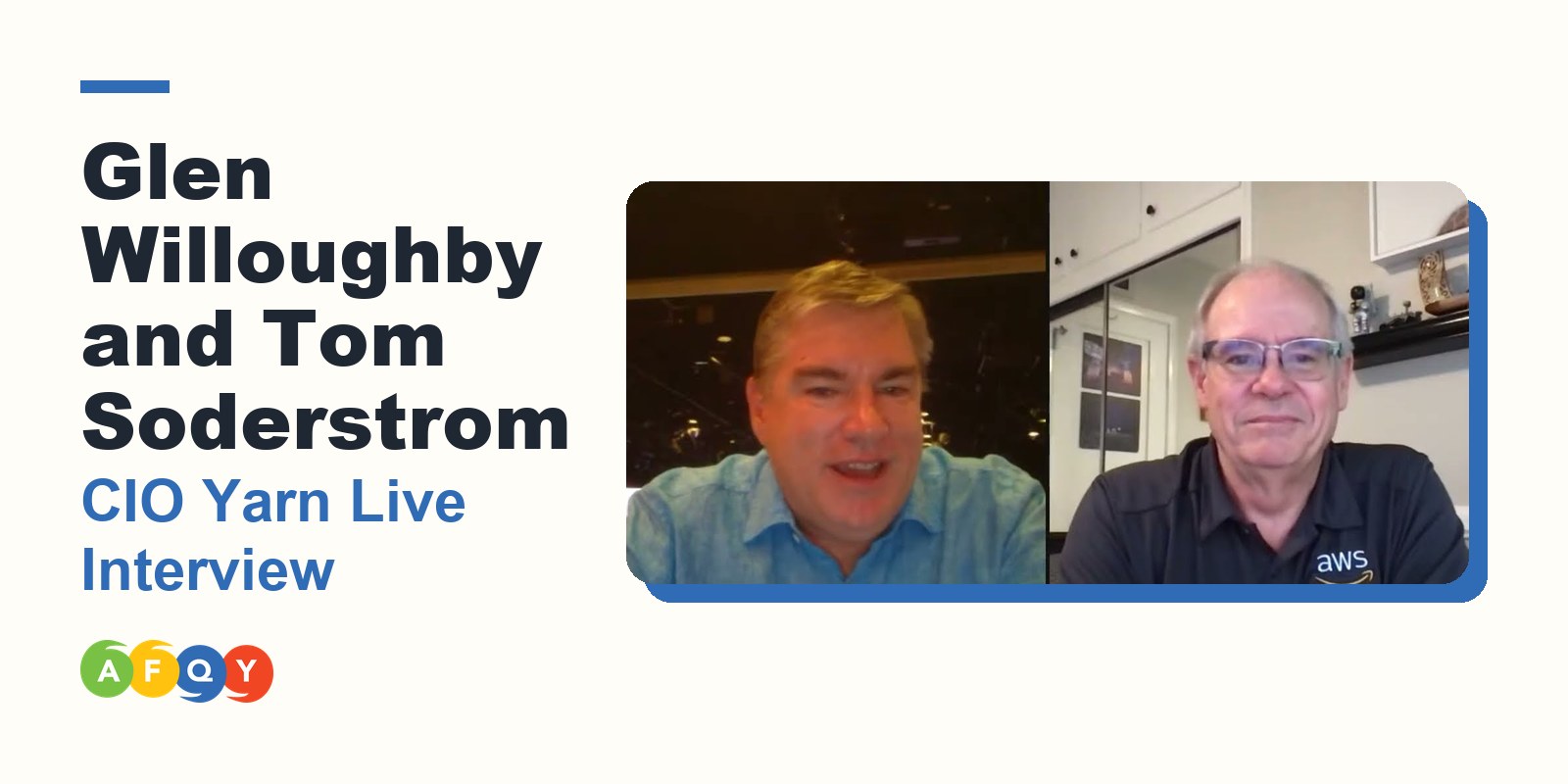
This article is written for the 2022 interview. In 2015 a New Zealand hospital technology chief heard a man from NASA speak at a conference in Auckland, and liked the talk so much that he took the speaker down to Wellington to give it again to his own team. Seven years later the two were still working together. By then they had helped open internships at NASA for New Zealand students, and they were starting a project to train artificial intelligence on the country’s breast screening images.
Glen Willoughby and Tom Soderstrom told the story on Thursday 21 April 2022, on CIO Yarn Live, AFQY’s weekly on-camera interview with a technology leader. This was a special edition with two guests, fitted around two busy diaries: early afternoon in New Zealand, dinner time in Los Angeles, where both men were. Willoughby, a New Zealander, was Chief Information Officer at Singularity University in Silicon Valley and an adviser to NASA’s Jet Propulsion Laboratory (JPL). Soderstrom had been JPL’s chief technology and innovation officer for IT from 2006 to 2020, and was by then Director, Chief Technologists at Amazon Web Services (AWS). Guests on the show usually got the same three questions, on culture, on technology and on one lesson. This edition ran as one free conversation and touched all three on the way. The host was AFQY’s Ryan Ashton.
This piece comes from the archive, so read it as a picture of April 2022. Willoughby hoped COVID was coming to an end, so that people could get around and meet again. Soderstrom is now an Executive in Residence at AWS. Willoughby was in the line-up for the Tauranga AI Business Summit in June 2026, where his biography said his work with NASA had continued, most recently with NASA Ames. What the two said about starting small, about people and machines, and about friendships across an ocean still stands up.
TL;DR
- Glen Willoughby and Tom Soderstrom met through the 2015 CIO Summit in Auckland, where Soderstrom was a keynote speaker from NASA’s Jet Propulsion Laboratory. Willoughby took him to Wellington to repeat the talk for his district health board team.
- Willoughby and Soderstrom’s friendship helped open internships at NASA’s Jet Propulsion Laboratory (JPL) for New Zealand students. Willoughby said JPL offered four places, and Soderstrom said the New Zealand candidates were so strong he would have taken them all.
- In 2022 Willoughby and Soderstrom were starting a project to train AI on New Zealand’s breast screening images as a tool to help radiologists, working with Victoria University of Wellington, the Ministry of Health, AWS and a private radiology firm’s clinicians.
- Soderstrom’s view of AI: treat it as an intelligent assistant. The machine sorts the clear cases, and a person reads the uncertain ones in the middle.
- Willoughby’s rule for innovation: the first project must be a guaranteed success, because confidence is what lets a team and its leaders take on the next, harder one.
- William Pickering, born in Wellington, led JPL for 22 years. Under him, JPL’s Explorer 1 became the first United States satellite, launched on 31 January 1958.
Meet the people, not the suits
Ryan opened with a countdown. In New Zealand, he said, we kick off in three, two, one; at NASA they lift off. Then, as always on the show, the introductions began outside work.
Soderstrom went first, from his home in Los Angeles. He grew up in Sweden and went to the United States at 19 to swim. He was a swimmer, and it was that or military service. One year turned into two, two into three, and three into forever. He still goes back to Sweden a lot, but the Los Angeles weather is a little nicer. He swims, and in winter he skis. “Most of the time I just innovate,” he said.
His career began in programming, because programming was what he knew how to do. He found a job at JPL and stayed a long time. He worked in the Deep Space Network, became a manager, and started some companies out of the laboratory.
He explained JPL for anyone who had not met it. It is a federally funded research centre of NASA, and it explores the heavens. For a long time JPL was the only one on Mars, he said, and now there is company, thank goodness. Its people ask where the universe came from and where it is going, and what our place in it is. If a big asteroid were heading for Earth, could we redirect it? Are we alone? Is there life on Mars, or on Europa, and would we recognise it when we saw it? These are not idle questions for a bar, he said. They are things JPL is trying to work out scientifically. Then there are the launches and the spacecraft, and what he called perhaps the most important question of all: how do we protect Mother Earth?
His own job there was chief technology and innovation officer for IT. He described it as helping everybody work out where to go next and how to use the technology, and enabling others to be more productive by getting them the latest tools. In 2008, he said, JPL started using cloud computing, one of the trends his team had seen coming. As one of the earliest large organisations on the cloud, JPL got to shape a lot of what AWS was doing, and he sat on AWS’s customer advisory board for more than a decade.
When it was time for a new adventure, he looked at one company only. It was JPL, then AWS, he said: a very similar culture and a great place to be. In 2022 he was leading its chief technologists globally, which meant working internationally again. He had missed that.
Willoughby spoke from a hotel in Beverly Hills, where he was attending a conference. He grew up in Cambridge, a small town in the Waikato. He started medical school at Otago very young, changed course in his first year, and went home to take his first IT qualification at Waikato Polytechnic. He spent part of his twenties in the health sector, where one of his projects was setting up the breast screening programme with a company that was then small, Orion Health. That project would come back later in the conversation.
He played soccer for many years at national league level and still likes the masters game. These days he plays golf.
A conference talk, repeated in Wellington
The two met, Willoughby said, courtesy of the New Zealand CIO conference in 2015. Soderstrom had been invited over as the chief technology officer of NASA JPL. That was exciting enough for a New Zealand CIO. More exciting still was the work Soderstrom had done on innovation inside a large public sector organisation.
Willoughby was then chief information officer for the Capital and Coast, Hutt Valley and Wairarapa district health boards. He took Soderstrom down to Wellington and, at the eleventh hour, gathered his team and anyone else who wanted to come, and asked him to give the presentation again. Health work is hard, he said, and it is nice to do something inspirational. It really helped. Around that time the team did three or four small projects that he called pretty world leading. It was a really great team.
Since then, he said, Soderstrom has been a really strong friend of New Zealand. Whenever Willoughby has wanted to do something, he has usually reached out to him.
His first example was internships. The New Zealand Government wanted internships with NASA. It already had some at another NASA centre and was looking for the right people to talk to at JPL. Willoughby remembered meeting the New Zealand consulate team from Los Angeles on site at JPL, in 2018 as he recalled it. By April 2022 the JPL internships were in their second year. The first was announced at the United States Embassy in New Zealand, he said, and at that announcement JPL offered four places, which he described as unheard of. New Zealand was one of the few countries to have four. A second intake had followed. A few days before the show, he and Soderstrom had talked the long-term view through with Chris Mattmann, who had been Soderstrom’s deputy at JPL and followed him as its chief technology and innovation officer.
The great thing about a relationship like this one, Willoughby said, is that there are things you can do and doors you can open that are hard to reach from New Zealand alone.
Soderstrom said it was no accident that one internship had become four.
"I was extremely impressed with the quality of the New Zealand candidates. We only had one slot at the time, but we would have brought all of them in."
They were well educated, well spoken, hard working, enthusiastic and entrepreneurial, he said, and he could go on.
The New Zealander who led JPL
Ryan had learned from Willoughby that New Zealand’s link with NASA goes back much further. An Auckland road, William Pickering Drive, carries the name, and he asked for the history behind it. Soderstrom thought it right that a Kiwi should talk about a Kiwi.
Willoughby said that, like Ryan, he had only known the name. Then he walked onto the JPL site for the first time, around 2015 or 2016. Walk on site and make a right turn, he said, and you come to a room holding replicas of the spacecraft from the early missions. Next door is the von Kármán Auditorium, a very famous auditorium at JPL, and in it is a famous photograph of the first American satellite, which he said JPL developed, launched and managed. It was the response to Sputnik, at the start of the space race.
William Pickering, he said, is one of the fathers of space exploration. He held the director’s role at JPL for 22 years and is held in extremely high reverence there to this day. Willoughby suspected the people of JPL know a lot more about Pickering than most New Zealanders do.
JPL’s own history bears him out. Pickering was born in Wellington in 1910 and was JPL’s director from 1954 to 1976, longer than anyone else. Under him, the laboratory’s Explorer 1 became the first United States satellite, launched on 31 January 1958.
Soderstrom added another part of the story. He was so influential, Soderstrom said, that in 1958 JPL became part of the civil space programme, and ever since it has been a premier place for science, for the good of humanity and for the sake of science itself. That followed from the success of Explorer 1. Sputnik was first into space, but Explorer 1 came right after, in almost no time, because the JPL team had built its satellite beforehand and was ready when its turn came. What made all the difference, in his telling, was that Explorer 1 was a science satellite, with science instruments on board. When NASA was formed, Pickering lobbied for JPL to be part of it, and so it was.
Ryan called it one of an amazing array of humble Kiwi stories that many Kiwis have never heard.
An intelligent assistant for breast screening
Asked about innovation since 2008, Soderstrom turned to the work he and Willoughby had done together. With one of them in New Zealand and one in the United States, he said, they see different things, and that has been a benefit. Cancer research was one of those things. Willoughby brought the idea to the table, at a time when Soderstrom was looking at AI very early as an emerging trend. He handed the story to Willoughby.
Willoughby began with what he has come to appreciate about space exploration: it means doing something that has never been done before. At JPL, Soderstrom was at the forefront of bringing in new ideas to support the missions, at a time when cloud was a new concept, AI was in its early days, and most people were unsure what voice assistants and the internet of things were. In his innovation centre he was trying these things, showing them, and bringing people in to see.
Health moves carefully, Willoughby said. Changing how services are delivered with technology is a slow process, because it is not a field where you can accept risk. Seeing an innovation centre so far ahead in its thinking lets you shortcut your own learning. It made a new conversation possible: imagine taking all the breast screening images New Zealand has gathered, and training an AI engine on them as one more tool to help clinicians diagnose. The aim was not to replace them. It was to give them another tool.
He still repeats something Soderstrom said when they first met. AI is not really artificial intelligence. It is better to flip the letters around and see it as an intelligent assistant. Willoughby called that a really important concept. “The technology can move quickly but human behaviour doesn’t move as quickly, and you’ve got to join the two together to get an outcome,” he said.
The project had been discussed for some time. Willoughby said approval to use New Zealand’s data came from his past colleague Dr Ashley Bloomfield, then Director-General of Health, who, Willoughby said, had done an exceptionally good job. Through Soderstrom’s work with AWS, the team was introduced to the senior people in AI research and product design, and in April 2022 the work was kicking off again with his support.
It is fine to have an idea, Willoughby said, and fine to think about how technology might be applied to a problem. Visiting a place that does it as part of its daily work, in extreme settings, makes the discussion tangible: how do you set up a project to do something that has not quite been done before at this scale? It is a common story, he said, for technology trialled at NASA and JPL to find its way into other industries. Without the innovation centre and Soderstrom’s work, his team would probably still be years away from the confidence to know how to approach the project, and who to approach it with. When an organisation truly values digital innovation, and its leaders and teams come together to make it real, it opens opportunities nobody could have imagined.
Soderstrom agreed, and added his own part. Innovation means daring to experiment. Some experiments do not work, and those deserve to be celebrated too, because each one teaches something. He recalled the old story of Edison learning a thousand ways not to build a light bulb. With machine learning and image recognition where they had got to, he said, breast screening was no longer an experiment. The aim now was to save lives, and the job was execution.
What the tool would do
Ryan asked what it would mean in practice. Willoughby called it a good example of a technology that has had a good gestation in the space industry and can now be turned to another problem.
Every breast screening image is reviewed by two independent radiologists. After medical school, he said, it takes another 10 years to qualify to read them. The work is like looking for needles in haystacks. About 98 percent of the images are fine, and the readers are searching for the very small number that are not. They have to concentrate hard, because they cannot afford to miss one, which is why there are two independent reads and a big quality process around them.
Every OECD country, he said, faces the same challenge: demand for breast screening is rising fast and there are not enough clinicians. New Zealand has something many countries lack, a vast and very good set of data. Reading images is a task that AI and image recognition do extremely well. The aim is to support clinical practice, not replace it, and to let people do what people are good at. Looking through thousands of images, day in and day out, for the one that is different is not that. AI is really good at it.
“AI is not so good at dealing with people,” Willoughby said. “It might get there, but long way to go. But people are really good at dealing with people.”
He compared it with the early days of cloud computing in health, when the sector was cautious. By 2022, he said, the opposite was true: New Zealand was one of the forerunners in the use of cloud, particularly under the Ministry of Health’s leadership of the time. Support for the technology had grown strong in a short time, mainly because there was a compelling problem to solve and a workforce that needed help.
Four years earlier, when the idea first came up, the plan had been to trial how good AI could be. In the years since, a number of organisations had proved it. That left a more exciting question: how good can it be made, in support of clinical practice? The goal, he said, was not only research. It was to use New Zealand’s data to create a strong clinical tool, with the value coming back to New Zealand.
The partnership was wide: Victoria University of Wellington, the Ministry of Health, Soderstrom and AWS as technology partners in New Zealand and in Seattle, and the clinical team of a private radiology firm. There were many moving parts, he said, and a lot of motivated people after the same outcome, spread over three continents. And it all stemmed, he told Soderstrom, from a phone call Soderstrom had made to AWS executives, saying this would be a good one to do.
Soderstrom picked up what the cloud makes possible. Suppose every image ever taken needed to be screened again. It could be done, by switching on many more computers for the job and finishing far sooner than a few machines could. He sees that message over and over. When he used to start companies, he said, he would raise venture capital and spend 60 percent of it on IT and office space. Now a founder may not need venture capital until the product is nearly finished and it is time to scale and market it. Built on the cloud, it scales up and down by itself. That is why the cloud excites him: the innovation, and the outcomes, from saving lives to answering the big questions.
The first one must be a guaranteed success
Ryan asked what comes after breast screening: more kinds of screening, or a sharper focus on this one?
Willoughby answered with a model Soderstrom developed at JPL for adopting technology. Do the first thing. Then do the next thing, which is larger. Then do the really big things. The process was documented around Soderstrom’s first project, which put large collaboration screens into the room where spacecraft are built. It was a really good lesson, Willoughby said, and one he planned to raise at the conference he was attending.
"Fail fast is a nice concept, but when you're looking at innovation and doing something new, it's a confidence game, and the first one must be a guaranteed success."
Innovation, he explained, is a cultural activity within a group of people or an organisation. Once the first project succeeds, your own team and the leadership around it gain the confidence that they can do the next one, and the one after. So the first has to be a guaranteed home run.
Breast screening fits. As a technical task for AI it is not all that hard, he said, and the more data it has, the more refined it becomes. Asteroid detection is far more complex, and AI is making good inroads there. Other medical imaging, such as CT and MRI scans, is complex and difficult too. The first project should bring good returns and, with them, a platform for the really hard work, which will not be quick or easy. Getting started matters, he said, and it is as much about taking everyone with you as it is about getting the technology right. Even your own team needs the confidence for the next step.
So breast screening would keep the team busy for some time. The aim was a clinically useful tool, which is not an overnight task. Once it was embedded and able to scale, they would turn their minds to other things. There were interesting strategic aspirations, he said, but the bread and butter was getting this one done right.
Soderstrom added that the approach matters as well.
"Perfection is the enemy of progress, because you never get started."
He showed how that works with screening. Some images are absolutely not cancer, and machine learning can say so. Some absolutely are, and machine learning can say that too. The ones in the middle are where the human is needed. That is the intelligent assistant again. As the system learns, more can be automated. For the next, harder task, the approach is the same: start wide, where the uncertainty is, and tighten as you go. That way a team can get started quickly, and take no risk with human lives until it is sure. Sometimes, he said, you get started and figure the rest out on the way, without taking foolish risks.
Fast ideas, and a walk around JPL
For closing remarks, Willoughby went first. He had recently begun working with Singularity University as its chief information officer, which puts him among all sorts of great people and good ideas. His takeaway was how fast a good idea can now go from idea to execution. It is much faster than he could ever have imagined, and the pace keeps surprising him. At Singularity University and at NASA JPL alike, he said, the speed of getting things done to a high quality with cloud-based tools is lightning.
"If you get great people together that have great motives and good spirit, and you align that with some amazing proven technology that gets you to move at pace, you can do some pretty amazing things really, really fast."
He called that his algorithm for success. It lets you solve problems much more quickly and, more than that, it lets you learn much faster. The pace of change, he argued, is starting to mirror Moore’s law and becoming far more exponential. The breast screening work was his proof: from idea to building it in a matter of weeks, and analysing it a few weeks later. Nobody could have contemplated that when the idea was first discussed. Fun and exciting times, he said.
Soderstrom finished by going back a few years. Willoughby had asked whether he would show a group of young people in Auckland around JPL. He put his iPhone on a gimbal, walked around the laboratory and gave them a tour. It was wonderful, he said. The students had fantastic questions, and he was really impressed. CIO reported a tour of this kind in August 2018, when Soderstrom led close to 200 Auckland high school students through JPL’s mission control and spacecraft build rooms by video.
His dream is that the tour inspired some of them to help answer the big questions. Anyone can now explore the heavens and take part as a citizen scientist with a laptop, he said. “You don’t have to own a spacecraft, you don’t have to be a national space agency. You can join a startup, and New Zealand has several space startups.”
Cloud is what makes that happen, he said. You find your partners, you share your data, your code and your stories, and then you explore. One day, he hopes, one of those students will walk up and say they saw him when he walked around JPL. That would be amazing. “They are the ones that will answer those big questions.”
Ryan thanked them both for the effort it took to be there, one from a hotel and one from home.
What it means
More than four years on, parts of this conversation have become ordinary. Cloud computing no longer needs explaining. The internships carried on as well. In March 2023, Victoria University of Wellington reported three of its students winning internships at JPL.
The method has not dated. Pick a first project that will work. Let the machine take the clear cases and keep people for the doubtful ones. Start before it is perfect, and stay careful with lives while you learn. And when a talk changes how you think, follow it up. This whole story began that way.
Two of the lessons
- The first one must be a guaranteed success. Innovation runs on confidence, so pick a first project you know will work and let that win carry the team and its leaders to the harder ones.
- Think of AI as an intelligent assistant. Turn the letters around: the machine helps the expert, and the expert still decides.
There are 27 more lessons from this conversation, kept for AFQY Tech Leaders. Join the AFQY community as a Tech Leader to read the rest and discuss them with other Tech Leaders.
Sources
- AFQY on YouTube: CIO Yarn Live, Glen Willoughby and Tom Soderstrom, 21 April 2022
- AWS Executive Insights: Tom Soderstrom, Executive in Residence
- AWS re:Invent 2022: The future of cloud computing in the public sector (session WPS204 slides)
- Institute of Directors: Technology and governance, lessons learned from NASA JPL, 9 March 2023
- Humanitix: 2026 Tauranga AI Business Summit Fundraiser, 12 June 2026
- NZ Herald: NASA CTO to speak at SkyCity summit, 9 March 2015
- CIO: Movers and shakers, 16 November 2015
- CIO: How to inspire the next generation of ICT leaders, 22 August 2018
- NASA Jet Propulsion Laboratory: Dr. William H. Pickering (1910-2004)
- NASA Jet Propulsion Laboratory: William H. Pickering, former director of JPL, dies
- Dr. Chris Mattmann: About
- Victoria University of Wellington: University students awarded NASA internships, 15 March 2023