
The Models Will Come and Go: Maria Mingallon on What AI Can't Copy
13 October 2026· AFQY News
Maria Mingallon opened by picking up something Craig Young had said an hour earlier about wanting his grandchildren to come home to New Zealand. She was not born here. She came from Spain as a highly skilled professional, headhunted for a role, and she and her husband chose to make New Zealand home: drawn by the work-life balance, by Kiwi agility and appetite for innovation, and by a country that punches above its weight. She now has a son who was born here. She wants the same thing Young does, and framed it as the reason she does the work.
She wears two hats. One is AI Leader APNA at Mott MacDonald, an engineering consultancy. The other is chair of the AI Forum of New Zealand, and it shaped where she started.
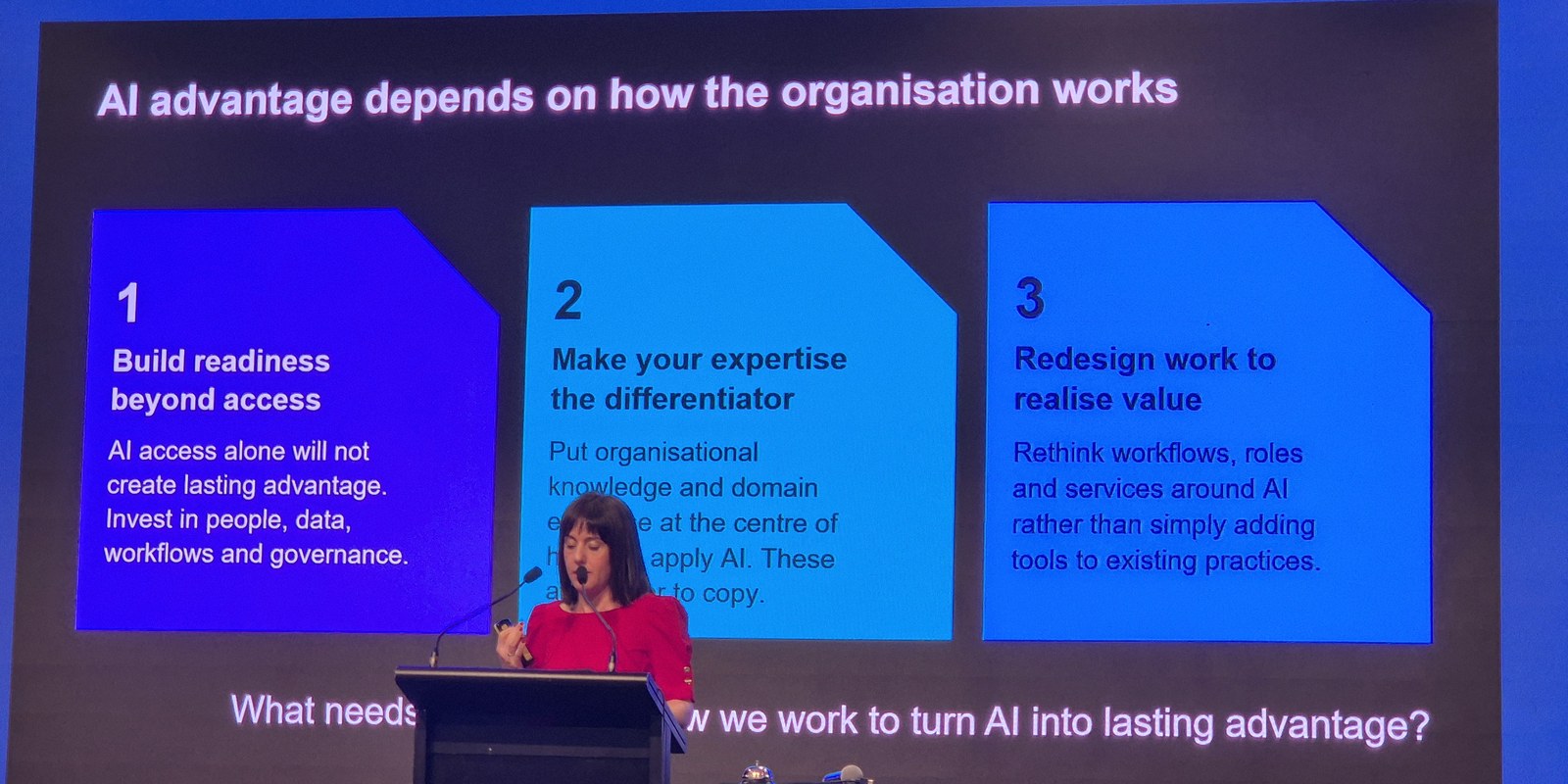
"Access to technology isn't enough, because it doesn't mean adoption, and it doesn't mean you're going to see a business benefit."
It was a direct extension of the point Haley Mortimer had made in the previous session, and it set up everything that followed. The gap between having a licence and getting value from it is where most organisations are currently stuck.
The Forum, and who is in it
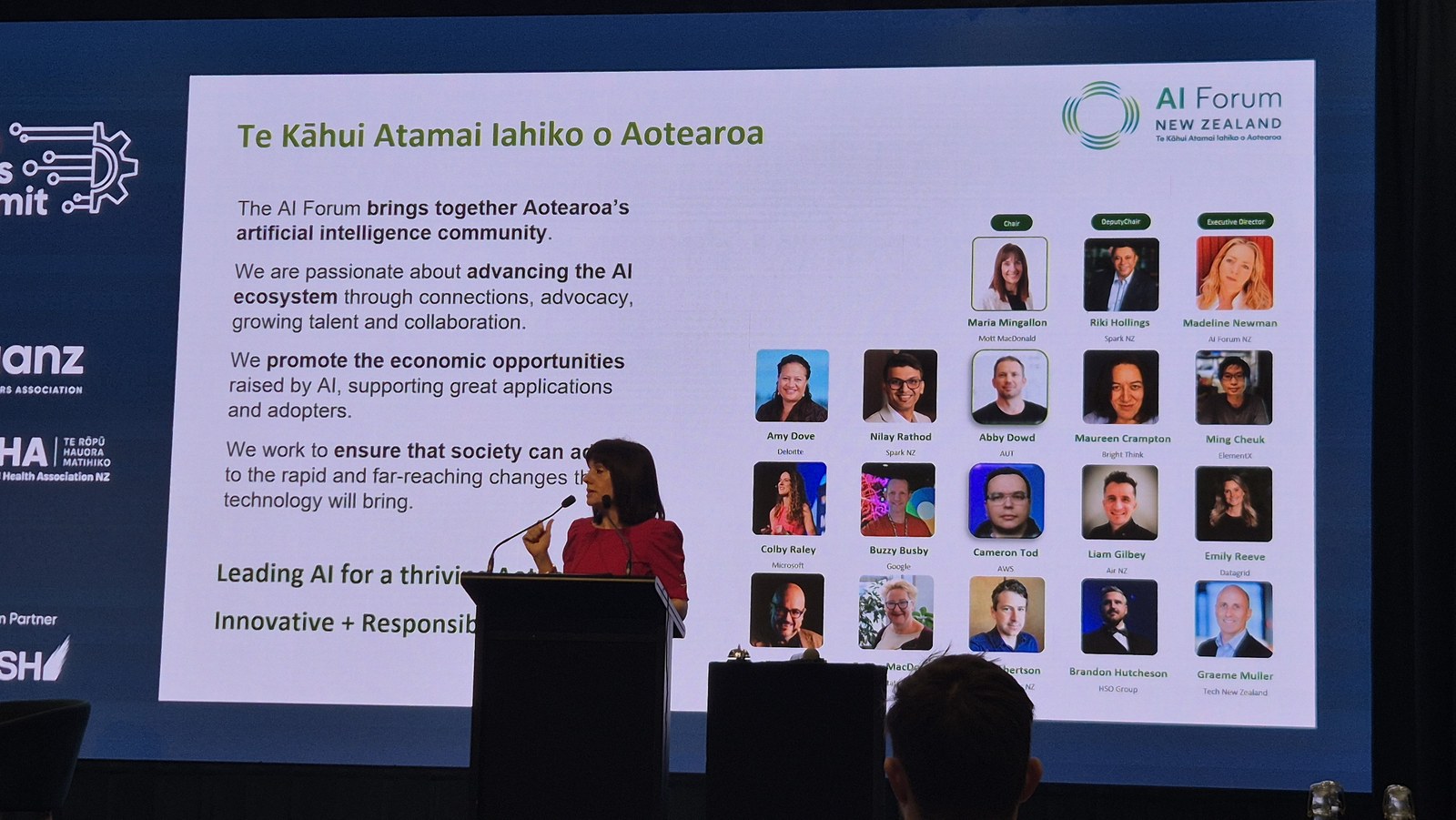
The AI Forum, Te Kāhui Atamai Iahiko o Aotearoa, exists to advance the AI ecosystem through connections, advocacy, growing talent and collaboration. Its own framing is that it promotes the economic opportunities AI raises while working to ensure society can adapt to the pace of change.
Mingallon was careful to say this is not advocacy for AI’s own sake. The point is a thriving ecosystem in Aotearoa, which means AI adopted responsibly and inclusively, without losing sight of innovation.
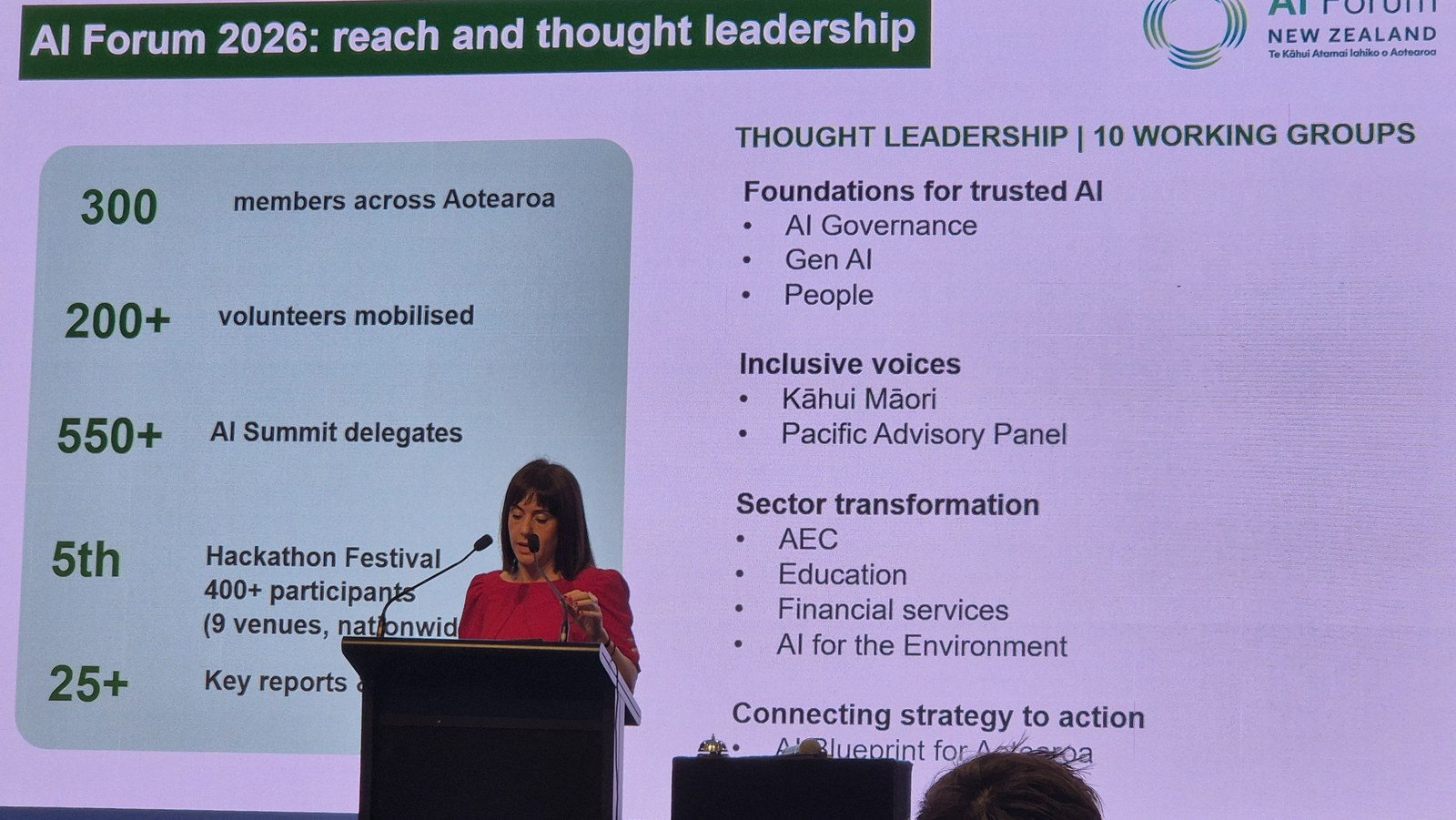
The numbers are modest by international standards and substantial for a country of five million. The Forum passed 300 members across Aotearoa this year, supported by more than 200 mobilised volunteers. Its AI Summit drew over 550 delegates, its fifth hackathon festival ran across nine venues nationwide with more than 400 participants, and it has published twenty-five or more reports.
Behind that sit ten working groups, organised into four strands: foundations for trusted AI, covering governance, generative AI and people; inclusive voices, through Kāhui Māori and a Pacific Advisory Panel; sector transformation across architecture and construction, education, financial services and AI for the environment; and connecting strategy to action through an AI blueprint for Aotearoa.
When she asked how many people in the room were members, a few hands went up. “We need to work harder,” she said, which was a more honest response than most association pitches manage.
What Mott MacDonald did
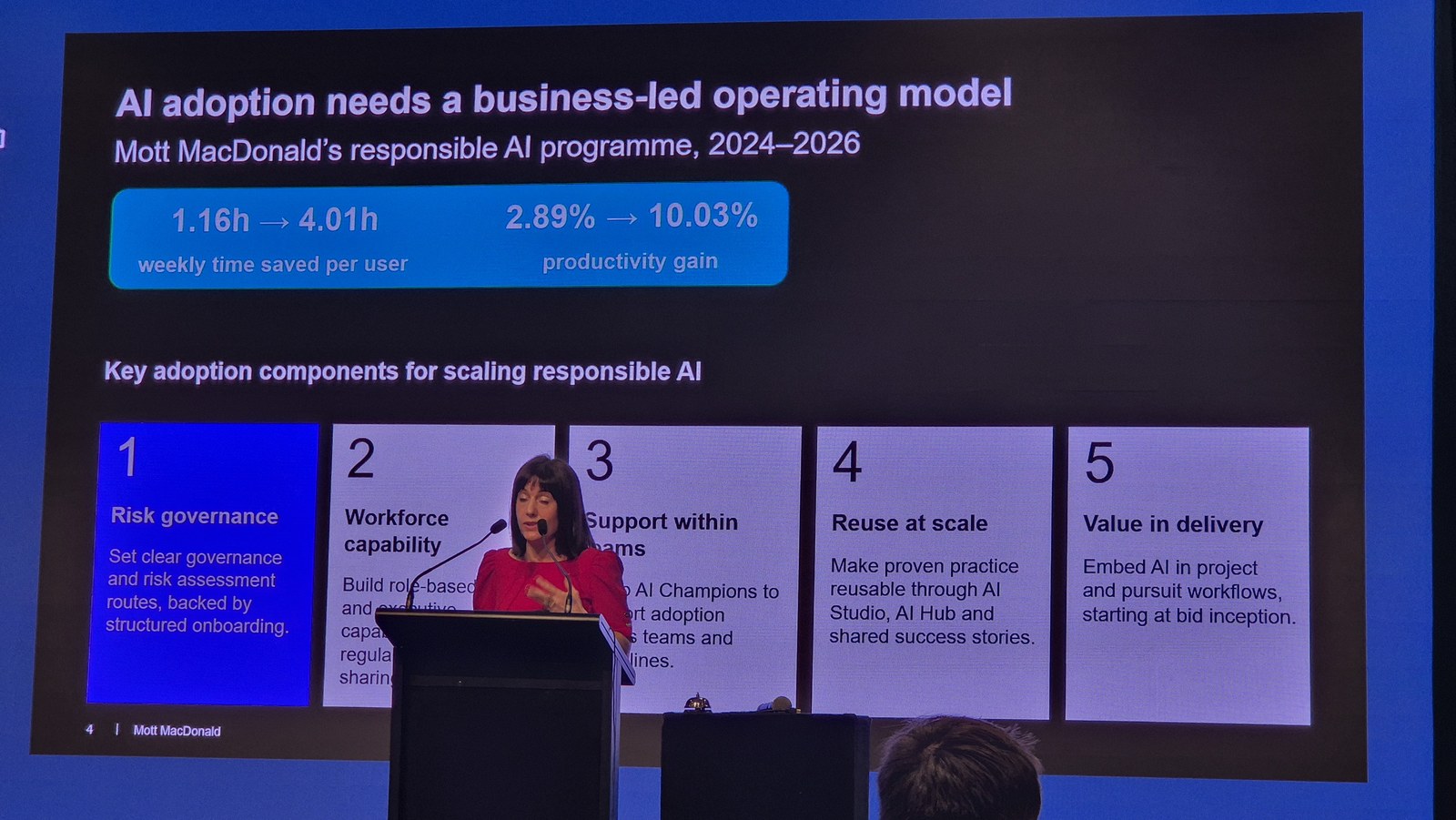
The second half of her talk was a case study, and it had the thing most case studies lack: before and after figures.
Across Mott MacDonald’s responsible AI programme from 2024 to 2026, weekly time saved per user rose from 1.16 hours to 4.01 hours. The reported productivity gain rose from 2.89 percent to 10.03 percent.
Her explanation for the change was that the firm realised early it needed an operating model around AI rather than a tool rollout. Five components carried it.
Risk governance came first, and she was specific that this means more than writing a framework. Everyone in the organisation has to understand what good looks like and where the risks sit, backed by structured onboarding.
Workforce capability was where she was sharpest. Having a generative AI course, and having people attend it, does not mean anything has changed.
"Just because we've got a gen AI course and people go to the training course, it does not mean they've taken any action on it."
Capability, she argued, only counts when it changes the way people work.
Support within teams came through AI champions: local people in individual offices who understand both how AI works and how it applies to their own work, so colleagues have a pattern they can copy from someone they already know.
Reuse at scale was about not letting that stay local. Proven practice has to become reusable, through shared tooling and shared success stories, or you end up with isolated pockets of good work that never reach the rest of the organisation.
Value in delivery meant embedding AI into project and pursuit workflows, starting at bid inception rather than after a job is won.
If you do not measure it, you do not care
Mingallon asked the room how many were measuring the value they get from AI, whether in hours saved or any other terms, and then put it bluntly: if you do not measure something, you do not really care about it.
One of the first things Mott MacDonald did was decide what it wanted to track. She was candid about the data quality problem underneath that. You cannot take the numbers the AI vendors hand you at face value, so her team dug into how those measures were derived, right down to how long a given vendor assumes an email takes a person to write.
The adoption programme is what made the numbers worth having. Getting any number at all, she said, is a huge win, because it lets people see and understand what is changing in the business. They supplemented the quantitative measures with surveys asking what else people had found, what was working, what was not, and whether people felt better for not having to do a particular task.
They also gathered it where people already were: live anonymous polling during knowledge-sharing sessions, and a gamified approach, on the grounds that engineers love competition and most people like a game. The side effect was the valuable part. People started sharing how they were using it with each other.
Five conditions anyone can copy
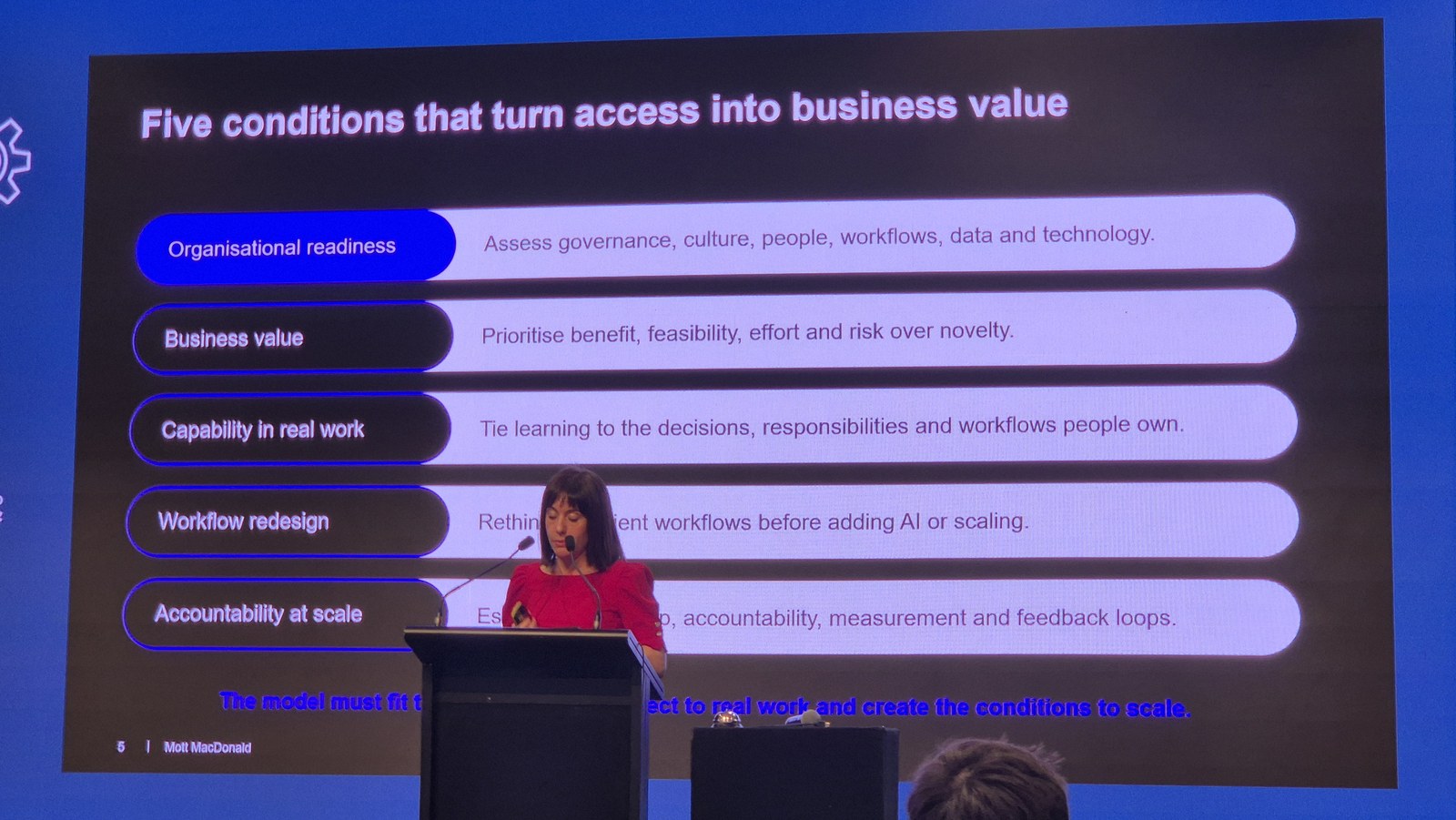
Knowing that a case study is only useful if it travels, she pulled out five conditions she considers transferable.
Organisational readiness. Assess your governance, culture, people, workflows, data and technology honestly before you start.
Business value. Prioritise benefit, feasibility, effort and risk over novelty. Her practical version was to look for use cases that are easy to manage and low risk, and do those first.
Capability in real work. Tie learning to the decisions, responsibilities and workflows people own, rather than to a generic course.
Workflow redesign. This was the one she spent longest on. Buying AI into an existing workflow without redesigning that workflow will produce an efficiency gain at best. Reimagining the way an organisation is used to doing things is genuinely hard work, she acknowledged, but it is where the value is.
Accountability at scale. The leaders driving this for the whole organisation have to be comfortable owning it, with measurement and feedback loops attached.
The part worth keeping
"The AI models are going to come and go. Your own judgement, your own knowledge, that's your real IP."
Her closing argument was the most strategically interesting thing said in the session, and it cuts against the way most organisations are currently spending.
Models will get cheaper, better and more numerous. Compute will keep moving. None of that is defensible, because everyone gets it at the same time. What an organisation knows, the decisions it takes and the reasoning behind those decisions, is the asset nobody else can buy. Her advice was to treat that as the differentiator and to invest in curating it, which is a very different budget line from licences.
She wrapped with three imperatives: build readiness beyond access, by investing in people, data, workflows and governance rather than seats. Make your own expertise the differentiator. And set aside real time to redesign the work itself, because applying AI to unchanged processes will not produce the change you are hoping for.
Her final line reframed the whole anxious debate in one sentence. This is not about human people versus AI tools. It is about building organisations that are capable of using AI well.