We Can't Demand a Capable Workforce While Retreating From Technology in Schools
13 October 2026· AFQY News
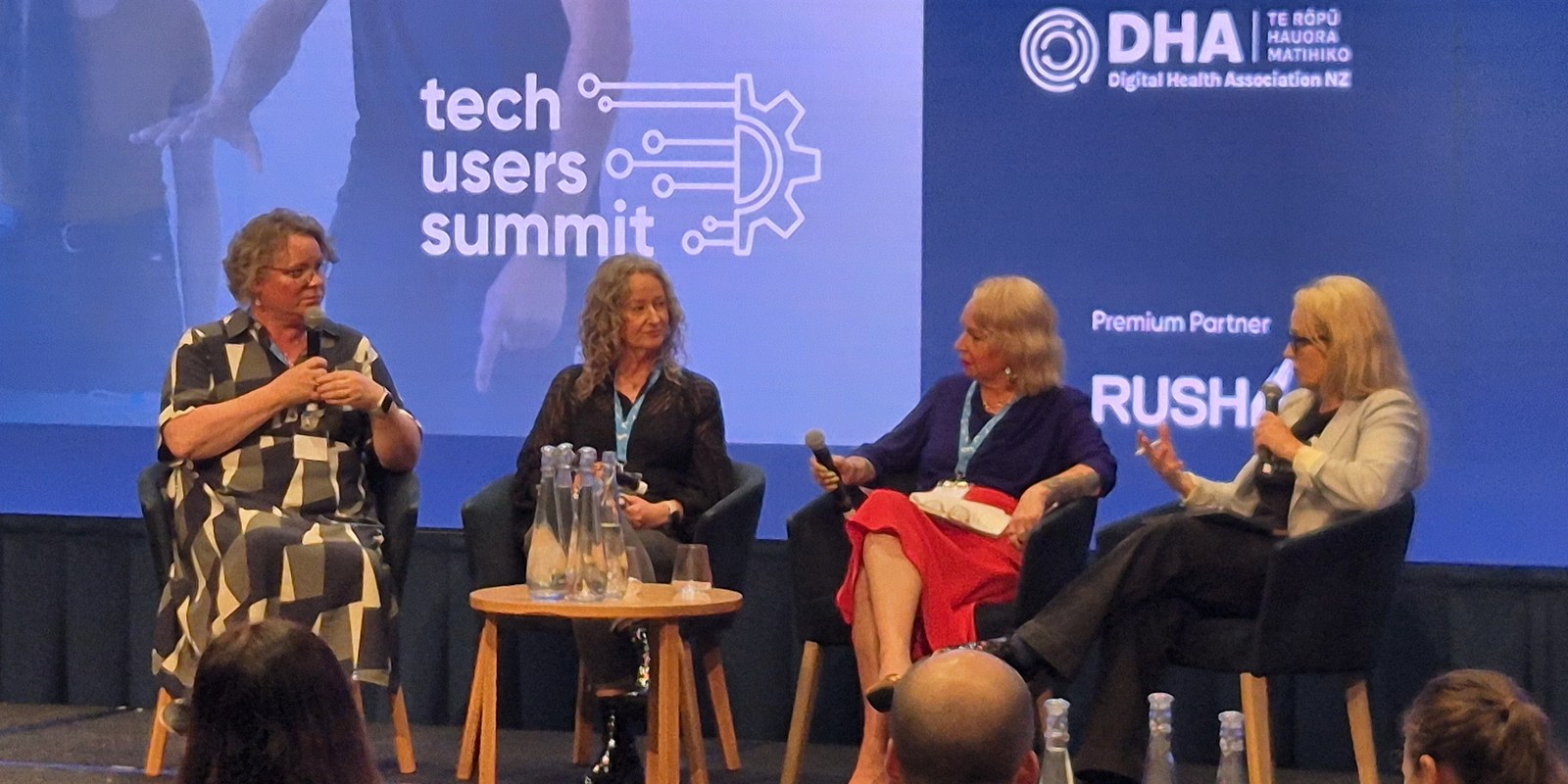
The session was introduced with an observation that had been hanging over the whole summit. AI is taking on work that junior people used to do. That has real benefits, and it also means fewer first jobs and fewer places for young people to learn. Which is a problem for everyone, because the country needs skilled people in the years ahead.
What followed was the most direct hour of the day. A standards body setting out a new school subject that does not exist yet. A principal telling a room of business leaders that the country is contradicting itself. And an employer explaining what her company changed when it noticed entry-level work quietly disappearing.
At the Tech Users Summit’s Education to Employment session, Jenni Pethig, Claire Amos and Sarah Bellett each came at the pipeline problem from a different end, and arrived in roughly the same place.
TL;DR
- Industry Skills Boards replaced the Workforce Development Councils on 1 January 2026, and the Ministry of Education has asked them to design industry-led subjects for schools. Applied Intelligent Systems is one of nine on that path, developed by the Electrotechnology, Information Technology and Creative Industry Skills Board.
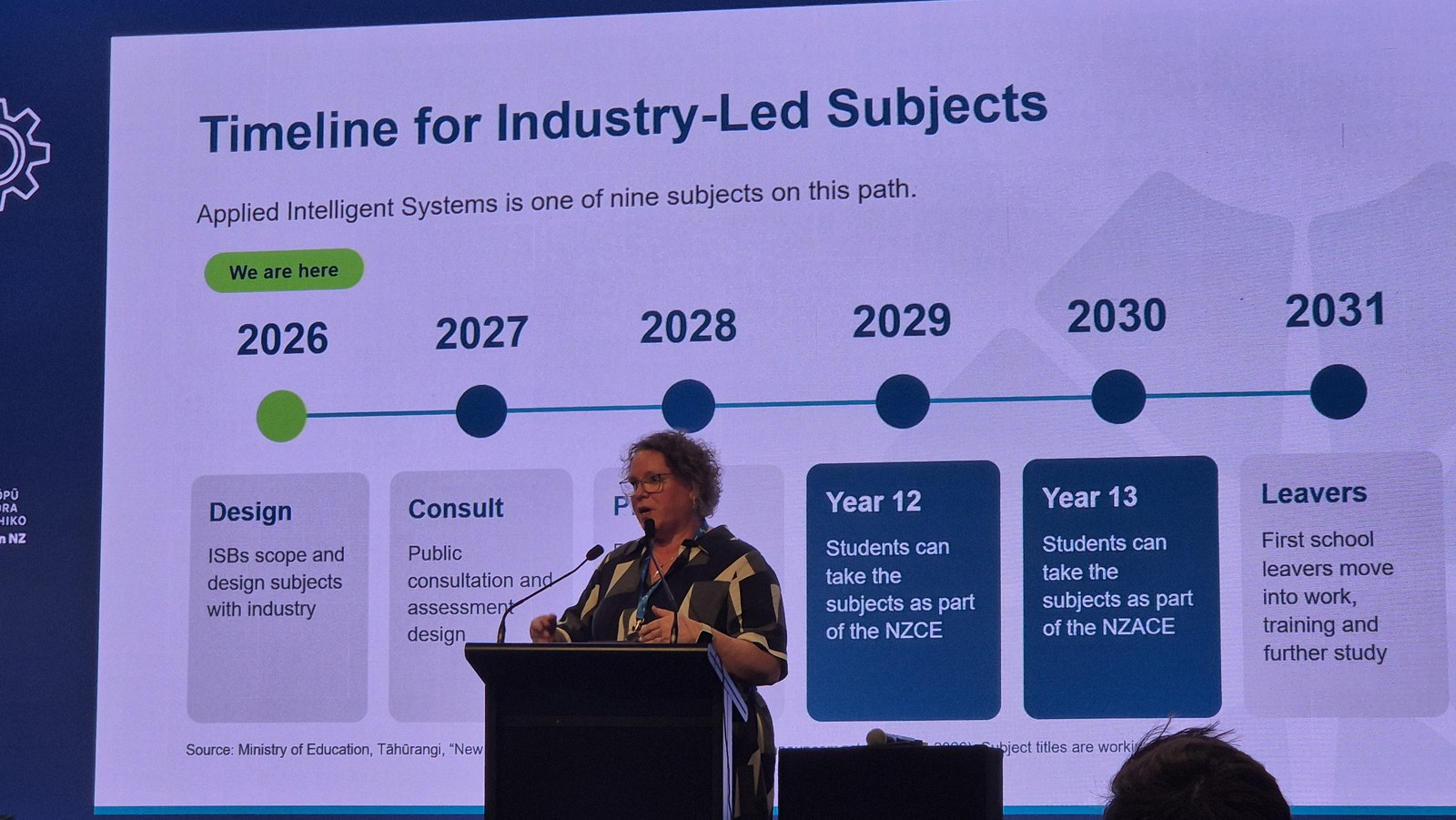
- The timeline is long. Design in 2026, consultation in 2027, piloting in 2028, available to Year 12 students in 2029 and Year 13 in 2030, with the first school leavers coming through in 2031.
- It is deliberately not called an AI subject. It is technology independent, described as the study of whole intelligent systems in human contexts rather than training in a particular product, built around enduring human capabilities because the technology will keep changing.
- Claire Amos, principal of Albany Senior High School, argued the country cannot demand a technologically capable workforce while retreating from technology in classrooms, and called the response to AI in education a real contradiction.
- New South Wales has published daily screen-time limits for public schools: 15 minutes for Kindergarten to Year 2, 30 for Years 3 and 4, 45 for Years 5 and 6, a quarter of subject time for Years 7 to 10 and half for Years 11 and 12. Recommended from Term 1 2027 and mandatory from 2028. Amos called them arbitrary and warned New Zealand is good at copying this kind of policy design.
- Sarah Bellett of One NZ said roles are not being removed by AI, tasks are, and the question that matters is where the learning those tasks used to carry now happens instead.
- Her framing closed the session: talent is critical infrastructure in this country and should be treated the same way as physical and digital infrastructure.
Jenni Pethig: a subject for a technology that does not exist yet
Jenni Pethig is chief executive of the Electrotechnology, Information Technology and Creative Industry Skills Board, which sets the standards and qualifications for vocational training across those sectors. She has held senior roles in industry training organisations, a workforce development council and local government, and she opened by acknowledging that the organisation’s name is a mouthful.
The structural point behind it matters more. Industry Skills Boards replaced the Workforce Development Councils on 1 January 2026. They develop and maintain qualifications, micro-credentials and standards, moderate assessment across on-the-job, on-campus and online learning, endorse vocational programmes leading to NZQA-listed qualifications, provide workforce analysis, and advise the Tertiary Education Commission on funding priorities.
This year they picked up something new: designing subjects for secondary schools.
The Ministry of Education asked the Industry Skills Boards to develop a range of industry-led subjects, and ETITC pitched successfully for one of them: Applied Intelligent Systems.
The timeline is the first thing a room of technologists notices, because it runs at the speed of an education system rather than the speed of a product. 2026 is design, with the boards scoping subjects alongside industry. 2027 is public consultation and assessment design. 2028 is piloting and transition, including the professional development teachers will need. Students can take it as a Year 12 subject in 2029, Year 13 in 2030, and the first school leavers who studied it reach work, training or further study in 2031.
Pethig is in the industry-gathering phase right now, and was openly asking the room for input on what belongs in the curriculum.
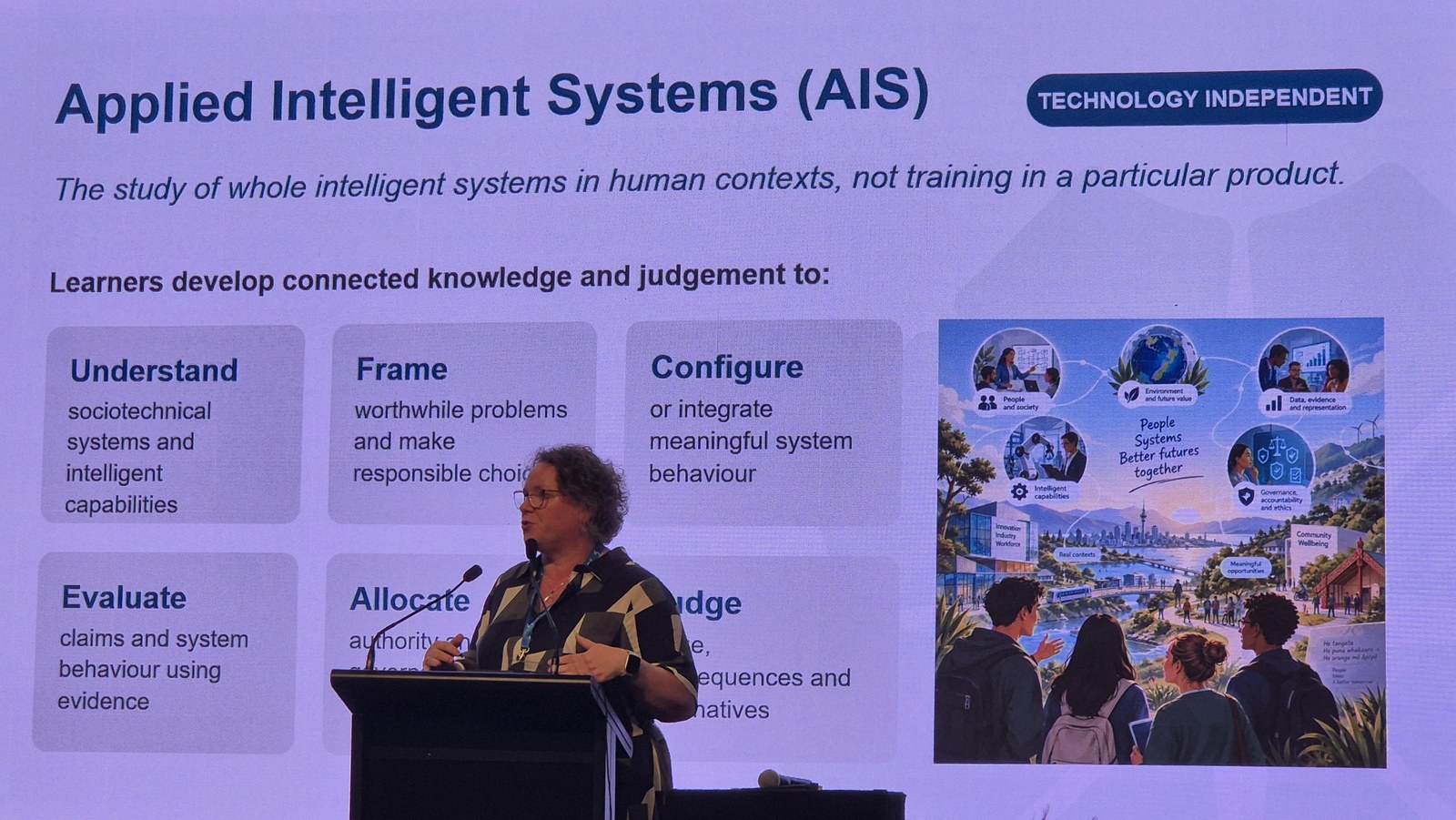
The design choice worth noting is what it is not. It is not called an AI subject, and the slide carries a “technology independent” tag. The definition on screen was precise: the study of whole intelligent systems in human contexts, not training in a particular product.
Learners are meant to develop connected knowledge and judgement to understand sociotechnical systems and intelligent capabilities, frame worthwhile problems and make responsible choices, configure or integrate meaningful system behaviour, evaluate claims and system behaviour using evidence, allocate authority and design governance, and judge value, consequences and alternatives.
That is a list about reasoning rather than tooling, and deliberately so. The industry feedback they have been getting, Pethig said, is that the subject needs to build the enduring human capabilities people will need, because the technology itself changes rapidly.
It is aimed at 15 to 18 year olds across Year 12 and Year 13, each taught over a school year at four to five hours a week for 33 weeks, in English-medium schools and through Māori-medium pathways via Te Marautanga o Aotearoa. Its stated purpose is to support broad industry pathways rather than prepare students for specific occupations. Pethig described it as a horizontal subject, one that packages with other subjects rather than sitting in a silo.
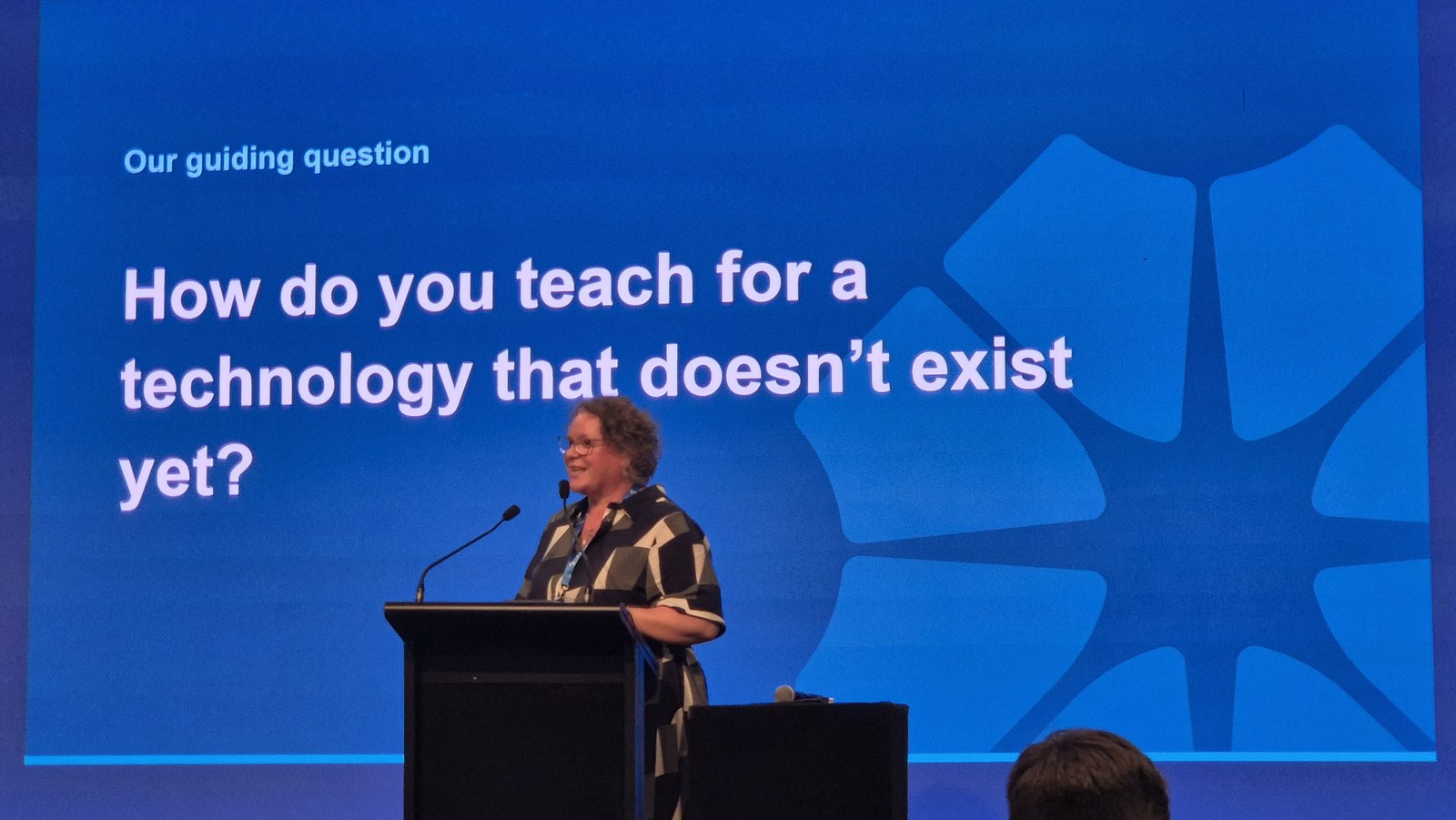
"How do you teach for a technology that doesn't exist yet?"
Their own stated challenge is creating something future-focused enough to stay relevant as the technology changes, and the answer they have landed on is to teach judgement: understanding data, algorithms and intelligent systems, applying them to authentic problems, judging evidence and trade-offs, and exercising agency over collective decisions about technological futures.
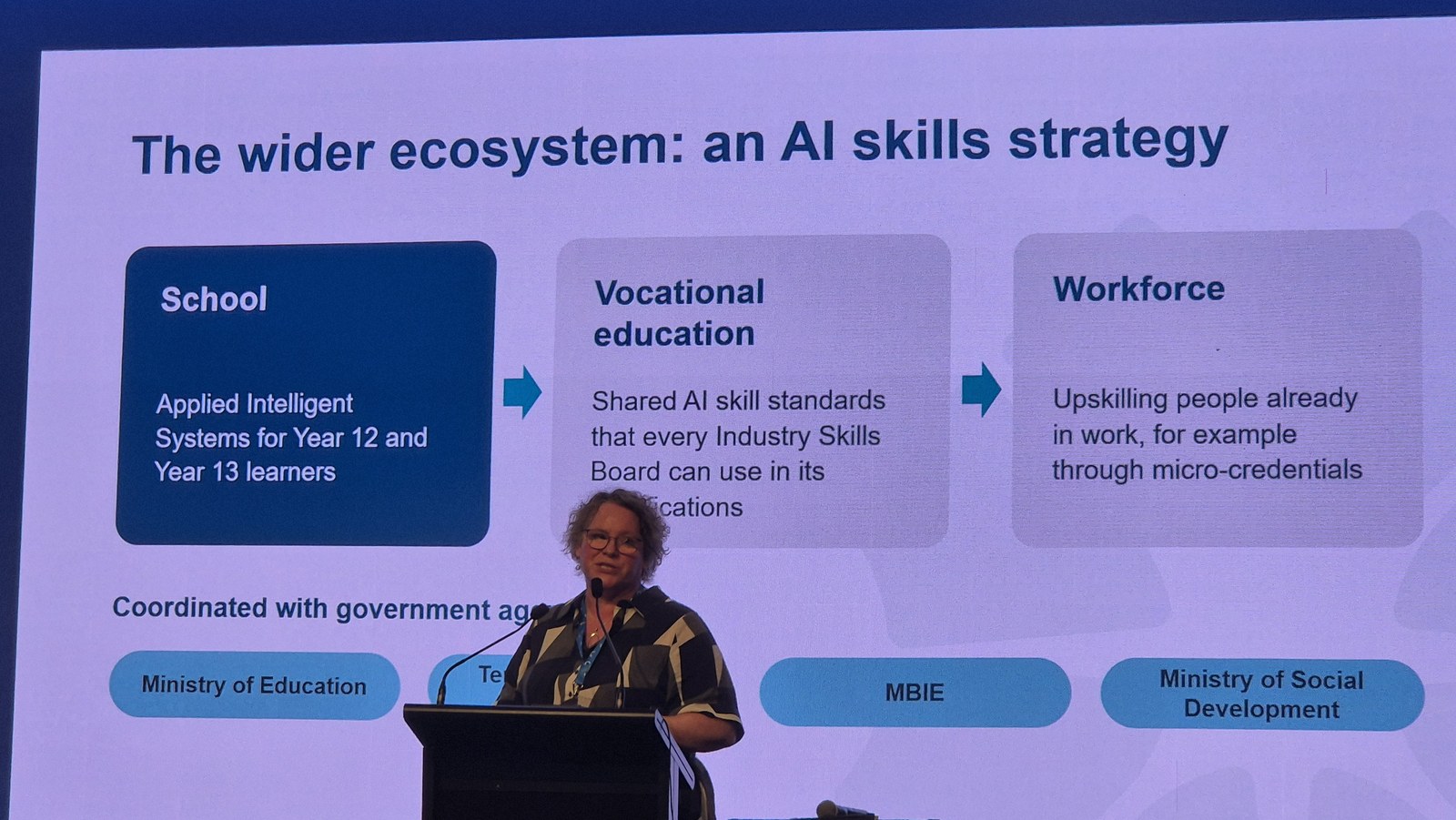
Pethig was clear this is bigger than a curriculum project. The slide set it inside a chain running from secondary education through industry-led subjects, vocational education and industry workforce needs to an emerging AI skills strategy, with shared AI skill standards every Industry Skills Board could use in its qualifications, and micro-credentials for upskilling people already in work.
Which led to her most consequential observation, and it echoed what TUANZ had argued that morning.
"We have become very aware of the lack of a coordinated national AI skills strategy."
Claire Amos: the contradiction we are living with
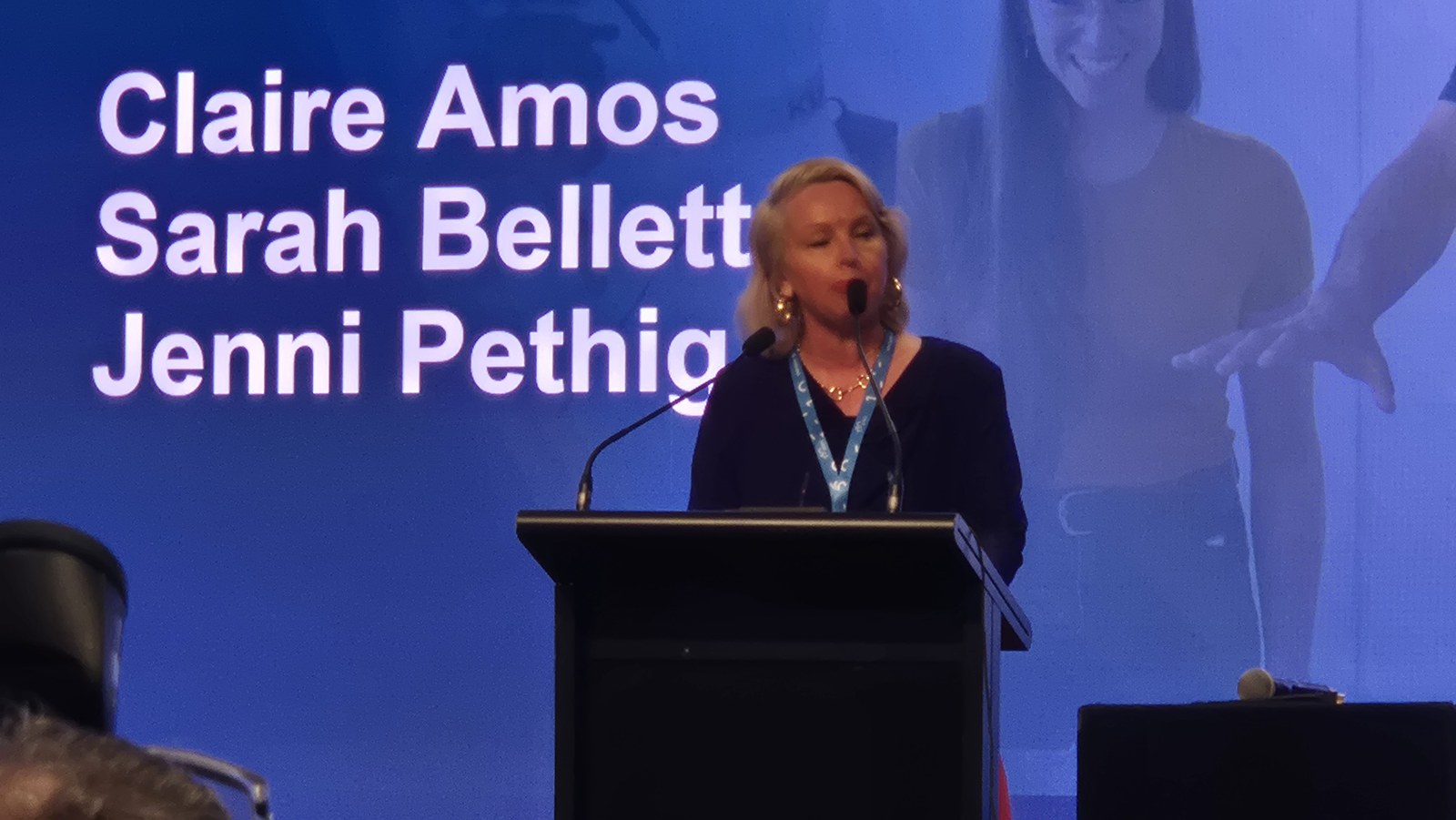
Claire Amos is principal of Albany Senior High School, with more than twenty-five years in education and school leadership, and a member of the AI Forum and Global Women New Zealand. She arrived without slides and delivered the most forceful ten minutes of the day.
Her opening was the whole argument.
"We cannot demand a technologically capable workforce while retreating from technology in schools."
The country, she said, is worried about AI, automation, digital transformation and a shortage of advanced technological skills, while much of the education conversation is focused on restricting technology and removing it from classrooms. She called that a real contradiction, and asked the room to be wary of the current back-to-basics framing, of an increasingly stuffed and mandated curriculum, and of a locked-down approach to assessment.
Her example was fresh and specific. New South Wales has published screen-time limits for its public schools, scaled by year level. No individual devices in preschool. Fifteen minutes a day up to Year 2. Thirty minutes for Years 3 and 4. Forty-five for Years 5 and 6. A quarter of subject time for Years 7 to 10, and half for Years 11 and 12.
Her verdict was blunt: a ridiculous set of arbitrary mandates, with no nuance and no discussion of what meaningful use of devices or development of digital literacy means. Her warning was that New Zealand has become very good at copying Australia’s simplest education policy.
For the record, the published guidelines were announced in mid-September, come in as recommendations from Term 1 2027 and become mandatory from 2028, with exemptions for students with disabilities, additional needs and English as a second language. The figures Amos cited are accurate.
She extended the point to universities retreating to pen-and-paper assessment in response to AI, which she thought ridiculous as a response, while being careful to say the underlying worry is legitimate.
This is the part that makes her credible rather than merely loud. Amos is an English teacher first, and said she has huge concerns about the unfettered use of AI and its impact on young people. Her position is not that schools should hand students chatbots. It is that they should be taught explicitly how these technologies work, how to use them effectively, and how to put them down.
She described her own approach as a braided river: talk about what effective use of technology and generative AI looks like, and talk equally about putting the devices down, getting outside, getting your hands dirty, and keeping handwriting and note-taking because we know they matter cognitively.
"We can't spend all our time worrying about young people using technology and then wonder why we haven't developed a generation capable of creating with it."
Entitlement, not elective
Her second argument has direct implications for the subject Pethig had just described. Digital capability, Amos said, must be an entitlement and not an elective. Every young person needs a sophisticated level of digital fluency regardless of what subjects they choose, which means it cannot rest solely on industry skills boards and senior vocational options.
She was equally clear that this does not mean another compulsory subject. It means understanding what digital fluency looks like across the whole curriculum, and resourcing and upskilling teachers accordingly.
Her precedent was from 2010, when she was an ICT professional development facilitator at Epsom Girls Grammar School under a national ICT PD strategy that let schools design and deliver training on using technology to raise literacy and engagement, and to differentiate and personalise learning. If we want things to change, she said, we have to invest in teachers and schools again.
The divide is about opportunity
Her sharpest material was on equity, and it will have been uncomfortable for parts of the room.
The digital divide is not only about devices, she argued. Access matters, but the real divide is in opportunity: whether young people learn to use technology creatively, solve real problems and work alongside industry experts. Some of her students barely have reliable access to a phone, let alone technology at home.
"My concern is that we will create a generation of technology creators and another generation of technology consumers."
She extended it to schools themselves, noting a real divide in the appetite of schools to adopt and understand AI and AI curriculum, with each left to its own devices. Without a national strategy, she warned, upskilling becomes a postcode lottery.
Then she named the group she holds responsible for the loudest part of the debate. The people most keen to ban social media and get children off devices, she said, are often the same privileged group with no concerns about their own children’s digital literacy, because those households have unlimited access to technology and internet. That cannot be taken for granted. There are entire communities where it is not the case.
What she wanted from the room
Amos pushed back on framing education as workforce preparation, saying young people are not little robots to be upskilled into specific roles, and that education policy is being reduced to business KPIs in a way she found genuinely infuriating. All young people, she argued, need all of the opportunities, not vocational training for some and academic pathways for the privileged.
Her asks of the business audience were concrete.
Work with schools, so young people encounter business and careers before they leave. Albany Senior High School has set aside one day a week for seventeen years for impact projects, where students work with business, industry and community partners using design thinking and agile methods. The school gets called loose and liberal for it, which she thought absurd given it builds exactly the problem-solving and learner agency a complex world demands.
Then the question aimed straight at the audience: when you use AI to replace interns and apprenticeships, what are you doing for your pipeline in the long term?
And finally, a route to influence most of the room had probably never considered. New Zealand schools are self-governing, and school boards set each school’s strategy. If the people in that room joined school boards and had conversations about digital equity, closing the divide, whether their school has an AI curriculum, and whether it is rolling out arbitrary screen bans, the system would be measurably better.
Sarah Bellett: tasks are going, roles are not
Sarah Bellett is head of people experience at One NZ, leading learning and capability, leadership, future of work and talent, and currently focused on AI skills across the organisation. Her advantage, she said, is being able to look at the organisation as a system, spot patterns, and ask how they might play out in future.
What she sees does not match the headlines.
"What we are not seeing today is roles being removed by AI. What we are seeing is some of the tasks being removed."
The important question follows from that, and it is the one most organisations are not asking. What was the learning that used to sit inside those tasks? What context did they give someone? Because if the task goes and nobody replaces the learning it carried, the capability gap arrives a few years later, quietly, and by then it is too late to fix cheaply.
One NZ has made two deliberate moves in response.
The first is a recruitment forum that challenges every new role coming into the organisation. The test is not whether to replace a departing person with the same years of experience and the same qualifications. It is what outcome the role needs to deliver, and whether someone earlier in their career could deliver it given the right skills, the right tools and the right people around them.
The second is growing the early-careers pipeline on purpose: a graduate programme, and increasing the number of interns year on year. Her warning was that this only works if you do it before you need it. Leave it, and you turn around to find a gap that the labour market will not fill on demand.
"Talent is critical infrastructure in this country, and it should be treated the same way we treat physical and digital infrastructure."
The panel
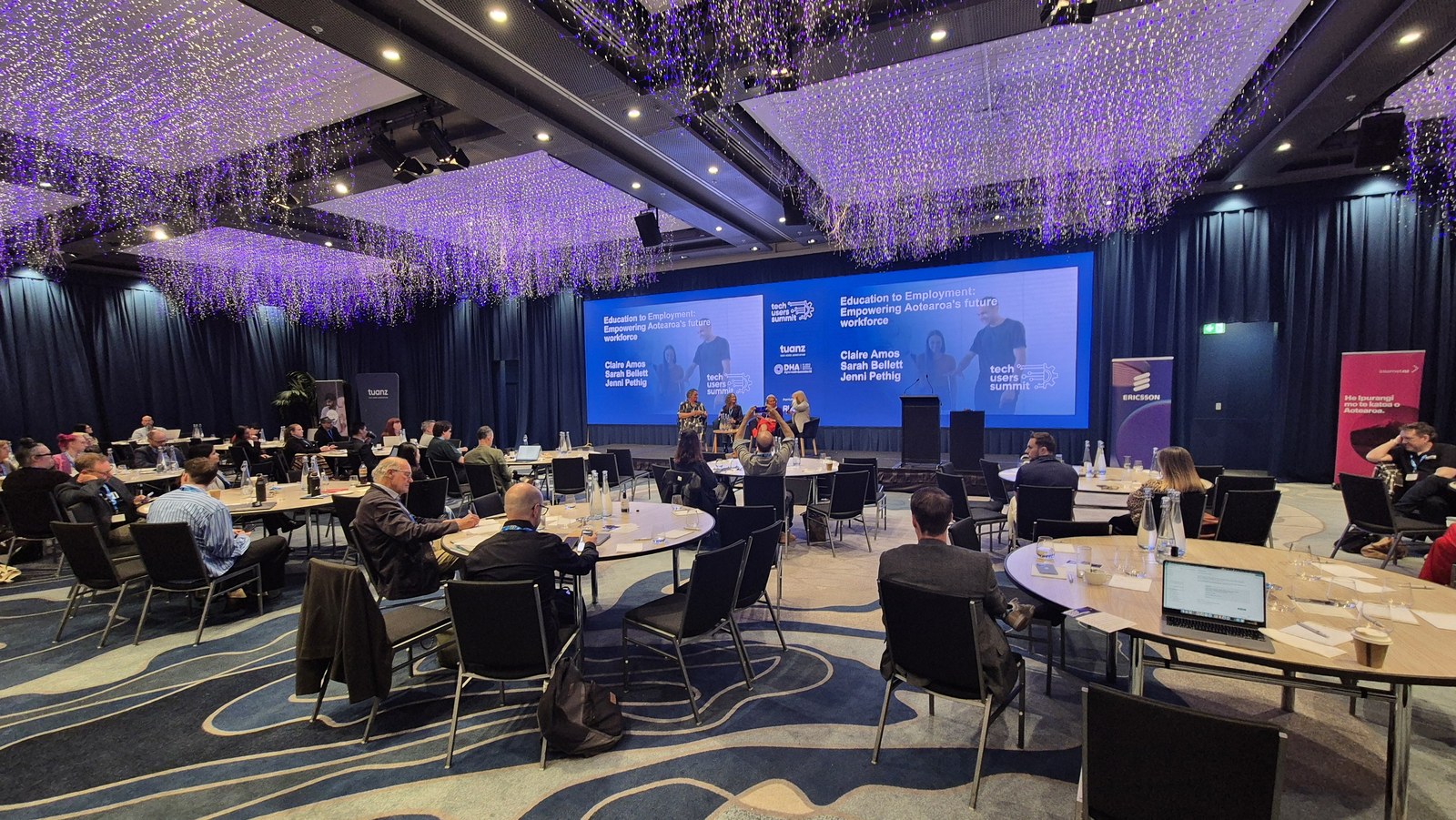
On what education wants from employers, Pethig explained the mechanism that already exists: industry representatives help develop the qualifications and standards, so employer input on skills, qualities, behaviours and attributes gets built in directly. The system is moving faster than it used to, which is part of why the new subject matters.
Amos answered with a story. Years ago she took a group of students to GridAKL for a day to meet startups. One of those students met a company that day, and now, many years later, works there, via a conversation that turned into work experience.
Her second idea was for organisations that feel they cannot host interns: externships. She described a movement she first saw out of Singapore, where companies including large technology firms offered real problems of practice to groups of school students to work on in their own classrooms. Give them a genuine problem, especially if any part of your business touches young people, because they are potentially your customers.
Her practical ask was smaller than any of that. Teachers across all subjects are looking for authentic contexts and experiences for their students. Answer the email when one of them gets in touch.
Amos also voiced a worry about Pethig’s subject, generously but clearly. However well designed, a standalone subject risks staying standalone, when the real value comes from integrating this thinking across subjects. The more the sector can challenge mandated, siloed curriculum design, the more space schools have to work flexibly with business and industry.
On how AI is changing leadership, Bellett described a shift away from technical problem-solving. Leadership at One NZ has historically been built on strong technical skills and solving hard technical problems. What they now ask of leaders is adaptiveness: sense-making, and leading in perpetual change rather than through a change with an end date. They are working on leadership as a mindset rather than as a form of expertise, which requires mentoring, nurturing, creating context and handing people problems to solve.
Then she said something that cuts against the way most organisations talk about AI adoption.
"We want those people coming into our organisation who are pushing back a little bit on AI, because we want them questioning the ethics of what we're doing."
One NZ was an early adopter, she said, and has since come round the cycle to something more moderated. The symptom she wanted to avoid is familiar to anyone who has sat through a few meetings lately: every presentation looking the same because it was produced by AI, presented by someone who cannot answer questions on it because they never interrogated it.
On whether this only helps teenagers, Pethig confirmed the work is designed for a wider age group, with pathways for people already in employment through upskilling and reskilling alongside what comes through schools.
On wellbeing, Amos zoomed out. Young people are in a wellbeing crisis with rising anxiety, part of which is the existential weight of AI and climate change. Balance matters: upskill them to be digitally literate and to engage with AI critically, and spend equal effort on empathy, human-centredness and face-to-face capability. Her observation that teenagers are frightened of making a phone call or having a conversation in a shop landed with every parent in the room.
Her conclusion was that communication and connection will be the differentiating skill, not the technical one.
Bellett agreed from the employer side, with a specific example. One NZ has 54 retail stores and an onshore contact centre. As AI takes the friction out of transactional interactions, those roles increasingly require relationship building and genuine troubleshooting. She expects them to become more valued than they are today, which makes entry-level retail a more interesting place to start a career rather than a less interesting one.
On what the room should do, the answers were unusually actionable.
Amos: speak up. There are parties making bold claims about education right now, and this sector has standing to ask what their digital and AI plans really are, and to bring industry knowledge about the skills and competencies young people need. Mandated, locked-down, boring learning does not produce the people industry says it wants.
Bellett: take the conversation out of the room, work out what it means in your own organisation, and get on a school board.
Pethig: engage with the subject design while it is still open, and think hard about internships and apprenticeships, including workplace apprenticeships, which she thinks the sector overlooks.
The moderator closed on Bellett’s phrase, and it is the right one to carry out of the room. Talent is critical infrastructure. It needs a longer-term view than three years at a time.