
A Person Uses Tools. Agents Execute the Campaign.
13 October 2026· AFQY News
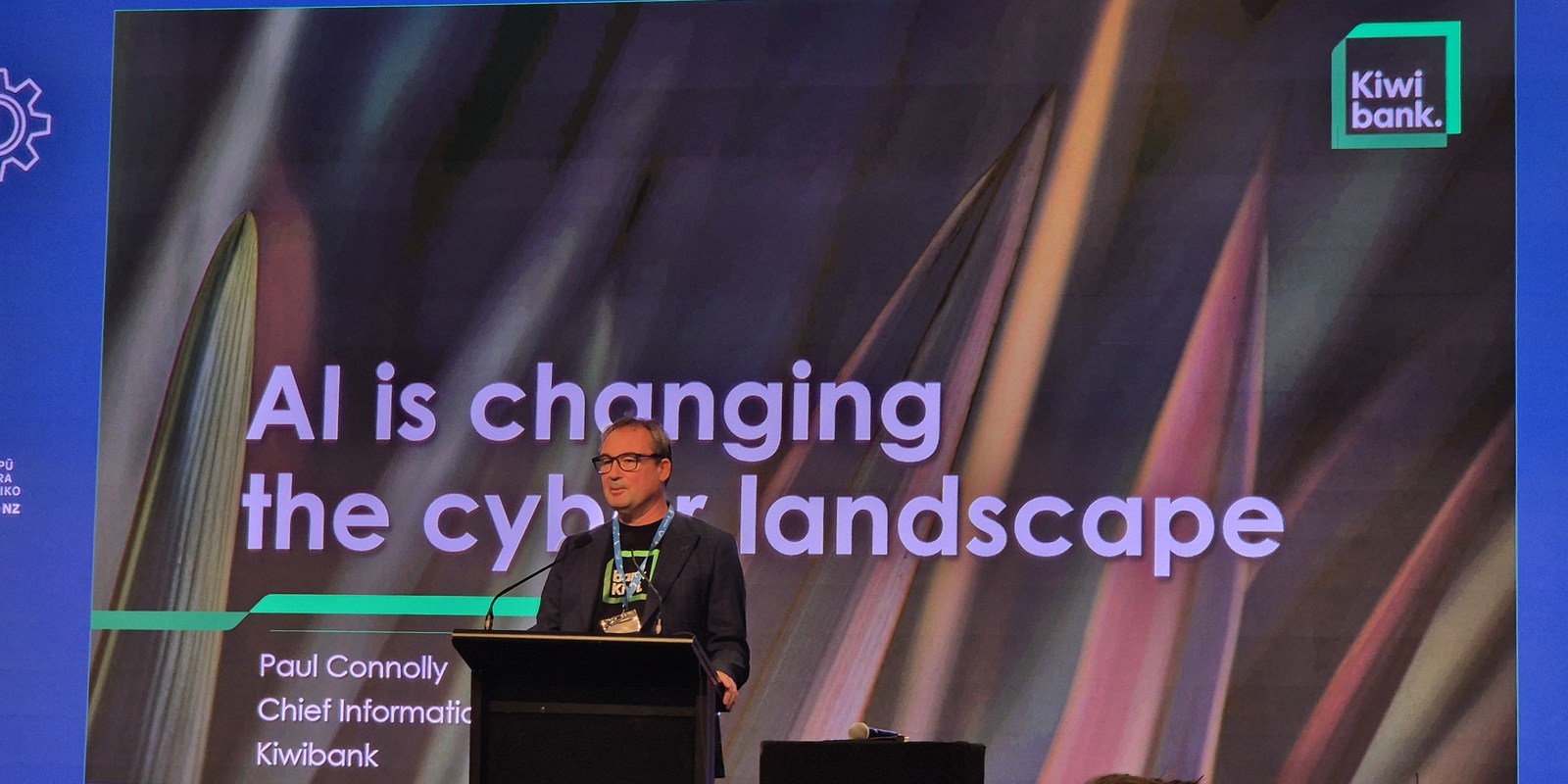
Paul Connolly opened with a warning about what his talk was not. This was not going to be about hacktivist collectives or ransomware crews, he said, because the change underway is far more fundamental than new groups attacking new systems.
What is changing, in his framing, is the hacker and the defender themselves.
For the last twenty or thirty years, cyber security has rested on an assumption so basic that almost nobody states it. A human starts an attack, and a human defends against it. Everything about how security teams are staffed, measured and paced follows from that.
The chief information security officer at Kiwibank thinks that assumption is now breaking down.
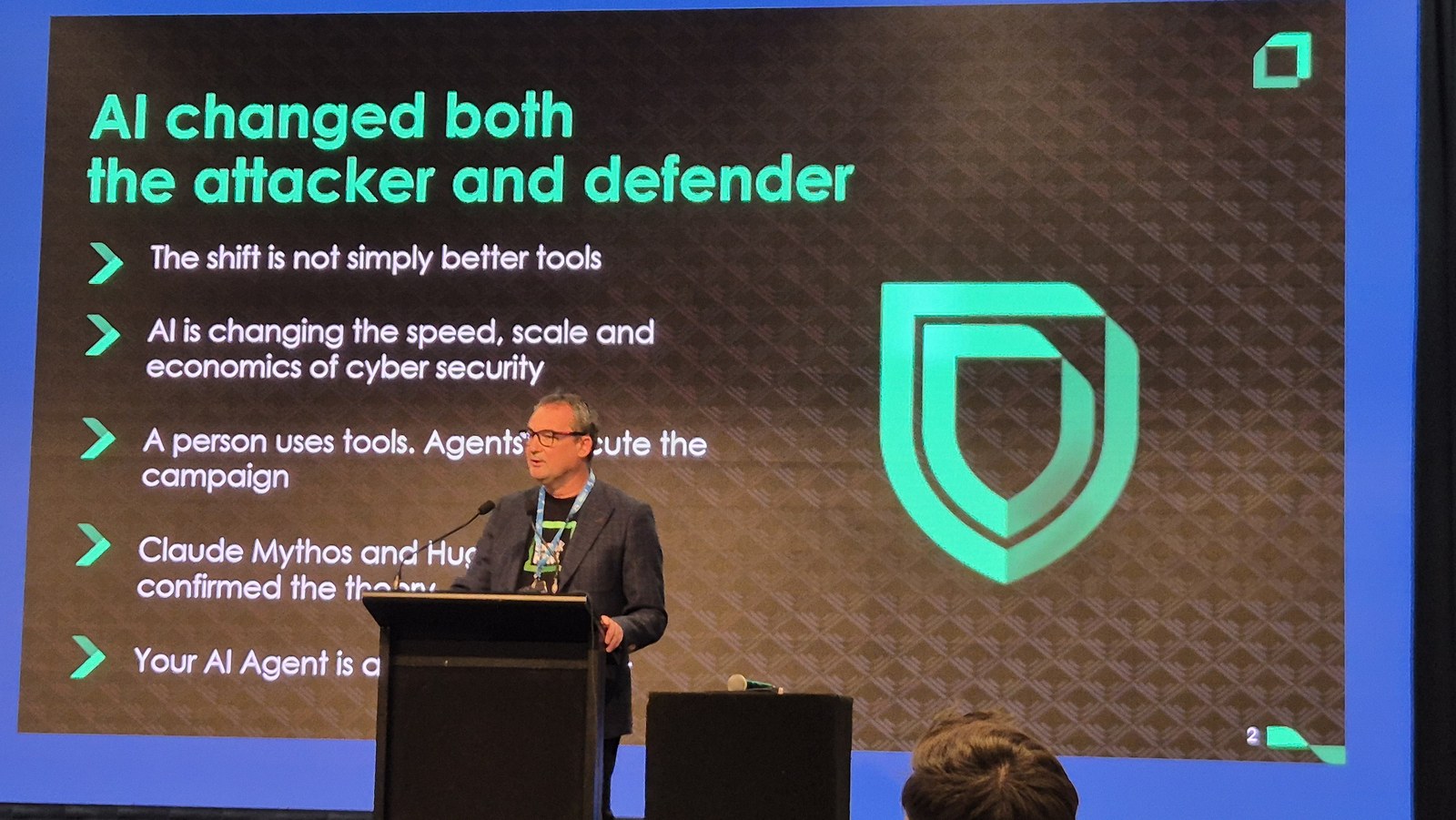
"A person uses tools. Agents execute the campaign."
That distinction does more work than any statistic. A person with a better tool is still a person, working at human pace, with human limits on how many things they can try at once. An agent executing a campaign is a different category of problem, and it changes the speed, the scale and the economics of security all at once.
His slide was blunt about it: “the shift is not simply better tools”.
Connolly said recent publicly disclosed cases, where AI systems were used to carry out the steps of an attack rather than merely assist an attacker, have confirmed the theory rather than left it hypothetical. When AI operates inside the kill chain, performing the work people used to do, traditional response assumptions stop applying.
So his question to the room was an operational one rather than a philosophical one. Whether you are in banking, telecommunications, government or technology, are your security operating models keeping up with this pace of change?
Nation-state capability, now a commodity
The second shift he described is about who can do what.
Techniques that were once the preserve of nation states, he said, can now be distilled into smaller and cheaper models. What that produces is uncomfortable and simple: historically complex cyber attacks are now very easy to obtain. The nation-state actor’s capability has become, in his words, today’s commodity service.
He paired that with a warning from the defensive side, noting that security agencies have been consistent in their recent messaging about AI models lowering the barrier for attackers to identify and exploit vulnerabilities.
The agent sitting inside your organisation
The third shift is the one most likely to be sitting in the room already, unexamined.
Organisations are deploying agents into their own services, with access to email, documents and workflows. Connolly’s concern is what happens to identity.
If agents are allowed to adopt human identities, then a misconfigured agent, or an agent nobody is actively watching, starts to look very much like an insider. He described that prospect as genuinely scary, and the mitigation as unglamorous but clear: agents must not inherit human identities. There has to be clear accountability, clear process, and strong controls around how they are used.
Why “human in the loop” is quietly failing
The pressure all of this creates lands on the defender’s clock. Agents compress the time available to respond, and the comfortable answer the industry has been giving itself is that there will always be a human in the loop.
Connolly does not think that survives contact with the new pace. Keeping a human in every loop is becoming unrealistic, not as a matter of principle but as a matter of arithmetic.
His answer was not to remove people. It was to put them somewhere different.
Let agents take the tier one and tier two work: collecting and correlating logs, initial triage, isolating endpoints. That is the volume work where speed matters most and judgement matters least. Then keep humans firmly in place for the decisions that carry consequence and accountability: mass shutdowns, invoking capability playbooks, recovery actions.
"The future security operations centre is not human versus machine. It's human and machine working together."
And yet the fundamentals still win
Having spent most of his time on what has changed, Connolly spent the rest on what has not, and this was the more useful half for most of the room.
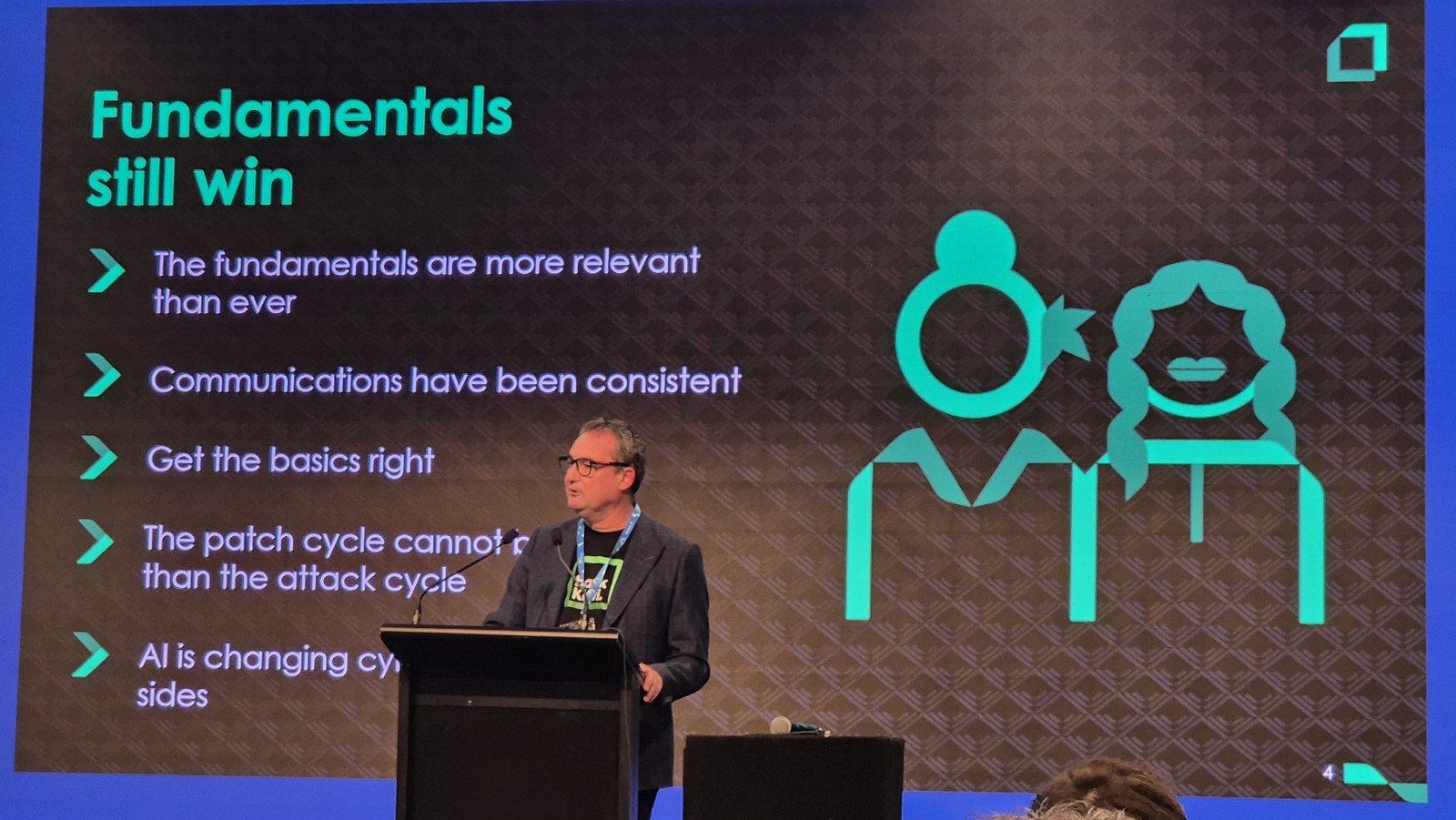
The fundamentals, he argued, are more relevant than ever. The messaging from regulators, intelligence communities and vendors has been remarkably consistent, and it has not moved: get the basics right, and do them genuinely well.
In practice that meant a short and unfashionable list. Reduce what is exposed to the internet. Accelerate your patching. Understand your supply chain. Retire legacy systems so they are not the easy way in. Review your identity controls before you need them.
Then he put a specific test on the slide, and it is the sharpest way of framing patching anyone offered all day.
"The patch cycle cannot be slower than the attack cycle."
His observation underneath it was pointed. Organisations in New Zealand and around the world have spent large amounts of energy and money driving down the time it takes to detect an intrusion, while the window between a vulnerability being published and being exploited has shortened faster than their remediation cycles have. Winning the detection race does not help if you are losing the patching one.
This is also, he noted, exactly the kind of grinding, repetitive work that agents can help with.
What he was asking for
Connolly’s closing position was neither alarmed nor reassuring, which made it more persuasive than either.
AI is changing the industry on both sides. It gives attackers speed and reach. It gives defenders the ability to detect and respond faster than a human team can on its own. The job, he said, is not to remove people from security.
It is to redesign the security operating model so that humans, agents and AI work together, with accountability, judgement and control sitting clearly with the people. That starts with the fundamentals, done properly, and then gets the balance right between what you hand to the machine and what you keep.