
Gerard Florian's Keynote: Stop Trying to Out-Plan AI, Start Trying to Out-Adapt It
4 August 2026· AFQY News
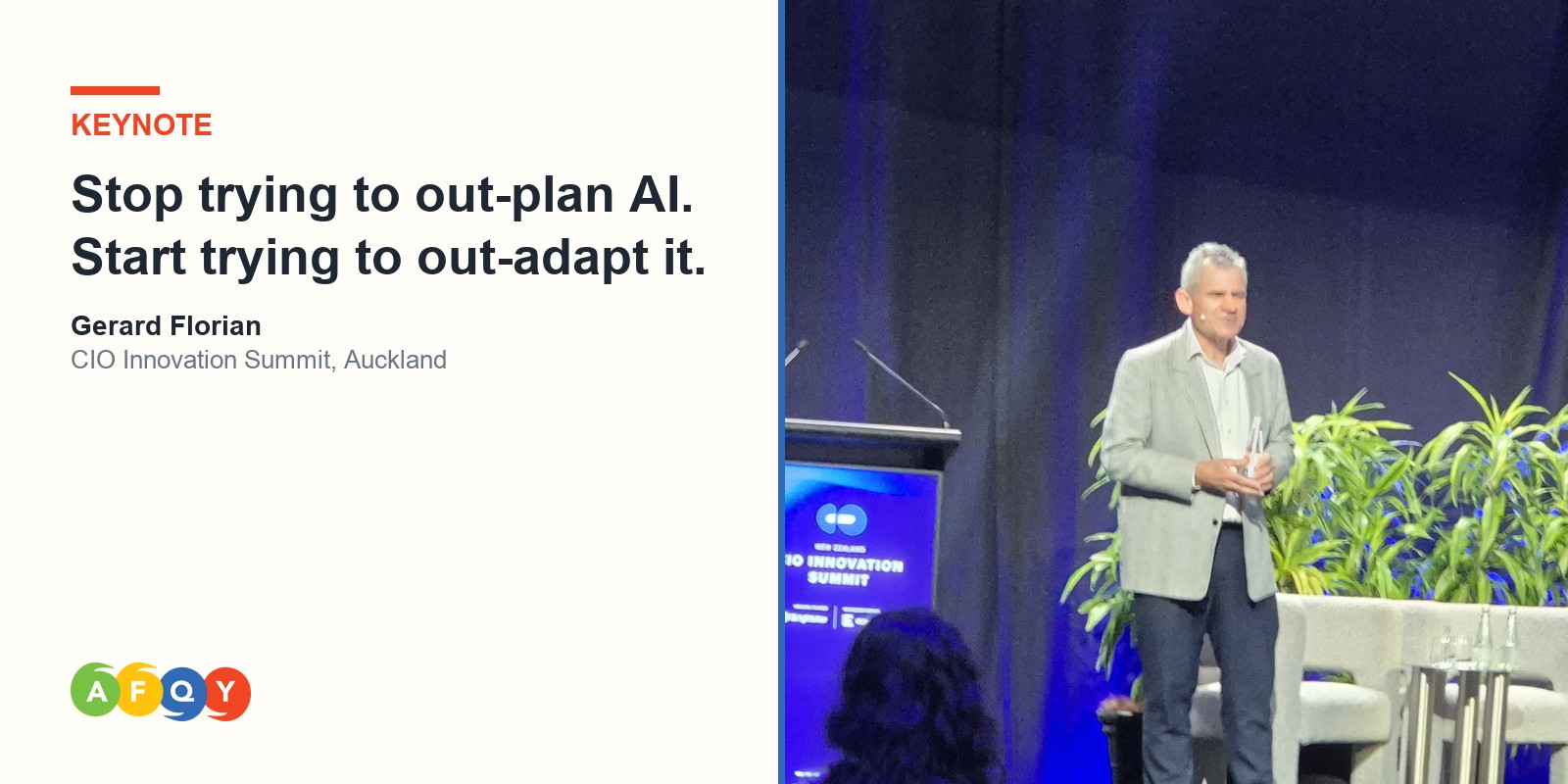
Gerard Florian retired as ANZ’s Group Executive for Technology and Business Services a year ago this week, closing out eight years running technology and, later, shared services for one of Australasia’s largest banks, on top of a 40-year career in the industry. Opening Day One of Auckland’s CIO Innovation Summit with a keynote titled “The Next Great Leadership Capability: Leading in the Exponential,” his argument was blunt: the strategic planning habit every large organisation has built over decades assumes a buffer that no longer exists. The actual question, he said, is how you lead through change you cannot out-plan.
Take cloud. Enterprises spent years telling themselves public cloud was fine for test and dev but not production, and had time to be wrong about it: time to build capability, bring the business along, bring regulators along. AI hasn’t given anyone that runway. Florian’s case is that this breaks two familiar playbooks. Over-plan, chase the perfect multi-year strategy, and the destination is obsolete before the plan is finished. Under-plan, wait for a tidier “version three,” and the gap compounds every quarter until it can’t be closed.
His alternative is a shift from planning to adapting: pace paired with genuine situational awareness, moving toward an opportunity even while it keeps moving. He drew a sharp line to COVID, when his own team ran ANZ’s shift of 40,000 people to remote work on daily stand-ups and no fixed plan, adjusting as the day’s facts changed. Tech teams everywhere pulled that off, but it ran on adrenaline, fine for a storm you survive and move past. AI, in his framing, behaves more like climate: permanent, not a season to wait out. That takes an operating system, not another sprint of goodwill.
The opportunity is real. Florian cited Microsoft’s productivity data placing New Zealand in the global top ten for AI use among the working-age population. But individual adoption is running well ahead of adoption in the processes that actually matter: McKinsey puts organisations embedding AI at scale in core workflows below 10%, and Florian pointed to a ServiceNow conference figure from the same week putting embedded agentic AI at roughly 8% of ANZ enterprises. Pressure from boards and competitors to visibly “do something” about that gap, he warned, tends to fragment organisations into disconnected pilots and shadow AI: motion that feels like momentum but is really just sprawl.
His answer is a three-part structure. A small, cross-functional leadership team, four or five people pulled fully off their day jobs with a genuine mandate to rethink processes rather than optimise them, sits at the centre; IT gets a strong voice without owning it outright. Around that team, a living “navigation system” replaces the static enterprise architecture document, read through business, data and technology lenses, on the premise that most AI value gets stuck in the handoffs between departments rather than in the models themselves. And instead of a fixed destination, a master plan treats AI adoption like a product: sorting opportunities by value and genuine readiness, since handing a contact centre to an agentic system carries a different risk than giving someone a drafting assistant.
Underneath all three, Florian argued for moving governance and capability-building out of their annual cycles and into the daily flow of work: continuous assurance in place of a yearly audit sign-off, learning built into people’s actual jobs rather than parked in a training day. He quoted Jack Welch’s line that an organisation’s ability to learn and act on it quickly is the ultimate competitive advantage, adding that most organisations still treat learning as a budget line to cut first.
Fielding questions afterward, Florian named curiosity as the clearest marker of leaders who navigate this well: asking what good actually looks like, and citing Box CEO Aaron Levie’s habit of sharing his own AI experiments publicly on LinkedIn as a model worth copying. On governance, he argued data-sharing contracts between teams should give way to treating data itself as a product: a small, centrally catalogued set rather than every team building its own spreadsheet. And on the gap between individual and enterprise use, he was direct: the real work isn’t getting people to ask a chatbot for help with an email, it’s closing the distance to an agentic loan approval or recruitment process actually running in production.
Sources
- CIO Innovation Summit New Zealand: agenda and speakers
- ANZ Newsroom: Gerard Florian to retire from ANZ
- iTnews: ANZ's group executive of technology Gerard Florian to retire
- iTnews: ANZ's tech chief Gerard Florian to take on expanded role
- Fast Company: Leaders from Box, Meta, and LinkedIn on how AI is reshaping the future of work