
AI Is Not a Technology Rollout: Sharesies and RUSH on the People Work That Makes Adoption Stick
10 August 2026· AFQY News
The uncomfortable part of enterprise AI is rarely the demonstration. A tool produces a useful answer, a prototype appears in hours, or a task suddenly takes minutes instead of days. The harder question comes next: what happens to the people whose work, confidence and professional identity were built around doing it the old way?
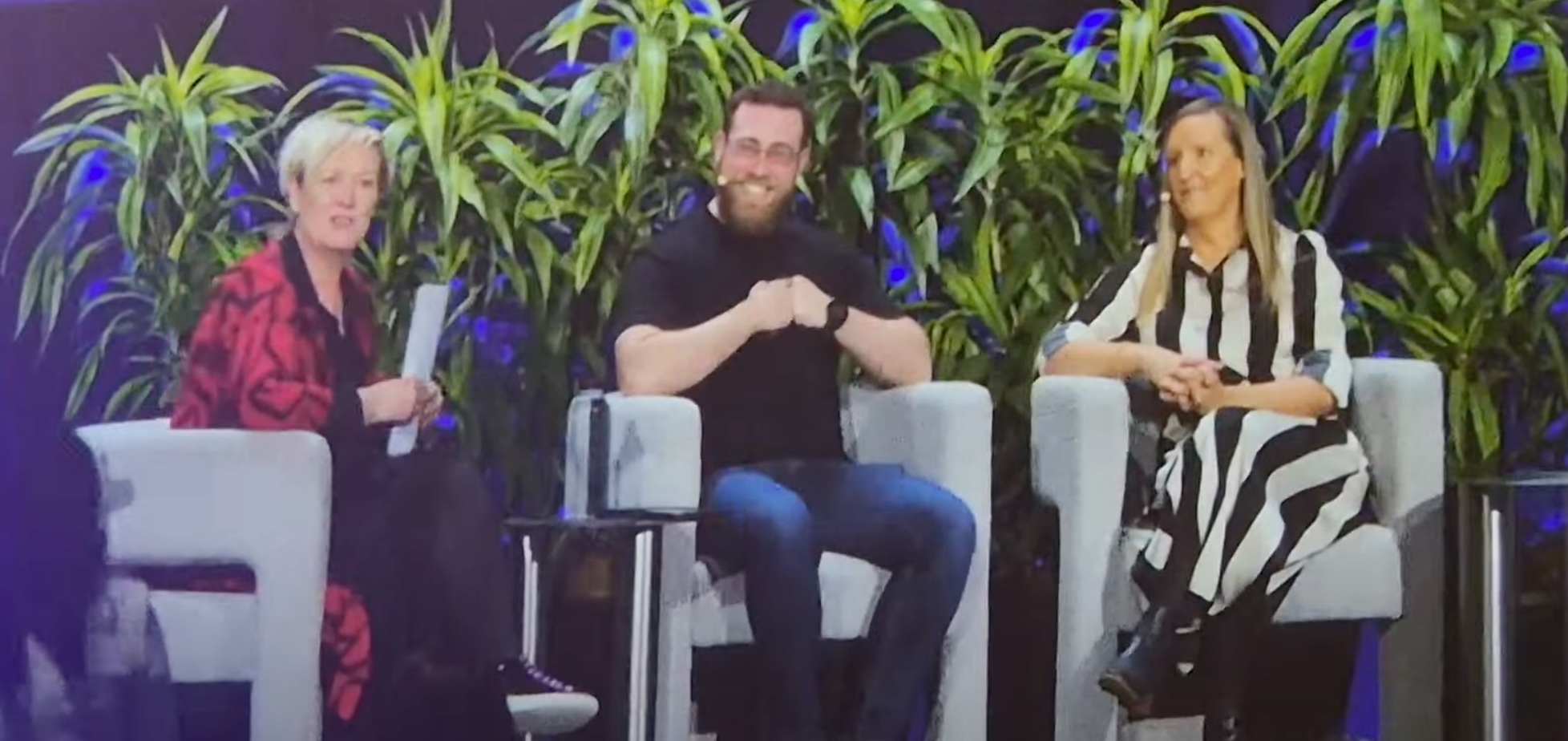
That was the real subject of Beyond the Technology: Why People Will Determine the Success of AI at the CIO Innovation Summit in Auckland. Best Places to Work™ CEO Julie Gill chaired the discussion with Vic Roper, Head of People & Capability at Sharesies, and Heather Polaschek, Head of People & Performance at RUSH.
The panel was not arguing that technology is unimportant. It was arguing that working technology is only the entry ticket. Organisational value arrives when people understand what is changing, trust how it is being managed, have enough capacity to learn, and can see a credible place for themselves in the work that follows.
That makes the partnership between the CIO and the chief people officer more than a useful alliance. It may become one of the defining operating relationships of the AI era.
TL;DR
- AI adoption is organisational change, not a technology deployment with training added at the end. CIOs and chief people officers need to co-own work design, workforce readiness, trust and value.
- New Zealand employees appear increasingly willing to innovate, but capacity is a serious constraint. Best Places to Work™ data shows 46% strongly agreed they were encouraged to explore better ways of working in 2025, up from 26% in 2024, while 70% said their workload was not manageable.
- The investment balance remains heavily tilted towards tools. Deloitte says 93% of AI investment globally goes to technology and 7% to people, even though organisations that design human and AI work well are almost 2.5 times more likely to report better financial results.
- Sharesies began with AI tools and use cases, then found that recurring questions about ethics, job security and changing roles demanded a much deeper cultural response.
- RUSH treated AI as a people transformation from the start, using intensive learning, visible experiments, regular show-and-tells, feedback loops and guardrails to turn uncertainty into participation.
- The next challenge is role design. Leaders must protect human judgement, critical thinking, emotional intelligence and early-career pathways while deciding how capacity created by AI will be reinvested.
The defining partnership is no longer optional
Gill opened with a proposition designed for a room full of technology leaders: the relationship between CIOs and chief people officers will be one of the most important executive partnerships of the next decade.
Technology strategy and people strategy have often travelled on separate tracks. One team selected systems, built platforms and managed risk. Another handled capability, culture, role design and change. AI makes that separation increasingly artificial because it sits directly inside the work itself. It changes how decisions are made, which tasks matter, what expertise looks like and how employees judge their future with the organisation.
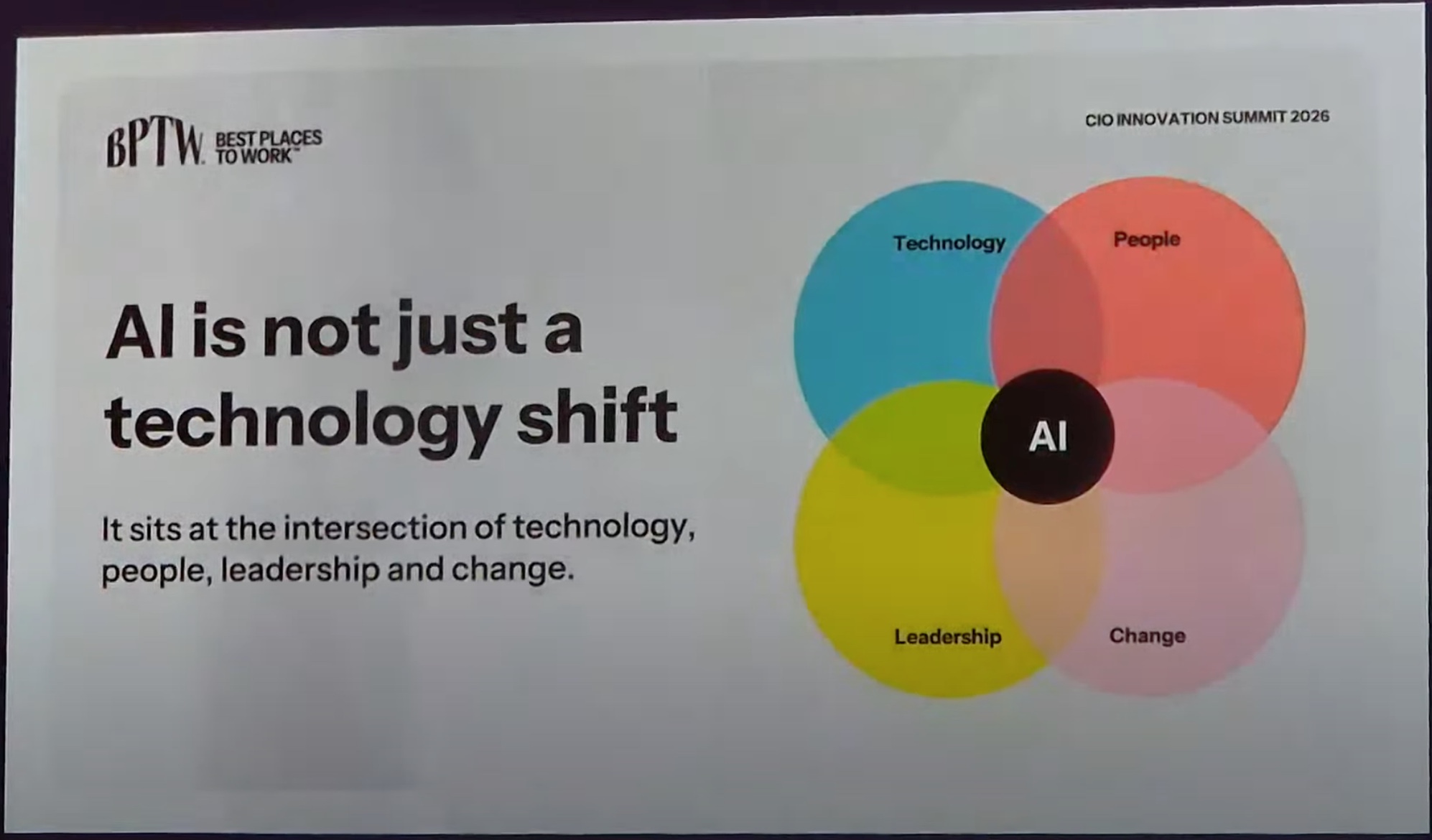
"The challenge isn't simply: how do we adopt AI? It's how do we build a best place to work in the age of AI."
For CIOs, that shifts the success test. Model performance, security, integration and cost still matter, but none of them proves that the organisation has changed how work happens. Adoption is not the number of licences issued or prompts submitted. It is whether people use the capability safely, repeatedly and with enough confidence to improve real outcomes.
The implication is practical. The CIO cannot hand the people work to HR after the platform decision. The chief people officer cannot treat AI as a technical programme happening somewhere else. Workflows, roles, learning, governance, workload and value measurement have to be designed together.
People want to innovate, but they are already carrying too much
Gill grounded the conversation in a tension visible across New Zealand workplaces. People are increasingly encouraged to try new ways of working, yet many do not have the capacity to absorb another transformation.
The 2025 Best Places to Work™ Employee Experience Survey insights, developed with Ecosystm from aggregated survey responses across New Zealand organisations, show the share of employees who strongly agreed they were encouraged to explore better ways of working rose from 26% in 2024 to 46% in 2025.
That is encouraging, but it sits beside a far harsher number. The same report says 70% of employees felt their workload was not manageable.
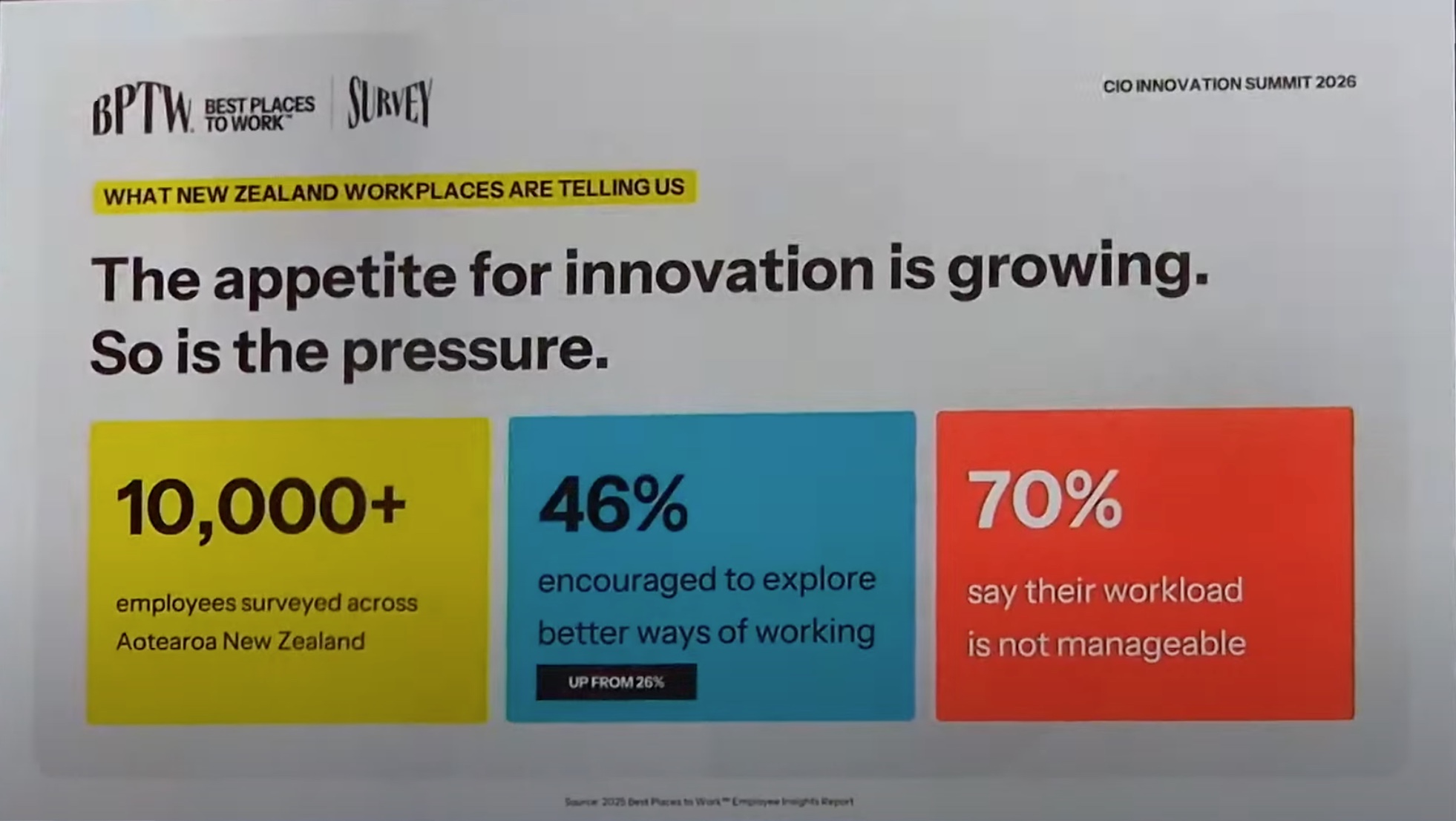
That combination matters. Curiosity is not the same as capacity. A workforce may be open to AI and still lack the time, energy, training or psychological space to experiment well. If leaders simply place new tools on top of existing workloads, the promised productivity gain can begin as one more demand on already stretched teams.
The data also complicates a common assumption that resistance is the central problem. The constraint may not be unwillingness. It may be that people are being asked to learn new tools, question established processes, protect customers, maintain delivery and imagine a different job at the same time.
For CIOs deciding how fast to scale, workload is therefore part of AI readiness. So are management capability, confidence, training and clarity about what will stop when new work begins.
The 93-to-7 investment problem
The panel’s people-first argument was reinforced by Deloitte’s 2026 Global Human Capital Trends findings. Deloitte says 93% of AI investment globally is focused on technology and only 7% on people. It also reports that just 7% of organisations believe they are good at designing how people and AI work together.
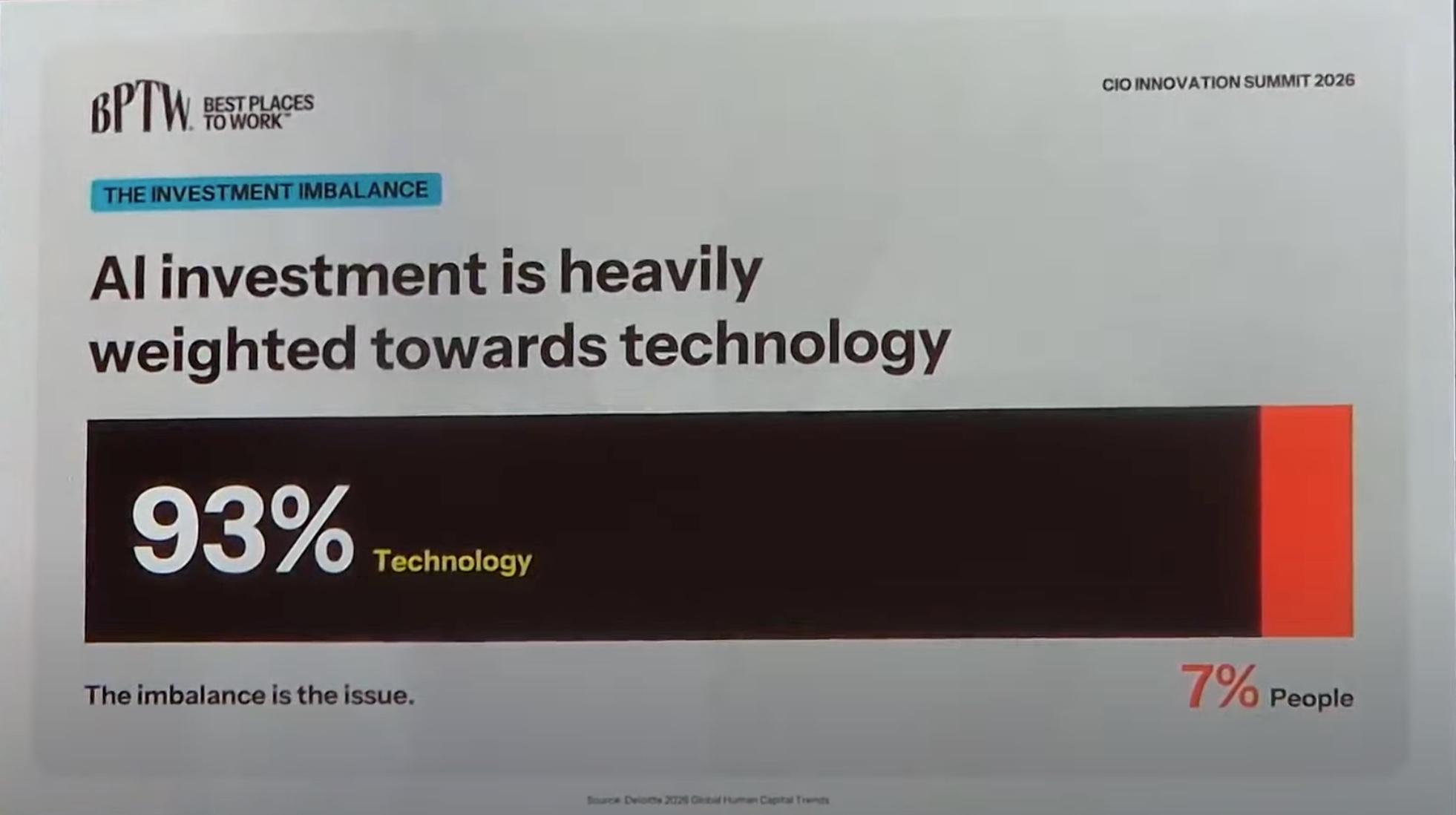
The commercial consequence is significant. According to Deloitte, organisations that do design that relationship well are almost 2.5 times more likely to report better financial results. Its New Zealand data, drawn from more than 60 local respondents, found only 2% believed their organisations were leading in this area.
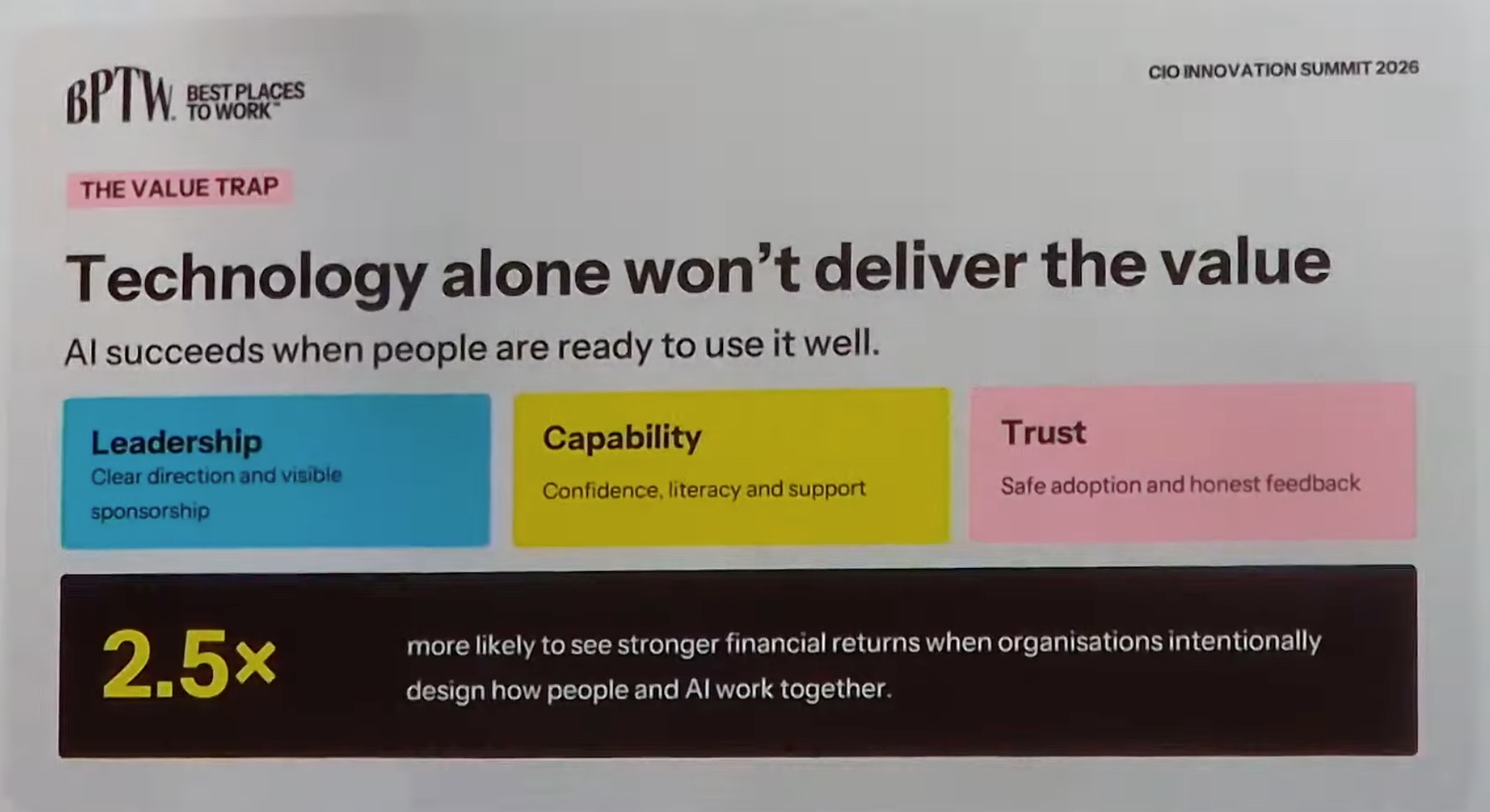
These are vendor-reported research findings, not a universal law, but they expose the imbalance the panel could see in practice. AI budgets can fund platforms, models, cloud capacity and governance while underfunding the work needed to change roles, build management confidence and help people use the technology responsibly.
Gill’s point was that the technology may work perfectly and still fail to create organisational value. If leaders, managers and employees are not aligned, supported and ready, the investment stalls between technical capability and everyday use.
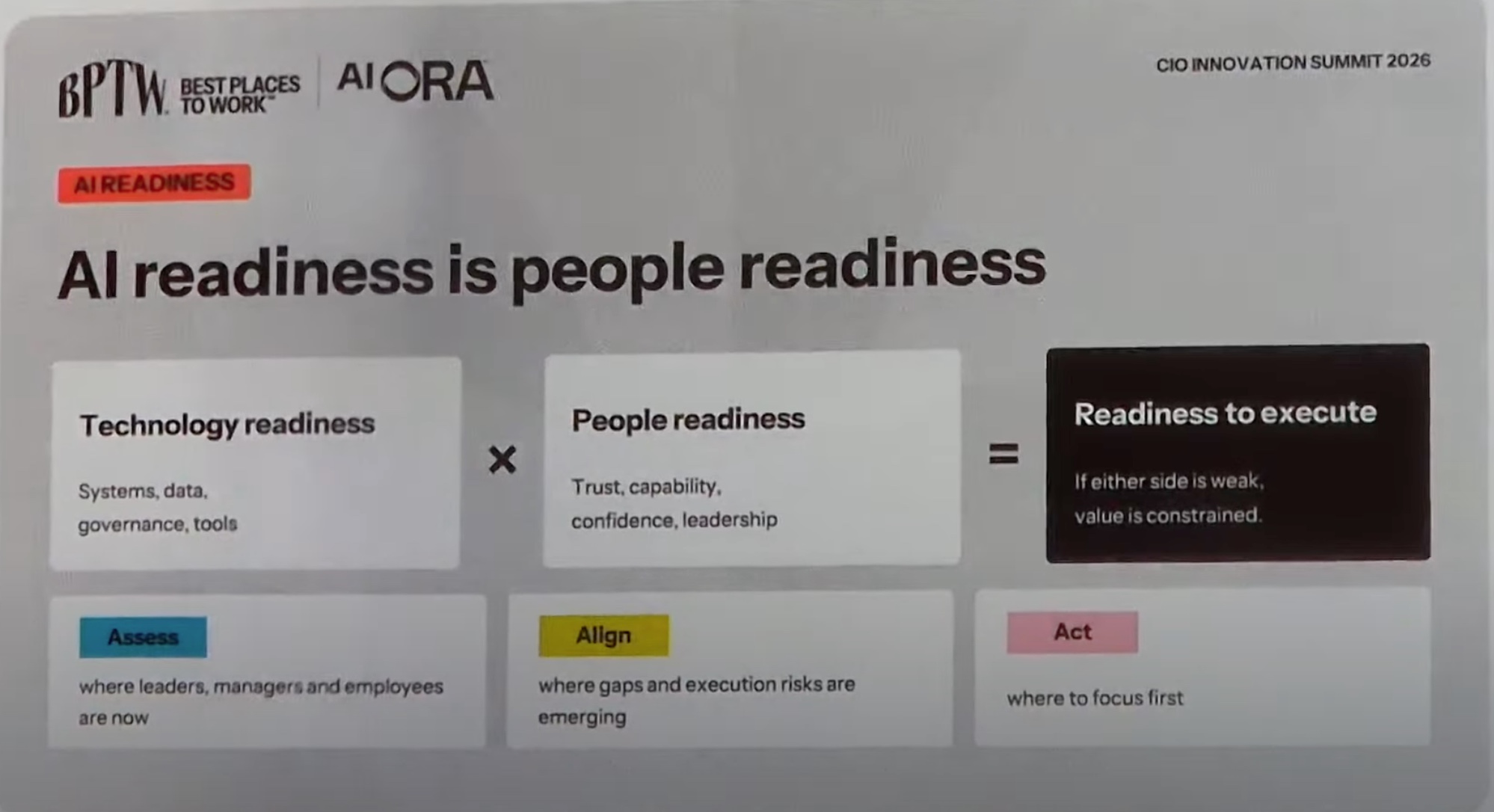
That gap is where the Sharesies and RUSH stories became useful. Both organisations had moved early. They did not take exactly the same route.
Sharesies: the people questions arrived after the tools
Roper said Sharesies began experimenting with AI across business workflows several years ago. It is a fast-moving organisation with a constant pressure to deliver more quickly, and the available tools offered obvious ways to increase capacity.
The first emphasis was technical. The deeper cultural shift came later than Roper would personally have preferred.
"AI was never not a people thing from our perspective."
The signal was not a failure in the tools. It was the pattern in the questions employees kept asking. What would happen to their jobs? Would they still have the same role? How should they think about ethics and security? What would AI change about the way they worked?
Those were not one-off concerns that could be closed with a launch presentation. They kept appearing in opportunities for staff to ask questions. Roper said the repetition made it clear that the organisation needed to respond at a cultural level, not simply explain product features or issue usage guidance.
That distinction matters for any CIO monitoring adoption. Repeated questions are data. If the same uncertainty keeps returning, more communication may be needed, but the underlying issue may also be unresolved role design, unclear decision rights or a lack of credible commitments about how change will be handled.
Sharesies’ response has been to make AI an ongoing conversation. Roper’s view was simple: familiarity lowers fear. Leaders need to keep discussing what is known, what is still uncertain and how the organisation will involve people as the work changes.
"The more you talk about something, the less scary it becomes."
That does not mean promising that every job will remain unchanged. It means refusing to let silence do the communicating. When leaders leave an information gap, people fill it from headlines, rumours and the most alarming interpretation available.
RUSH: start with excitement, then earn the trust to keep moving
RUSH saw the disruption early because technology is its business. Polaschek said the company could see what AI was beginning to do to engineering work, but it quickly became clear that the impact would extend across product, design, people and culture, finance and other functions.
The organisation began its focused AI transformation in mid-2024. Polaschek described an intensive opening phase that created a baseline across the company, communicated what was changing and showed people what could become possible.
The initial response included plenty of experimentation. At times, enthusiasm ran ahead of structure, and the organisation later strengthened its guardrails. That sequence is important. Safe adoption did not require extinguishing curiosity. It required making learning visible, then adding the controls needed to support it.
RUSH used lunch-and-learns, show-and-tells, hackathons and regular conversations with its people leaders. Its published account of the programme adds detail: an AI Champions Network, tailored learning for different teams, transparent roadmaps, internal discussion channels and short cross-functional micro-hackathons that produced working tools within hours.
Engineering and quality assurance explored AI-assisted development. Designers tested AI-supported prototyping. People and Culture used AI to synthesise feedback and support performance processes. Finance explored forecasting and validation. The programme made the technology relevant to the work each group actually performed.
Polaschek said RUSH had to be highly transparent with its people. The company already had a weekly town hall, so it used an existing communication rhythm rather than creating a temporary AI campaign. Security had become a recurring focus, reflecting the new vulnerabilities and questions arriving with wider use. Feedback loops and engagement checks helped leaders understand how sentiment was changing over time.
That last point is easy to underestimate. An employee who was excited two months ago may feel differently after seeing a tool perform part of their role. Readiness is not a score captured once before launch. It is a condition that shifts as capability, experience and external narratives change.
Trust is not reassurance; it is a system
Both organisations returned to transparency, but not as a synonym for relentless optimism. The panel’s version of trust involved explaining the difficult parts as well as the exciting ones, creating safe ways to ask questions, and showing that feedback changed the organisation’s response.
Polaschek reduced the principle to three words.
"Trust is familiarity."
Familiarity comes from repeated exposure, visible practice and accessible leadership. It is built when people see colleagues demonstrate a real use case, understand the guardrails, hear an honest answer to a hard question and know where to raise a concern.
For CIOs, those practices also function as operational controls. Regular show-and-tells expose how tools are actually being used. Open feedback can reveal shadow adoption, unsafe data handling or areas where policy has failed to match real work. Pulse surveys can show whether confidence is rising or whether anxiety is becoming concentrated in particular roles.
The alternative is to wait for certainty. The panel regarded that as unrealistic because employees are already experimenting. If the organisation does not provide safe pathways, people may use public tools without appropriate guardrails, enter information they should not, or build local practices that the business cannot see.
"We could sit back and wait, or we could disrupt ourselves."
The starting point, Polaschek suggested, is not another platform comparison. Ask people who is already using AI, what they are doing with it, what concerns they have and where they need guidance. That produces a more honest baseline for investment and governance.
AI can remove the easy work and leave people with an exhausting job
The panel also raised a less obvious wellbeing risk. A working day contains small tasks that are easy to complete. They create natural pauses and the minor satisfaction of finishing something. AI can remove those tasks first.
That may look efficient on a process map, but it can leave a person with a day made entirely of difficult judgement, complex communication and unresolved problems. If leaders treat every saved minute as capacity for more output, AI may concentrate work rather than lighten it.
The concern connects directly to the Best Places to Work™ workload finding. An organisation cannot assume that automation creates sustainable capacity merely because individual tasks take less time. Leaders need to measure what fills the space, whether cognitive intensity rises and whether teams still have recovery built into their work.
Professional identity adds another layer. People may have studied for years, built judgement through experience and earned trust from colleagues or customers. Watching a machine produce a recognisable version of that work in minutes can feel like a challenge to competence and value, even when the output still requires expert review.
Research discussed by Harvard Business Review frames the response around three psychological needs: competence, autonomy and relatedness. When AI supports those needs, workers are more likely to experience it as a useful collaborator. When it undermines them, the technology can feel personally threatening.
That helps explain why generic reassurance often fails. Employees are not only asking whether a job will disappear. They may be asking whether their expertise still matters, whether they retain control over their work and whether the organisation still sees a future for them.
Role design has to catch up with tool capability
Both panelists expected roles to change. Polaschek described boundaries already beginning to move between product and design, and from highly specialised engineering towards broader combinations of capability. Her own role spans people and culture alongside managed services, an example of executive responsibilities blending as technology and workforce questions converge.
Roper focused on what people can contribute when AI takes more routine or administrative work. The opportunity is not simply to produce the same output faster. It is to redirect people towards work that requires context, curiosity, judgement, leadership and connection.
The panel repeatedly returned to capabilities that remain fundamentally human: critical thinking, decision-making, emotional intelligence, leadership and a willingness to keep learning. Those skills are not soft decoration around AI. They are part of the control system that determines whether an output is sensible, fair, useful and worth acting on.
Gartner’s guidance on building a human-AI workforce makes a similar recommendation. It argues that CIOs should work with HR and finance to decide how capacity created by AI will be measured, governed and reinvested, rather than allowing it to disappear into more tasks. It also calls for continuous role and workflow redesign because the eventual division of work between humans and AI remains uncertain.
That is a larger programme than reskilling. Job descriptions, team structures, performance measures, career paths and recruitment practices may all need to change. An employee cannot be told to become more strategic while still carrying the same operational workload and being measured by the same output targets.
The early-career pipeline cannot be an afterthought
An audience question brought the discussion to graduates and young people entering the workforce. If AI handles more of the junior tasks through which people once learned a profession, organisations risk weakening their own future talent pipeline.
The panel did not claim to have solved that problem. It did make two points clear.
First, younger workers are not automatically disadvantaged. Interns and graduates can bring some of the best ideas because they approach AI with fewer inherited assumptions about how work must be done. Curiosity and the confidence to experiment may become important advantages.
Second, familiarity with AI is not a substitute for experience. New entrants still need opportunities to develop judgement, understand consequences, learn from experienced colleagues and take on progressively more complex responsibility. If organisations automate the work that once provided that pathway, they will need to design a new one deliberately.
This is another reason the CIO-CPO partnership matters. Workforce planning cannot wait until a role disappears. Technology roadmaps need to be connected to skills forecasts, apprenticeship models, internal mobility and the capabilities the organisation will need several years from now.
Two conversations before the next AI investment
Gill closed with two practical questions. What should every CIO do before investing in AI, and what conversation should they have with their chief people officer when they return to the office?
The panel’s first answer was to listen. Find out how people feel, who is already using AI and what they are doing with it. Ask what frightens them, where they see value and which recurring questions remain unanswered. That is not preliminary stakeholder management. It is evidence for the investment decision.
The second answer was to widen the strategy. Talk with the chief people officer about how the organisation will work, not simply which tools it will deploy. Examine role design, workforce capacity, leadership behaviour, learning, team structures, recruitment, wellbeing and the future of entry-level work.
The panel did not offer a fixed destination, because no one can describe with confidence what every role will look like in five years. It offered a repeatable operating practice: communicate before certainty, make experimentation visible, build feedback into the work, establish guardrails and redesign roles as capability changes.
AI adoption is not an installation. It is a continuing renegotiation of how work gets done, what people contribute and where accountability sits. CIOs may own much of the technology, but they cannot deliver that change alone.
Sources
- CIO Innovation Summit New Zealand: Beyond the Technology session and speakers
- Best Places to Work: 2025 Employee Experience Survey Insights Report
- Deloitte New Zealand: 2026 Global Human Capital Trends
- RUSH: How We Embedded AI Across RUSH
- Gartner: How CIOs Can Build the Human-AI Workforce
- Harvard Business Review: Why Gen AI Feels So Threatening to Workers