
From Tracks to Technology: Garry Collings on Modernising 3,800km of KiwiRail
10 August 2026· AFQY News
Garry Collings began with a practical warning: he has a habit of walking while he talks, and sometimes of falling off things. The stage had therefore barely survived the introduction before KiwiRail’s Executive GM Digital & ICT was checking which button was green, confirming that the slide on screen was in fact his, and getting down to business.
The humour suited a presentation grounded in physical reality. This was not digital transformation described from the safe distance of a strategy document. It involved live railway corridors, ageing infrastructure, tunnels with almost no room beside a train, weather-damaged terrain and people who still steal crossing signs, break barrier arms or believe they can outrun a locomotive.
At the CIO Innovation Summit’s “From Tracks to Technology” session, Collings showed how KiwiRail is using drones, LiDAR, digital twins, enterprise AI and private 5G to modernise that environment. The individual technologies were interesting. The more important pattern was how he connected them: start with a real operational risk, capture trusted information once, make it reusable, build the controls early and measure whether the result is valuable.
His central AI message was equally direct. Proving that a model can produce an answer is no longer the hard part. Building the organisational capability to deploy it safely, control the data, manage the cost and keep adapting is where the work now sits.
TL;DR
- KiwiRail’s digital challenge has national scale. Its latest published figures show 4,500 employees, 3,800km of track, around 16 million tonnes of freight a year, 24 million annual metro trips and 500,000 Cook Strait passenger trips.
- Drones began as a health and safety intervention. They let trained teams inspect damaged, inaccessible or high-risk parts of the rail corridor while producing consistent imagery, video and LiDAR data that can be reused.
- Reality capture becomes more valuable when it feeds a digital twin. The same data can support damage assessment, project delivery, asset evidence, maintenance planning and future comparisons instead of disappearing inside a one-off inspection.
- KiwiRail’s AI journey moved from imperfect experiments in 2020, including early work with Roy Cohen, through a Teams-based employee assistant and broader Copilot use, to formal enterprise AI foundations in February 2026.
- Collings’ operating model has four connected parts: people and adoption, trusted data and enterprise knowledge, an approved platform, and governance covering policy, security, ownership and risk.
- Connectivity and cost are now part of the architecture. KiwiRail has commissioned its first private 5G site, while Collings warned leaders to understand token consumption and consider smaller, controllable models where they fit the task.
A technology function serving three obligations
Collings started by explaining KiwiRail because, in his experience, suppliers often arrive without understanding the organisation they are trying to help.
KiwiRail is a state-owned enterprise with a history stretching back to the first rail laid in New Zealand in 1863. Collings described three priorities that can compete for attention: it must run a successful business, be a good employer and serve the wider interests of New Zealand.
It also operates across what rail calls “above rail” and “below rail”. Above rail covers the services moving freight and passengers. Below rail covers the infrastructure network, including the tracks, bridges, tunnels, signals and other assets that make those services possible.
That distinction matters to a CIO. Digital investment is not supporting a single office process. It has to work across a commercial logistics business and a nationally significant physical network, while satisfying public accountability, safety requirements and long investment horizons.
The latest KiwiRail half-year report, for the period ended 31 December 2025, describes the current scale:
- 4,500 employees
- 3,800km of track
- around 16 million tonnes of freight a year
- 1,100 mainline freight movements a week
- metro networks supporting 24 million commuter trips a year
- two ferries providing around 500,000 passenger trips a year across Cook Strait
- 2,691 signals, 1,305 public level crossings, 105 tunnels and 1,274 bridges
Collings used slightly different rounded figures on stage, including 4,800 people, 15 million tonnes of freight and 25 million metro trips. That reflects the way operating snapshots change. KiwiRail’s ferry fleet, for example, reduced from three ships to two in August 2025, and the latest published passenger measure is correspondingly lower than the figure on the presentation slide.
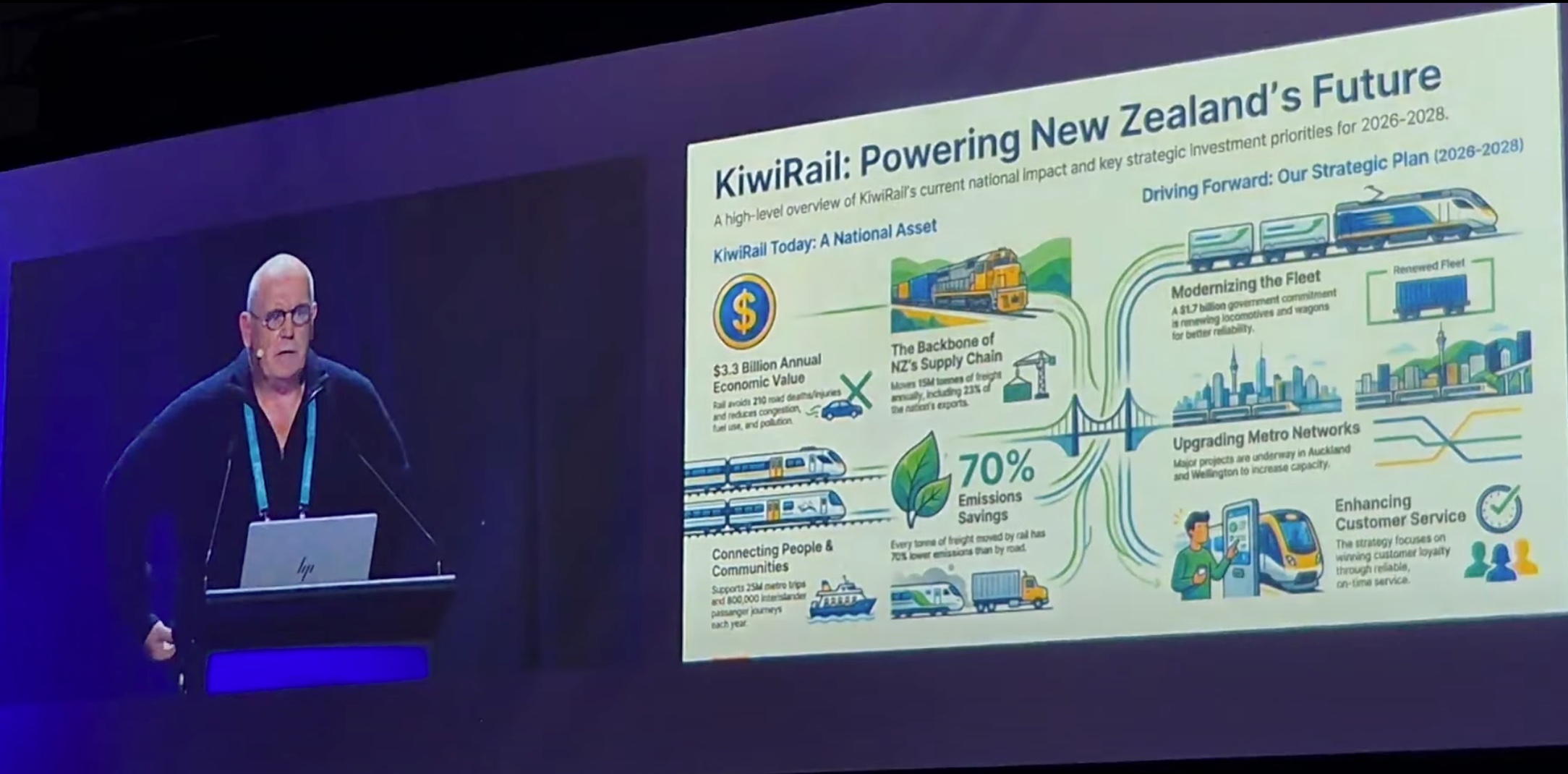
The economic case is broader than KiwiRail’s own revenue. Its current report cites an estimated $3.3 billion in annual value to New Zealand from rail, based on research commissioned by the Australasian Railway Association. It says rail removes around one million heavy-truck journeys from the roads each year and carries freight with an average emissions saving of about 60% compared with heavy vehicles.
The truck comparison depends on the train and route. KiwiRail’s FY25 report said one freight train could carry approximately as much as 54 trucks. Its latest half-year report uses a current range of 40 to 45. Either way, the point Collings wanted the room to see was tangible: every full train consolidates a large number of road movements, with consequences for congestion, road wear, safety and emissions.
The drone case starts with getting people out of danger
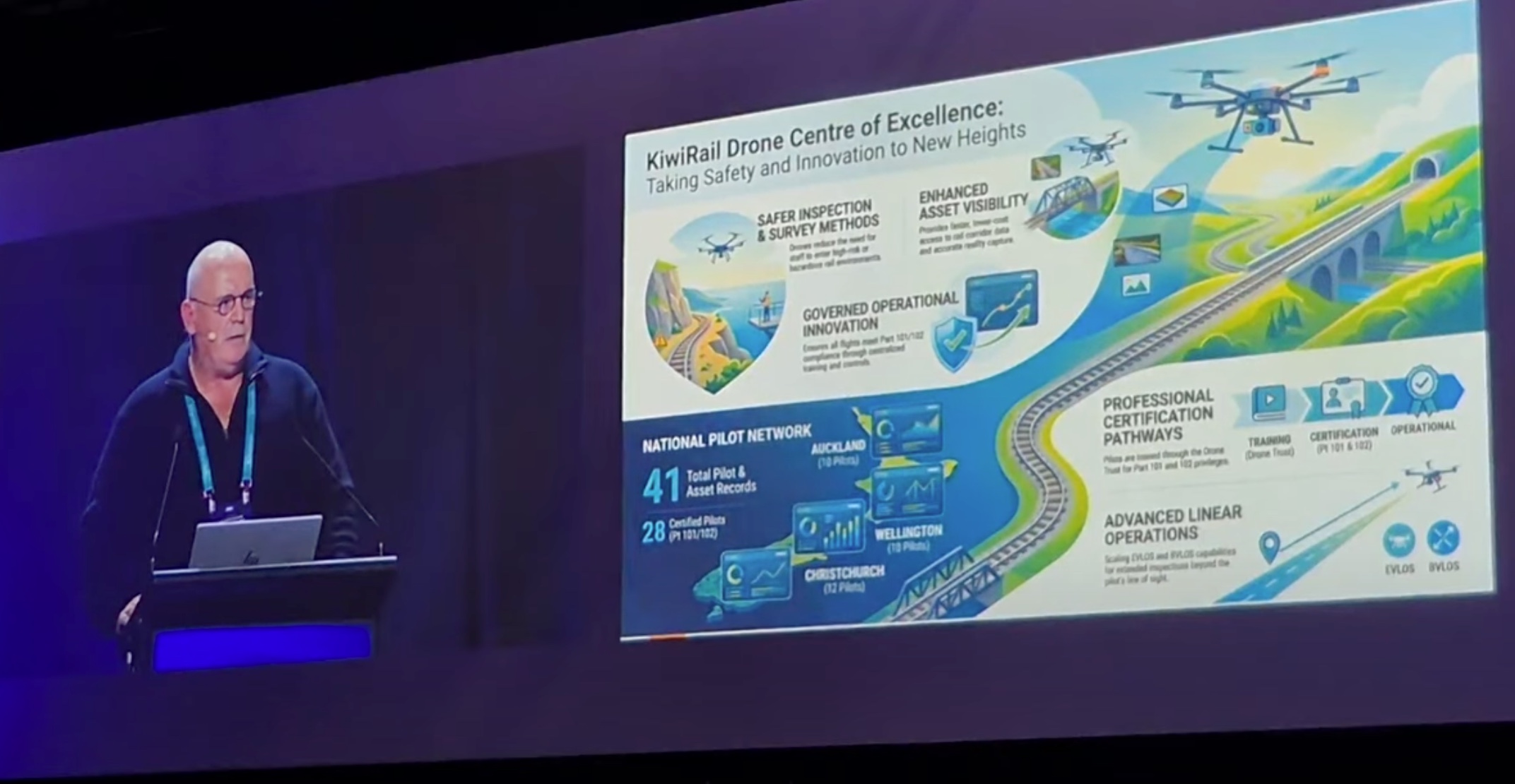
KiwiRail began developing its drone capability about three and a half years before the summit. Collings said the starting purpose was to create a safer, compliant and reusable way to inspect rail assets and reduce the need for people to enter hazardous or inaccessible environments.
That is particularly important after slips, storms and other events damage a corridor. Traditional inspection may require someone to climb across unstable ground or structures simply to understand what happened. A trained drone team can capture survey data, LiDAR, photographs or video before deciding what physical access is necessary.
The benefit is not merely that the first inspection is faster. A properly captured flight creates evidence that can be reviewed by multiple teams, compared over time and returned to during project or maintenance planning.
Collings described that as a major change in the physical experience of the work. A team can arrive at a site, deploy the aircraft and gather the information without first clambering over a structure and hoping everyone gets through the day safely.
The public evidence of the wider system is already visible. KiwiRail’s Network Visualisation platform centralises reality-capture data and makes approved datasets available to internal teams and suppliers. The organisation also publishes an operational requirement specifically for unmanned aerial vehicle activity over or near railway land.
That turns the drone from a flying camera into part of an asset-information system.
LiDAR makes the daily journey a source of evidence
LiDAR measures distance using pulses of light, producing a detailed three-dimensional representation of the environment. Collings said the capability had advanced far enough for KiwiRail to test LiDAR cameras on locomotives.
That opens a different operating model. Instead of sending a team to capture one nominated site, a locomotive travelling its normal route can observe parts of the corridor repeatedly. It can help identify changes, damage or interference with railway assets and contribute to a progressively richer model of the network.
Collings mixed the serious point with examples that showed why continuous observation matters. People steal railway signs. Barrier arms are damaged. Members of the public enter tunnels. Some still assume they can beat a train.
His warning about a Class One tunnel was blunt. Many were built when clearance expectations were very different, leaving little room beside a train. Entering one and expecting to run out first is not a contest a person can safely choose.
The value of LiDAR and repeat imagery is therefore not confined to engineering. It can support asset condition, safety evidence, incident review, project progress and maintenance priorities. When the information is centrally governed and geospatially referenced, it also builds the foundations of a digital twin.
A digital twin is a record of change, not a decorative model
Digital twins are often demonstrated as polished three-dimensional models. Collings’ account was more practical. For a network measured in thousands of kilometres, the value lies in creating an accessible representation of real assets and then keeping it useful with repeatable data.
The drone programme gives KiwiRail a way to capture that information under a common operating model. It can survey a site, record the state of an asset, preserve the evidence and return later to see what changed. The same dataset can support multiple decisions instead of every team commissioning another view of the same place.
That reuse is where the economics improve. A flight justified initially as a safety measure can also support engineering, delivery assurance, maintenance planning and supplier collaboration. The data becomes an enterprise asset rather than the by-product of an inspection.
The lesson for other CIOs is not that every organisation needs drones. It is that digital capture should be designed for reuse from the beginning. If the operating process, metadata, ownership and access model are missing, the organisation may simply create a new collection of isolated files.
Aviation governance is part of the product
Collings said KiwiRail had trained 25 pilots to operate within its Part 101 environment and three for work under Part 102 arrangements. Those numbers were presented as the organisation’s position at the summit and have not been independently published.
The regulatory distinction is important. Under Civil Aviation Authority guidance, Part 101 is the rule set covering most non-certificated unmanned-aircraft operations. Part 102 is an operator certification that can permit activity outside the Part 101 rules where the operator demonstrates how it will manage the risks. A training qualification by itself is not a Part 102 certificate.
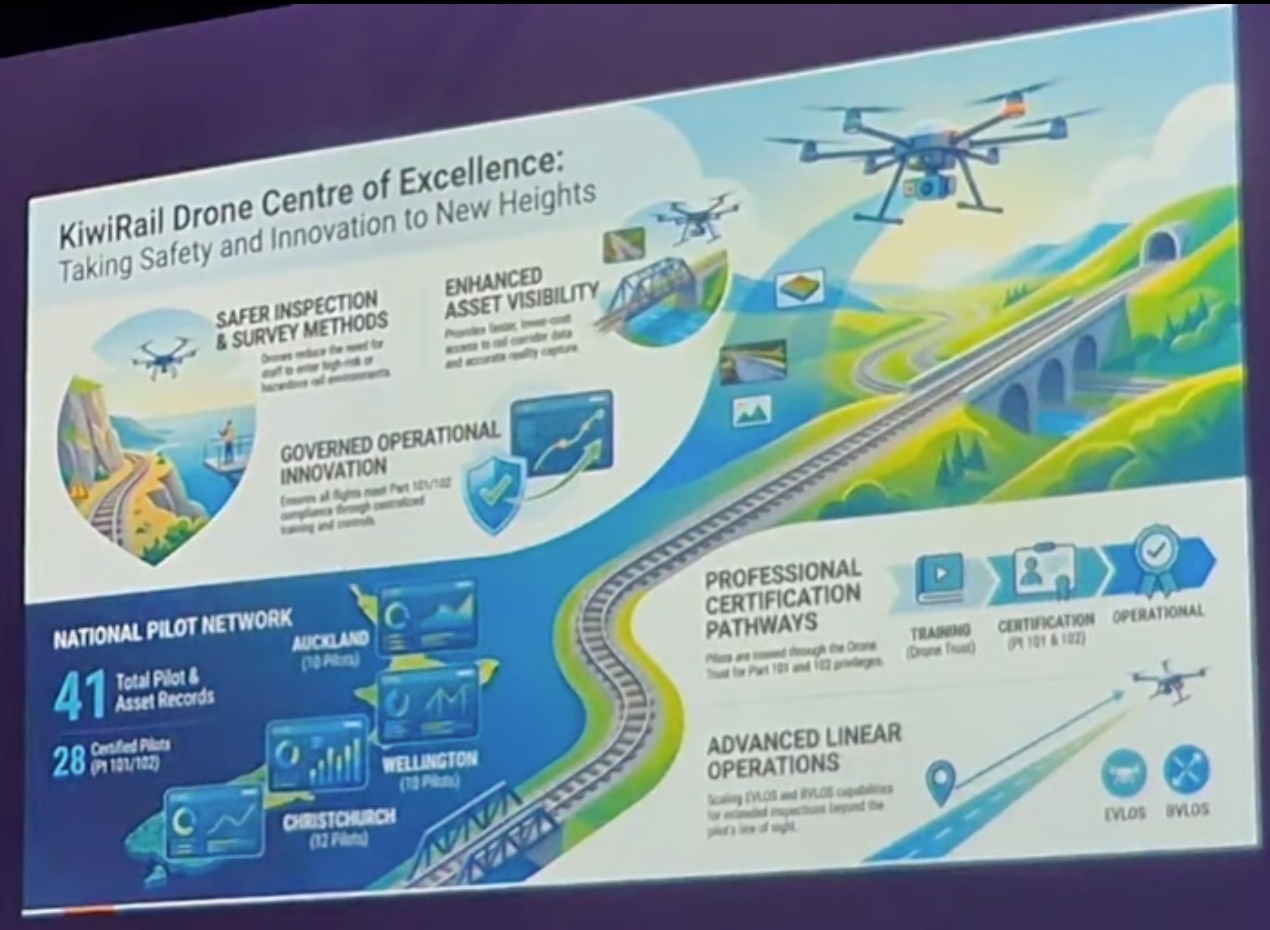
Collings also described extended visual line of sight and beyond visual line of sight operations. These increase how much corridor a flight can cover, but they also increase the importance of approved procedures, observers, communications, aircraft limitations and awareness of other airspace activity.
The garbled term that can sound like “no-tam” in conversation is NOTAM, an aviation notice used to warn pilots about abnormal or temporary conditions affecting airspace or an aerodrome. Cranes, airshows, police activity and emergency operations can all change what is safe on a given day.
In other words, the drone programme is not a collection of aircraft handed to enthusiastic teams. The useful product is the entire operating system: trained people, permissions, flight planning, standard capture, central data, maintenance of equipment and governance.
KiwiRail’s AI journey began before the current wave
Collings dated KiwiRail’s AI journey to 2020. He specifically thanked Roy Cohen, who was in the room, before recalling their early experimentation together. Cohen was then a senior KiwiRail technology leader. The capability was limited, and Collings made no attempt to pretend otherwise.
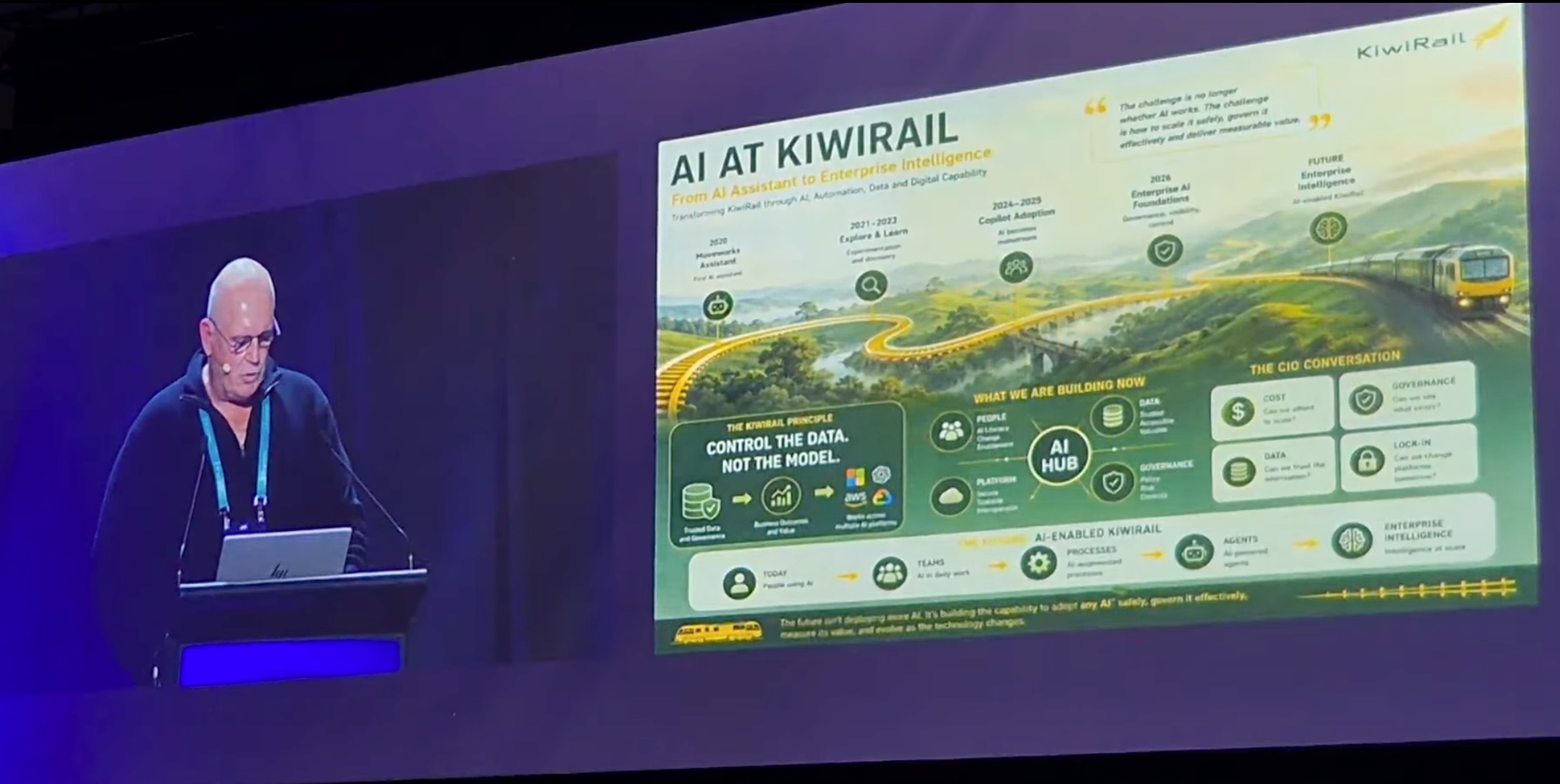
"In fact, one of the guys was actually in the room here, a guy called Roy Cohen, and we started playing around with Copilot."
Roy Cohen did not speak during this session. The comment was Collings’ acknowledgement of work they began together. Cohen is currently the CTO for Auckland Transport.
KiwiRail’s next step was Moveworks, an employee assistant embedded in Microsoft Teams. Collings said that after about 12 months it was resolving up to 1,800 employee requests a month without human intervention.
He immediately qualified the result. Was it great? No. Did it completely serve its intended purpose? Not quite. What it did achieve was more valuable than a polished retrospective might suggest: it put KiwiRail on the journey and gave the organisation practical experience of what conversational automation could and could not do.
From 2021 to 2023, Collings characterised the work as exploration and learning. The organisation experimented, learned early and accepted failure as part of discovering useful applications.
In 2024, broader use of Microsoft Copilot brought the technology closer to everyday work. Collings emphasised the value of operating inside the organisation’s approved Microsoft environment, where identity, tenancy and enterprise information controls could be considered as part of adoption.
Then, in February 2026, KiwiRail moved into what he called Enterprise AI Foundations.
The hard problem is no longer proving that AI works
The move into foundations marked a change in the question. Experiments had shown that AI could be useful. KiwiRail now needed visibility across use, named ownership, platform controls and a governance model that could support wider adoption.
"The challenge is no longer whether AI works. The challenge is how to scale it safely, govern it effectively and deliver measurable value."
That framing aligns with the wider New Zealand picture. TUANZ’s Digital Priorities 2026 report, developed from interviews with local digital leaders including Collings, describes AI moving from isolated experimentation into enterprise workflows. It identifies measurable return, data foundations and governance maturity as central priorities.
KiwiRail’s model connected four areas:
- People: AI literacy, training, adoption and the capability to use tools responsibly.
- Data: trusted information and enterprise knowledge that approved systems can use.
- Platform: Copilot, Power Platform and approved AI services that provide a controlled route to delivery.
- Governance: policy, security, ownership and risk controls that set the conditions for safe use.
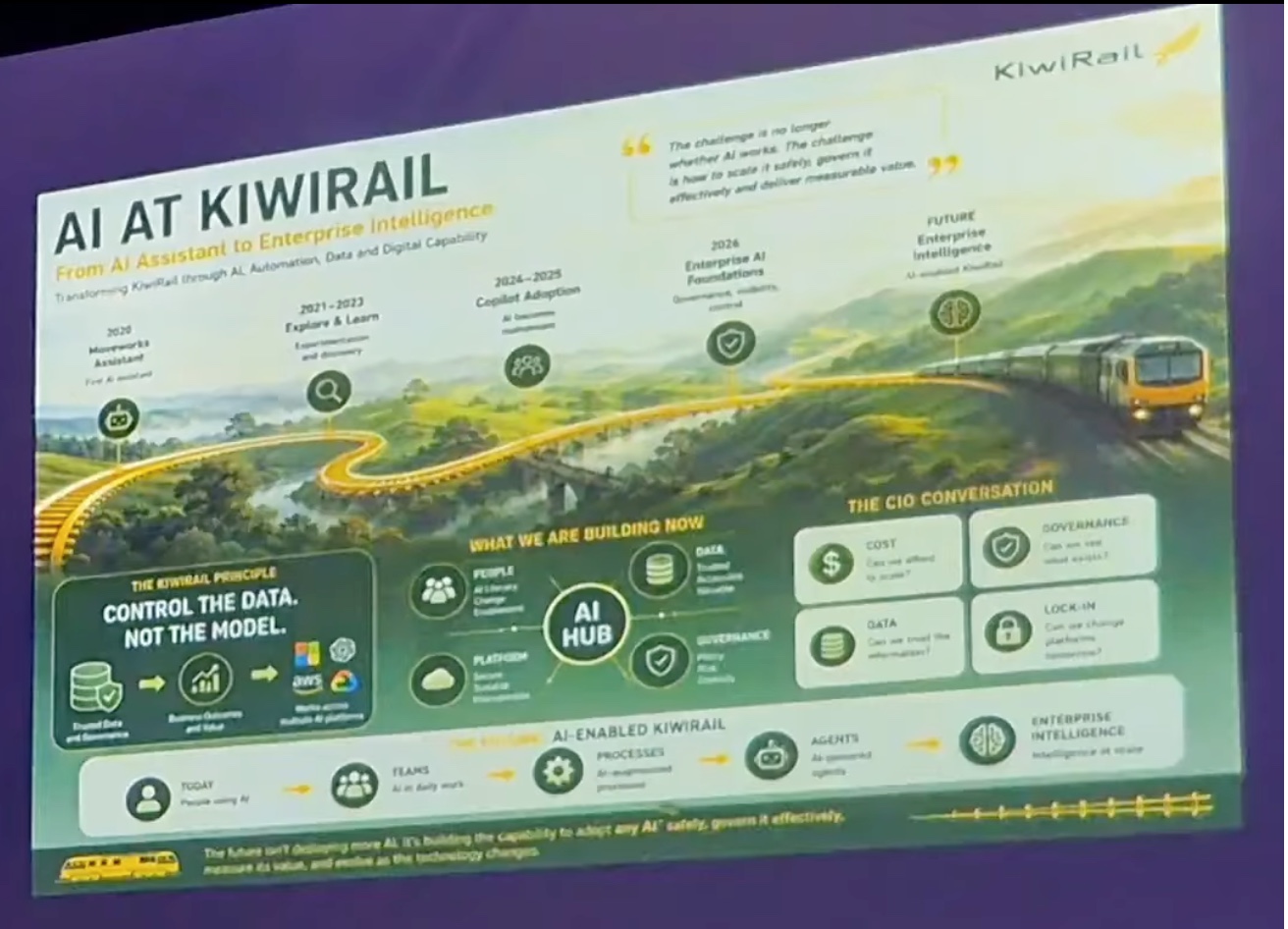
None of the four stands alone. A secure platform without useful data produces little value. Good data without adoption remains unused. Enthusiastic adoption without governance creates exposure. Governance without an approved path to delivery can drive the behaviour underground.
Collings reduced the design principle to five words.
"Control the data, not the logic."
The point was not that model behaviour is irrelevant. It was that models and interfaces will keep changing. Long-term advantage sits in the organisation’s trusted data, business knowledge, controls and people capability. Those are the assets that let a CIO change tools without rebuilding the entire operating model each time.
"The future is not deploying more AI. It is building the capability to adopt any AI safely, govern it effectively, measure its value and evolve as technology changes."
Private 5G connects the digital plan to the physical site
AI, drones and connected tools are of limited use if a railway yard has weak or unreliable coverage. Collings said KiwiRail had recently commissioned its first private 5G site to provide full connectivity in an environment where an ordinary mobile connection could be difficult to maintain.
He presented the site as an enabler rather than an isolated network project. Reliable local connectivity expands what operational teams can use in the field and what KiwiRail can test in what Collings called its “AI kitchen”.
The phrase captures an important distinction. An enterprise platform may be ready in the cloud while the place where value needs to be created remains offline, intermittent or constrained. For asset-intensive organisations, network coverage, edge design, device management and operational technology security are part of the AI architecture.
KiwiRail’s private 5G outcomes were described by Collings and have not yet been independently reported. The useful leadership point is the dependency: digital ambition has to be mapped all the way to the worker, asset and location where the task occurs.
Token costs can turn adoption into an unplanned bill
Collings closed with a warning about the economics of large language models. Tokens are the units models use to process inputs and produce outputs. Consumption may appear trivial during a small trial, then grow quickly when dozens of developers, automated processes or thousands of employees begin making repeated calls.
He offered an anonymised example of a development business with 46 developers that, he said, incurred a $50,000 token bill in one month. Its purpose was to expose a risk that is easy to ignore during experimentation.
Collings urged CIOs to consider smaller models that can be managed more directly when the task does not require the largest general-purpose system. A smaller model can sometimes provide lower latency, more predictable consumption, narrower data exposure and enough capability for a well-defined use case.
“Free” still needs care. Openly available model weights do not remove hosting, engineering, security, monitoring or support costs. The architecture decision is therefore not simply large versus small, or paid versus free. It is which model delivers sufficient quality for the task within the organisation’s cost, data and risk constraints.
The practical control loop is familiar even if the technology is new: set a unit of value, monitor consumption, define thresholds, assign an owner and be able to stop or redesign a service before usage becomes an unexplained monthly surprise.
What CIOs can take from the KiwiRail pattern
Collings’ quick-fire showcase covered drones, digital twins, AI and private wireless infrastructure, but it did not feel like a list of disconnected innovations. The same operating principles appeared repeatedly.
Begin with operational reality. KiwiRail’s drone story starts with getting people out of hazardous inspection environments. The technology earns its place by changing risk and access.
Capture information for reuse. Imagery and LiDAR become more valuable when they are centrally stored, geospatially referenced and available to future projects, maintenance teams and suppliers.
Treat governance as delivery capability. Flight rules, trained operators, data ownership, platform controls and AI policy are not paperwork added after innovation. They are what allow the organisation to repeat it safely.
Learn from imperfect systems. The early employee assistant did not have to be described as a triumph to have value. It taught KiwiRail about demand, limitations and the work required to progress.
Build foundations that can outlast a model. People, data, platforms and governance give the organisation a way to adopt changing AI capabilities without handing its strategy to one product cycle.
Connect value to consumption. Whether the unit is a drone flight, an avoided manual inspection, an employee request resolved or a model token consumed, the organisation needs a way to see what it is buying and what changed because of it.
Collings finished on time, with about 30 seconds left to leave the stage without falling off it. He also revealed that AI had produced all three of his presentation slides in just under 25 minutes.
That was a neat demonstration, but not the strongest evidence in the session. The more consequential work had taken years: training pilots, governing flights, centralising reality-capture data, learning from early AI, building enterprise controls and extending connectivity into the physical environment.
The slides were fast. The capability behind them was not. That is precisely the distinction technology leaders need to keep making.
Sources
- CIO Innovation Summit New Zealand: 2026 agenda and Garry Collings speaker profile
- KiwiRail: Half Year Report ended 31 December 2025
- KiwiRail: Annual Integrated Report 2025
- KiwiRail: Statement of Corporate Intent
- KiwiRail: Network Visualisation and Reality Capture Datasets
- Civil Aviation Authority: Drone regulations
- TUANZ: Aotearoa's Digital Priorities in 2026
- Microsoft New Zealand: Satya Nadella New Zealand visit 2026