
Innovation Isn't Invention: Lessons From the CIO Summit's People, Planet and Purpose Panel
4 August 2026· AFQY News
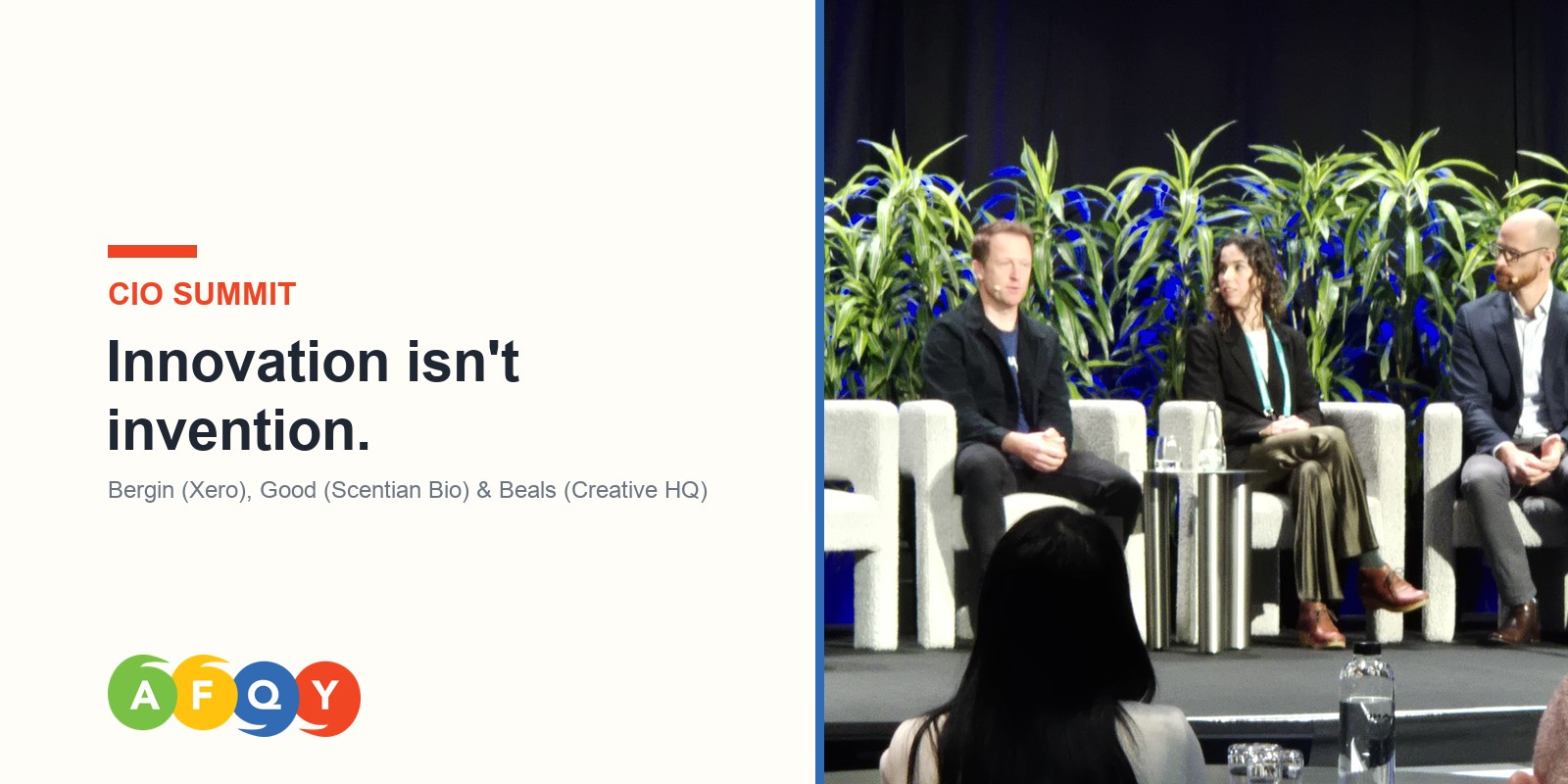
The CIO Innovation Summit’s mid-morning panel put three very different scales of organisation in the same four chairs: Xero, a listed global software company; Scentian Bio, a Wellington deep-tech startup building a “digital nose”; and Creative HQ, the accelerator that spends its days helping climate-tech founders get off the ground. The session was titled “Redefining Innovation in the CIO Agenda: People, Planet, and Purpose at the Core,” and the moderator’s opening framing was blunt: innovation is about impact, not just speed or efficiency, and technology should serve people rather than the other way round.
Asked what that phrase actually means day to day, James Bergin, Xero’s Executive General Manager for Technology Research and Advocacy, said it has to be all three at once. Xero’s purpose, to make life better for people in small business, their advisors and communities around the world, isn’t a slogan he needed a tattoo to remember. On planet, he pointed to publicly published sustainability targets and small operational choices, like the firm’s sign-up to a sustainable aviation fuel investment in Australia. On people, he reached for the whakataukī: he aha te mea nui o te ao, he tangata, he tangata, he tangata. What is the most important thing in the world? It is people, it is people, it is people, meaning both the team Xero has and the customers it serves.
"The definition of the word is to create something new in order to change something that's established. If you stop at the first part, creating something new, that's the definition of the word invention."
Holly Beals, ClimateTech Lead at Creative HQ, took the purpose question somewhere less comfortable. The founders coming through her programmes, often scientists and engineers rather than natural storytellers, mostly do arrive purpose-first. But the market they’re selling into has changed. A few years ago, climate was the value proposition: it was front and centre of corporate sustainability mandates, and that alone could carry a pitch. Now, in what she called an era of climate fatigue, it doesn’t.
"Saving the planet's not enough anymore. Our climate innovators need to find the real problem to solve for a customer, often quite separate from the decarbonisation problem, and land on a business model that solves both, at cost parity with what people are already using."
Jonathan Good, chief executive of Scentian Bio, came at the same question from the startup side: building from a green field, he said, is a genuine advantage, because it lets you design in flexibility from day one rather than retrofit it. Scentian Bio’s technology, insect odorant receptors synthesised in a lab and wired to sensor chips, translates chemical information the way a microphone translates sound, giving food manufacturers a real-time read on tainting, off-notes and contaminants. The company’s first application is food quality, with the founders’ longer-term ambition being sensors small enough to sit inside everyday devices.
Asked how leaders keep investors and executives patient when the payoff is years out, Good pointed to storytelling, customer obsession and, above all, showing tangible progress rather than promising a distant outcome.
"As humans, we're massively over-optimistic about the very short term, and we under-index on the medium and long term. A key job for any leader is showing the stepping stones toward those medium-term outcomes, not just the big promise at the end."
On psychological safety, Bergin drew a distinction he said gets lost in most corporate “experimentation” talk: a real experiment states a hypothesis and tests it, but businesses usually mean something closer to playing or exploring. Naming that honestly, he argued, framing a pilot as a hypothesis that might reasonably prove false, makes disproving it a genuine success rather than a failure to hide. Beals built on that: a lot of the stigma around failed projects comes from one person owning an idea that then scope-creeps until it’s burned real money, and defining “done enough to learn something” up front, with a backlog of ideas to work through, turns killing a project into a legitimate win rather than a loss. Good added that the learning function sits above all of it: even a result that disproves the idea is still real progress, feeding the next iteration.
Bergin was also the panel’s clearest voice on New Zealand policy, warning against innovation incentives that default to serving big business and individual consumers while forgetting that small businesses make up more than 97% of the economy. He credited the country’s outsized startup record to people who treated geographic distance as a fact to work around rather than an excuse, and argued policy settings need to keep that group in view rather than optimising only for scale.
Closing on where New Zealand’s biggest opportunity sits, Beals pointed to the country’s roughly 88% renewable electricity grid, its history of local, circular supply chains, and a science-commercialisation pipeline already producing repeat climate-tech founders, citing carbon-recycling company LanzaTech and Rocket Lab’s Peter Beck as examples of the kind of serial deep-tech entrepreneur the ecosystem is now producing more of. She named forestry and agriculture, sectors New Zealand currently exports as raw, low-value material rather than processing locally, as the clearest remaining opportunity to decarbonise and capture more value at the same time.
Asked for one universal innovation principle to close on, the answers came back fast: fall in love with the problem, not the solution. Stay curious, and keep experimenting. Get excited about trying something new. The moderator’s own takeaway tied it together: innovation isn’t really about adopting new technology at all, it’s about the deliberate choices behind it, where you focus, how you lead, who you partner with, and what you’re actually trying to create for people, your organisation and the planet.
Sources
- CIO Innovation Summit New Zealand: agenda and speakers
- Xero: Our Sustainability Approach & Performance
- NZ Herald: Scentian Bio raises $7m for its insect and AI-powered 'digital nose'
- MBIE: Favourable hydro conditions see record high share of electricity generation from renewables
- Creative HQ: Aurora Climate Lab