
AKQA: AI Can Scale the Story, but Human Judgement Still Holds the Pen
7 August 2026· AFQY News
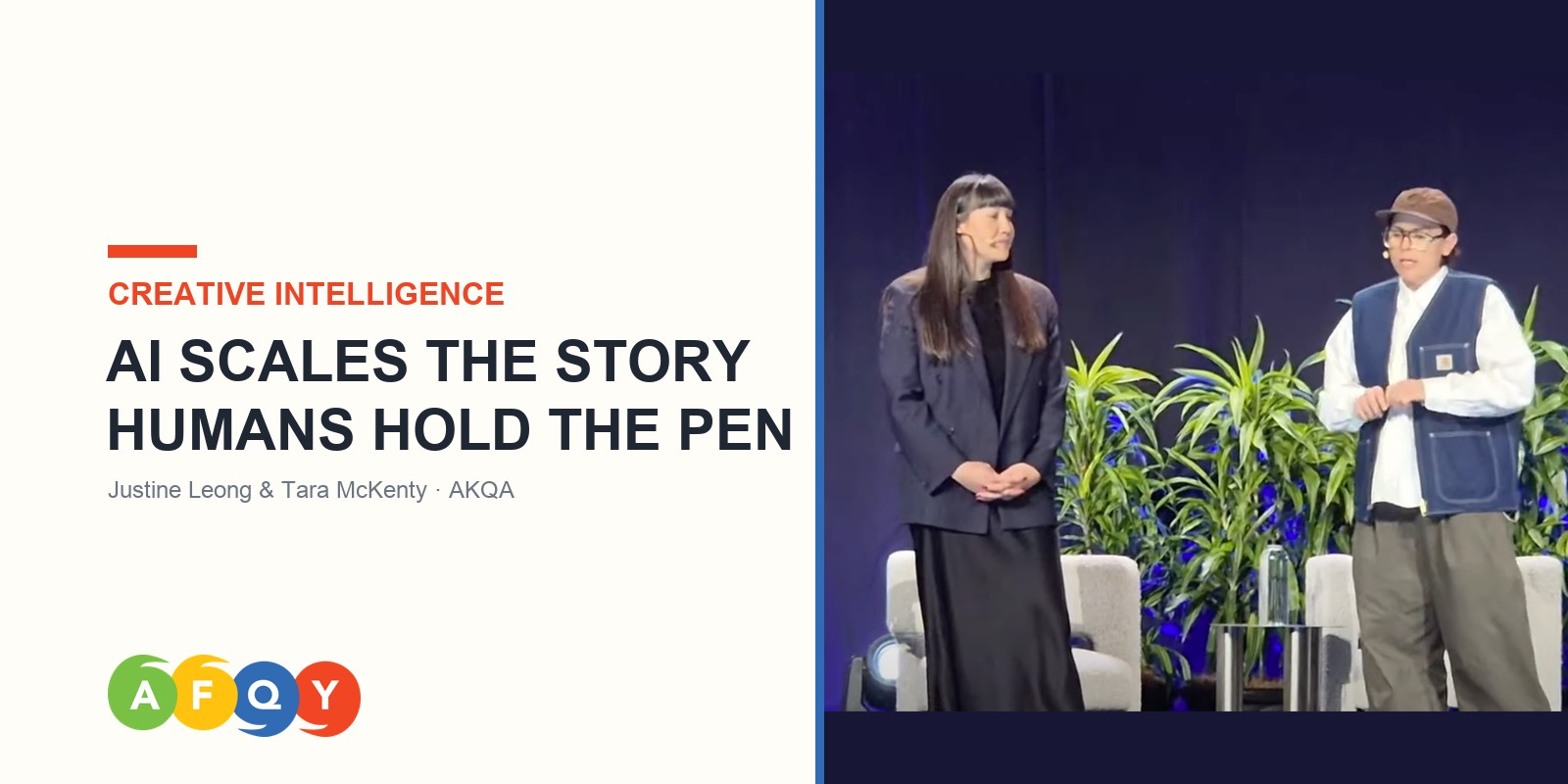
Justine Leong and Tara McKenty introduced themselves as business partners in crime. Or spies. The audience was invited to decide, although Leong had apparently already reached a verdict.
It was a useful way to begin a closing keynote built around an uncomfortable idea. Brands have spent decades trying to control their story, yet the technology now shaping customer experience is distributing authorship to creators, data, systems, customers and culture itself. The serious question underneath the jokes was no longer simply what a brand should say. It was who now gets to say it, shape it, challenge it and decide whether it is worth hearing.
At the CIO Innovation Summit session, Creative Intelligence: Where Human Imagination Meets Technology, AKQA Managing Director Justine Leong and Chief Creative Officer Tara McKenty argued that technology should enlarge human imagination, not replace it. Their examples crossed bedtime stories, cricket, elite sport, generative commerce, brutally honest Reddit reviews and one of the most expensive advertising slots in the world.
The message for CIOs was more consequential than a lesson in marketing. Architecture, data and AI platforms increasingly determine who can participate in an organisation’s story, how fast that story changes and whether customers experience a monologue or a relationship. Generative capacity may be abundant. Judgement, trust and taste are not.
TL;DR
- Technology is an amplifier of human imagination, not a substitute for it. The valuable operating model is human and machine, not human or machine.
- Brand authorship has moved beyond the marketing department. Creators, live data, adaptive systems, customers and culture now shape the story alongside the organisation.
- Shared authorship can build trust only when the system preserves truth, context, consent, moderation and clear editorial accountability.
- Infrastructure choices are creative choices. Platforms designed for feedback and continuous iteration allow organisations to listen and respond; rigid broadcast-era systems keep them talking at people.
- Wider access to creative tools can improve participation and representation, but generative scale does not decide what is meaningful, accurate or worthy of attention.
- The CIO’s role is increasingly editorial as well as technical: enable creation, protect human agency, design the guardrails and make certain somebody remains accountable for judgement.
Humans will turn almost anything into a story
Leong began with her other chief creative officer, her five-year-old daughter. The title was unofficial, the imagination was not.
Her daughter sometimes prompts Claude to help make bedtime stories. The characters included Poppy the Pig, a turtle finding its way home to its sister, and an entire academy that sounded difficult enough to pronounce without AI assistance. Leong conceded that one plot may have borrowed a little from Finding Nemo. McKenty did not appear ready to launch a copyright investigation.
The child was not writing in the traditional sense, Leong said, but the spark and the choice were hers. Claude completed the picture. Sometimes the result was good enough. That small domestic example introduced the keynote’s central question: if organisations tell stories with systems that can generate, personalise and distribute material, who is the author now?
The need to make stories is much older than any platform. Leong used the famous 1944 experiment by psychologists Fritz Heider and Marianne Simmel to illustrate the point. Participants watched an animation containing two triangles, a circle and a rectangle. All but one of the 34 people in the first experiment described the movements in human-like terms. They saw conflict, fear, pursuit and personality where the screen contained only shapes.
Leong admitted that she still felt sorry for the circle. A pause might be required.
The humour made the insight memorable: people do not passively receive information. They organise it into motives, characters and meaning. Any enterprise building customer-facing AI is therefore doing more than automating output. It is influencing the material people use to understand the organisation and decide what kind of relationship they have with it.
Infrastructure broke the broadcast model
For much of modern brand history, storytelling was linear. A company decided what it wanted to say, made an advertisement, billboard or campaign, and distributed it. The customer received the message and perhaps remembered it long enough to buy something.
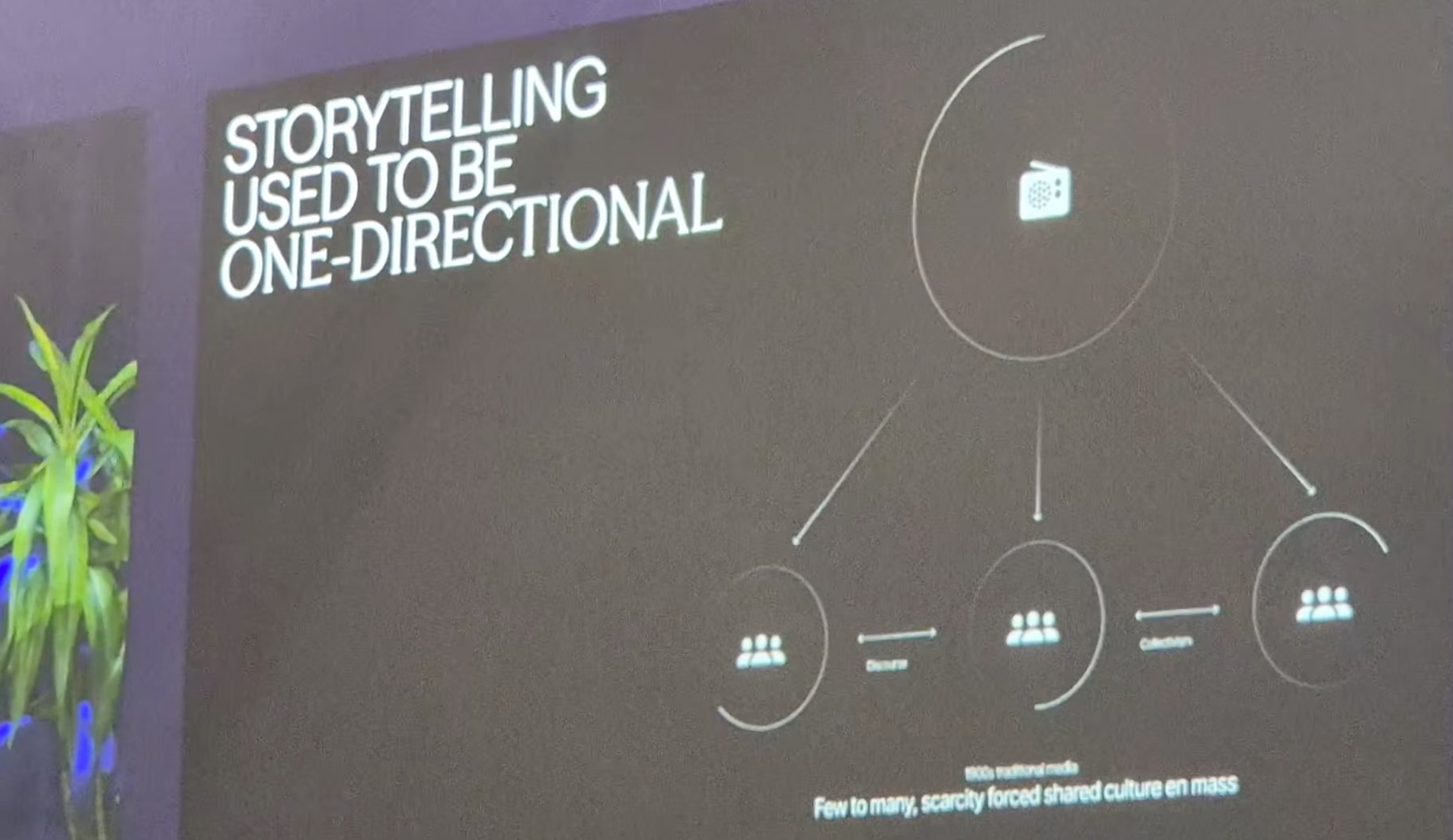
Leong argued that the model was not displaced by one brilliant creative idea. It was broken by infrastructure: data, platforms, always-on channels and generative tools. Those systems reduced the distance between what a brand says and what a customer experiences, believes and says back.
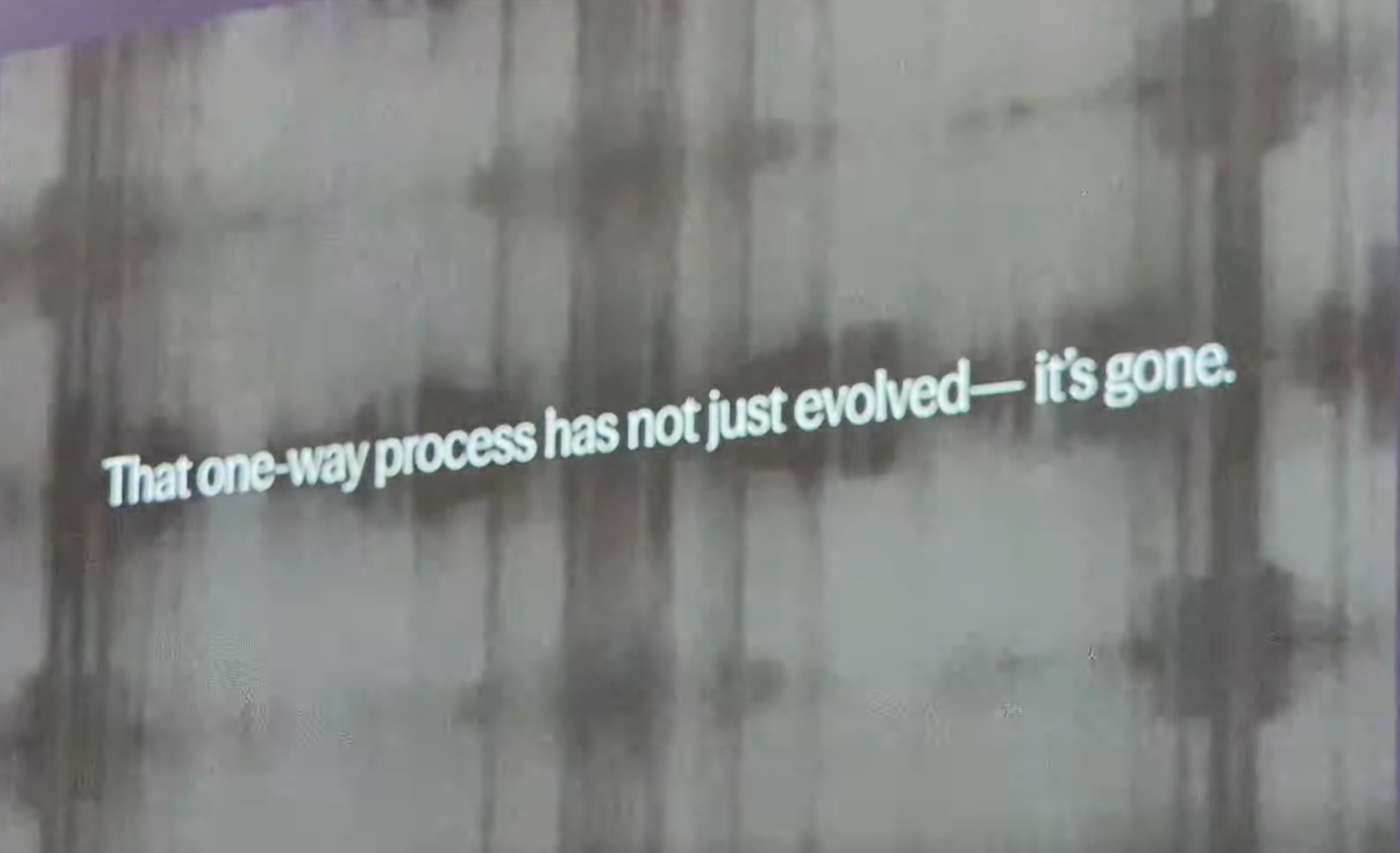
The customer is no longer only an endpoint. Creativity, creators and customers now collide in real time. A single idea can become video, audio, images, objects, memes and public conversation at once. The old journey, in which content was designed to arrive at a known place and moment, has given way to something continuous and participatory.
That shifts a technology decision into an organisational one. A platform built only to publish finished material assumes the company remains the sole author. A platform built for feedback, adaptation, identity, moderation and reuse assumes the story will evolve after release.
"Technology is always the enabler of human imagination and intelligence. It's always an and. It is never an or."
That “and, not or” distinction became the keynote’s operating principle. Every case was presented as a human idea made larger by technology, not a human idea made unnecessary by it.
Five ways to give away the pen
McKenty warned the marketers in the room that the next section might make them slightly uncomfortable, in a good way. The technologists, she suggested, already knew this moment was coming. Everyone could hold hands and take a deep breath.
Across five examples, AKQA progressively moved authorship away from the traditional brand custodian. The pattern ran from a controlled creator tool through to the more alarming prospect of letting culture carry the story.
"When authorship is shared at every single step, trust went up."
That was the session’s thesis, not a guarantee that every open platform automatically creates trust. Each example depended on a different combination of context, constraints and human decisions.
1. Give creators a culturally specific tool
The first example was Bollywood Spin, a YouTube India experiment built with Gemini. McKenty described a problem in cricket culture: women fans could be excluded by male-dominated commentary around a sport with enormous national significance.
The tool combined live cricket moments, such as sixes, wickets and dramatic swings, with Bollywood storytelling conventions. Female creators could use it to generate scripts and visual ideas in styles aligned with their own voices. The serious design choice was not simply to make more cricket content. It was to connect two existing cultural passions so a different group of creators could interpret the game for their communities.
McKenty said the model could extend beyond cricket, including learning financial literacy through Formula One or search marketing through Pokémon narratives. The claim was larger than personalisation. Encoding cultural fluency into a tool can distribute creative opportunity that was previously locked inside a small production group.
Yet this was not uncontrolled generation. McKenty described rules in the tool, moderation in the YouTube platform, a creative brief and approval before release. Giving away part of the pen did not mean throwing away the editor.
2. Let live data reveal another story
The second category transferred authorship to data. McKenty reached back to work she had led at Google, beginning with Project Huey, a machine-learning and computer-vision experiment intended to give surfing judges consistent performance measures.
Surfing was an intentionally hard test. Athletes compete on different, constantly moving waves and are assessed on both observable measures and concepts such as creativity and style. The Project Huey case record describes a system built to measure height, verticality and rotation, with the aim of reducing the room in which unconscious bias could influence judging.
The important qualification is that data does not become objective merely because a model produced it. People still chose what to measure, labelled the training material and decided how a metric should influence a judgement. The technology could make particular aspects of performance visible. It could not define the full meaning of athletic excellence on its own.
Project Skate extended the approach into skateboarding. Using multiple cameras and open machine-learning tools, the prototype could identify tricks and measure speed, height, rotation, airtime and grabs. McKenty said its narrative purpose was to make the skill and athleticism of female skateboarders harder to overlook.
The demonstrations also produced one of her more practical recruitment observations. New Zealanders kept appearing in the work, so anybody in the room looking for a technology job may have detected a pattern.
The larger point was that the same data can support different stories depending on the question around it. Measurement could help a judge, a coach, an athlete or an audience, but each use involves a different purpose and a different responsibility.
3. Let the system assemble the experience
Authorship moved next to the system itself. AKQA’s Generative Store uses Gemini to construct a shopping interface in real time around an individual’s intent.
Traditional ecommerce trains people to search catalogues, select filters and navigate fixed categories. McKenty contrasted that with the best physical boutique, where an experienced adviser reads the customer and quickly presents something relevant. The AKQA case study says Generative Store was designed to bring some of that intuition into digital commerce by creating interfaces that listen, curate and adapt.
Nobody designs the exact page that a particular visitor sees at that moment. The brand’s assets, heritage and design system provide the material and constraints, while Gemini assembles the experience. The customer also co-authors it through their expressed intent and continuing choices.
This is where a CIO’s platform decisions become visible to the customer. Product data quality, design-system rules, model behaviour, latency, privacy and fallback handling all shape whether the experience feels attentive or simply unpredictable. Infinite personalisation is not the same as useful personalisation.
4. Hand the story to the customer
Then came what McKenty called the scariest audience on the internet: Reddit.
Dove invited people to try its Intensive Repair 10-in-1 Serum Mask and committed to making the first 50 reviews the campaign, whether the comments were positive, negative or indifferent. The r/eal reviews campaign took those responses into advertising and physical spaces without polishing away the criticism.
The usernames helped. A conventional testimonial panel was replaced by voices including the magnificently direct “Hair Goblin 92”. Some loved the product. Some disliked the packaging, fragrance or result. The loss of control was the point.
"The boldest creative idea in Dove was a decision to do less and not to intervene and tell the truth."
Technology’s job in this case was not to manufacture persuasion. It was to find real customer testimony and place it in front of more people. That distinction matters as organisations think about AI-mediated discovery. A system can amplify a trusted signal, but synthetic praise, selective evidence or invisible editing will eventually damage the trust it is meant to create.
5. Let culture continue the narrative
By the fifth example, McKenty joked that AKQA had effectively given away every brand and would soon have nobody left to work for.
Levi’s Behind Every Original campaign treated its Super Bowl film as the beginning rather than the destination. The television moment created intrigue, while the deeper stories of the cultural figures in the campaign lived across social platforms. The AKQA account of the work describes broadcast as the spark for an always-on ecosystem rather than the peak of the campaign.
The creative itself had fun with the brand’s most recognisable point of view. Set to James Brown’s “Get Up Offa That Thing”, it focused on the backsides of people wearing Levi’s, including musicians, athletes, workers and even Woody from Toy Story. Serious cultural participation arrived through an unapologetically cheeky door.
The operating model was more important than the joke. Levi’s moved from a monologue to a dialogue, using television to direct attention towards stories that could continue, fragment and invite response. The brand remained present, but it did not pretend to be the sole authority on what made each person original.
Guardrails still matter when control moves outward
The five examples did not argue for abandoning control. They showed control being redesigned.
Bollywood Spin retained moderation and approval. Project Huey and Project Skate depended on chosen metrics, training data and human interpretation. Generative Store operated inside brand assets and a design system. Dove asked for honesty but still set participation rules and sought permission to reuse reviews. Levi’s created the platform and the invitation even when the cultural conversation continued elsewhere.
This is the governance challenge behind shared authorship. The organisation must distinguish between control that protects people and control that merely protects the institution from hearing something uncomfortable.
Useful controls include consent, privacy, provenance, accessibility, safety, moderation, brand constraints and clear responsibility for errors. Less useful control is the instinct to polish every customer response until it no longer sounds like a customer.
That is also why trust cannot be treated as a by-product of deploying AI. Gartner’s current customer-experience guidance makes a related point: efficiency and personalisation can scale, but people still need moments that make them feel seen. The design decision is where technology should accelerate the interaction and where human context, empathy and judgement must remain visible.
Participation changes who gets represented
During questions, McKenty connected the shift in authorship to inclusion. Traditional broadcast advertising offered only a small number of roles, while the people making the work did not always reflect the communities being addressed. The result could be a brand effectively yelling at people through a story in which they could not see themselves.
Generative tools can widen access to high-quality production and allow more communities to make work from their own perspective. Social platforms also turn communication from one-way instruction into a two-way exchange. Those are meaningful changes in who can participate.
But democratising a tool does not automatically democratise power. Access costs, model bias, training data, platform rules, language support, discoverability and who gets paid all determine whether participation is real. A low-cost subscription can help somebody make polished material. It does not guarantee that an algorithm will distribute it or that an organisation will listen.
For CIOs, inclusion therefore belongs in platform governance, not only in campaign casting. The questions include whose language the model understands, whose cultural context informs the system, who can challenge an output and whether communities are involved before the experience is scaled.
The technology leader becomes an editor
Leong closed by turning the keynote directly towards the people responsible for architecture, data and platforms. None of the work shown had been produced by an agency moving in a straight line towards a clean endpoint. Every example depended on systems that made iteration and participation possible.
Infrastructure built for the old world assumes long road maps, finished releases and stable channels. The world Leong and McKenty described has no final version. Insight moves into action continuously, audiences respond, and the story changes while the organisation is still operating it.
That does not reduce the need for craft. It makes craft more important because generative systems can produce an enormous quantity of material that is merely good enough. Leong returned to her daughter’s bedtime stories. Claude could generate one on demand, but shelves of favourite books, Disney and Bluey often won the evening. Even a five-year-old could distinguish available content from something worth choosing.
"Infrastructure without taste produces noise, and taste without infrastructure cannot scale. You need both."
Technology can expand who creates and how much is created. It cannot decide what deserves attention, what is true, what is culturally intelligent or what somebody will care about. Those remain acts of judgement.
The editorial role Leong described includes reviewing, crafting, fact-checking, supervising and experiencing the system as a customer would. In an enterprise context, it also means defining authority: what the model may generate, what data it may use, what can be published automatically and what requires accountable human approval.
"We aren't just building platforms, we are building who gets to shape the stories of the world."
That is the serious message the humour kept opening the door for. CIOs are not standing behind the creative process, supplying infrastructure after the important decisions have been made. Their architecture determines the distance between an organisation and its customers, the people allowed to participate, the truth a system can access and the speed at which a story can escape its original author.
The winners will not simply be the organisations with the most generative power. They will be the ones that know when to hand over the pen, when to hold the guardrail and when a human editor must still say: this is worth telling.
Sources
- CIO Innovation Summit New Zealand: Creative Intelligence session and speakers
- Heider and Simmel: An Experimental Study of Apparent Behavior
- The One Club: Google Project Huey
- The One Club: Google Project Skate
- AKQA: Bringing emotion and intuition back to online shopping
- Marketing Dive: Why Dove turned Reddit product feedback into a real-world campaign
- AKQA: Levi's Behind Every Original
- Gartner: Human Moments That Matter in an AI-Driven Customer Experience