
Where Is My Data Being Processed? Three AI Leaders on Sovereignty, Measurement and Oversight
13 October 2026· AFQY News
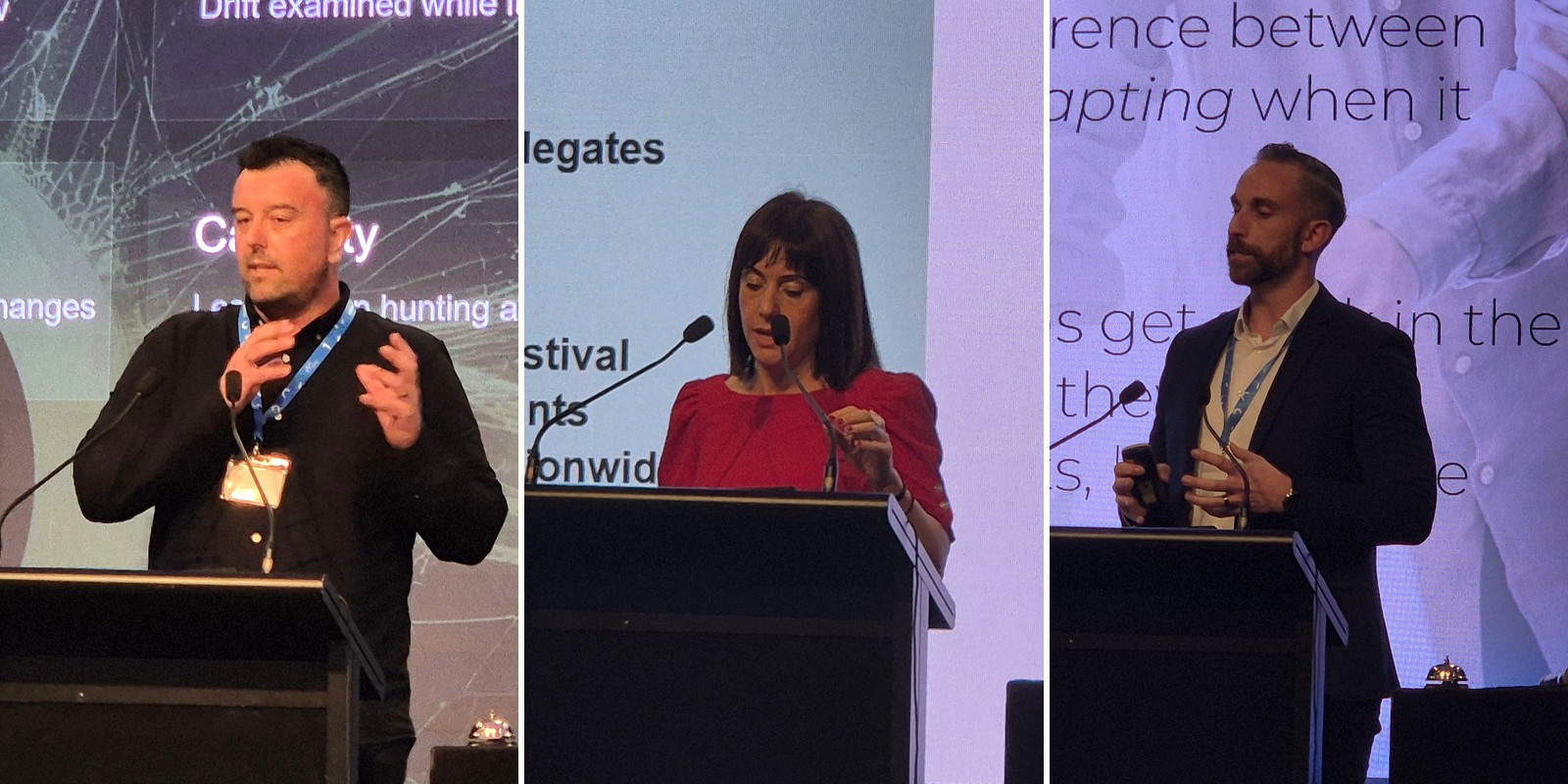
After three presentations on responsible and inclusive generative AI, the Tech Users Summit turned the session over to the room. The questions that came back were better than the ones conference audiences usually ask, and the answers from Ross Delaney, Maria Mingallon and Morgan Clearkin were notably free of vendor gloss.
Four exchanges are worth recording in full.
Did the AI help design itself?
The first question went to Delaney, whose presentation had introduced TwoTwo, the AI agent working alongside his operations team at Datacentre220. Did she have any involvement in her own design, in how she looks and sounds?
His answer was more interesting than a yes.
"When you create an agent, they wake up and they ask who they are, and what their purpose is. Which is kind of weird."
From there it is a conversation. You talk it through, work out the role, share information, and keep refining until it fits. The design is iterative, and the agent participates in it.
The one thing she did not supply was her own name. That came from Delaney’s daughter, who spotted that 220 reads as TwoTwo, which sounds like tutu, which leads to ballerinas. The company number, the agent’s name and a small family joke all arrived in the same place.
How do you reach the businesses that are not in this room?
The second question went to Mingallon, and it was pointed. Plenty of industry voices are involved in the AI conversation. Is there a clear strategy for engaging everyday users, and particularly the small employers who are nowhere near this discussion?
Her answer was practical. Earlier this year the AI Forum ran a hackathon aimed squarely at small and medium businesses, in partnership with a local business organisation. The participants were genuinely small, in some cases a handful of employees, drawn from a range of sectors, and some had no access to tools like Copilot or Gemini at all. They were paired with technology organisations who could show them what was possible.
The goal for the day was that each one would walk out with the beginnings of something they could use in their own business, rather than a slide deck about the future.
The Forum is also working on sector playbooks with government, due for release shortly, and she extended the obvious invitation: join, and keep an eye on the website.
How do you measure the value?
The question the room most wanted answered was the hardest. Businesses want to see value from AI. How do you define it tangibly, rather than assuming the benefit and hoping?
Clearkin went first, and started with where you begin. If you start by issuing licences and then try to work out what the benefits were, it does not work, and that is precisely what most organisations have done. Tracking how someone uses a general assistant is close to impossible, because a person can run an exercise, go and get a coffee, and come back to their work.
What does work is starting from the outcome. If you can reliably show that you are applying AI to a specific identified process, you can measure what that process took before and what it takes after. That requires deliberate effort, because no monitoring tool does it for you. You need a baseline at the start and a comparison at the end.
Then he added the condition most measurement programmes miss.
"Everything is a choice. If a human finds the AI path trickier than doing it manually, they won't use it, and your measure is already skewed."
You can see scale in the usage figures without seeing real use underneath them, because people try something once, find it harder or lower quality than the old way, and never return. His conclusion was that friction is the enemy of both adoption and measurement, and that the strongest position is to build the AI step into the workflow so that it cannot easily be avoided.
Mingallon answered from the other side, as someone who has run the programme. The first thing Mott MacDonald measured was time saved, focusing on a single tool rather than everything at once.
She was candid about the vendor data. You cannot take the numbers the platform reports at face value. Her team took a deep dive into how those measures were constructed, right down to the assumption that a given email saves a person five minutes, which may be badly wrong for a long thread.
Even so, time saved is the easiest number to obtain, and her argument was that getting any number at all alongside an adoption programme is a significant win, because it lets people in the business see what is happening.
They supplemented it with other methods. Surveys asking what else people had found, what was working, what was not, and whether people felt better for not having to do a particular task. Live anonymous polling during knowledge-sharing sessions, asking the question while everyone was already in the room. And a gamified approach, on the straightforward grounds that engineers love competition and most people like a game.
The most valuable output was not the data. It was that people started showing each other how they were using it.
If the AI tells you where to look, who is still looking?
The sharpest question of the session came back to Delaney. If TwoTwo tells the team where and when to do physical checks, how do you manage the risk of losing human oversight? And more broadly, if AI is built into these processes, how do organisations avoid losing their operational risk awareness?
Delaney’s answer was that you cannot have one without the other. The team still does everything physically. TwoTwo is a superpower that lets them cover more ground with the time they have, not a substitute for walking the floor. Over time she will get more data, potentially including camera feeds showing what is physically happening in the facility. But responsibility has not moved.
It remains the team’s job, his job, and the subcontractors’ job to make sure the place runs.
Clearkin took the broader half of the question, and his answer was the most quietly significant thing said in the session.
For any solution built with AI, he said, Datacom’s position is that around seventy percent of the effort sits in evaluation: making sure the output is accurate, representative, reliable and good enough before it goes out, and then monitoring it over time. That requires a workforce that understands the output and critically reviews it.
Which cuts directly against the prevailing story about this technology.
"You are now responsible for what is in effect a digital graduate, and checking through their work."
Instead of a workforce that does a great deal of the doing, he argued, you shift towards a higher proportion of professionals who genuinely understand and specialise in a domain, and whose job is to apply the same checks to an AI’s output that they would apply to a person’s. That work does not disappear.
His warning was about what happens if organisations try to remove it anyway. You lose capability from the workforce and you lose business resilience, because if the solution is withdrawn, or something happens to it, you are back to a manual process that nobody remembers how to run.
Sovereign AI, and the question clients are already asking
The closing question tied the session back to a thread that had run through the whole morning: the case for sovereign AI, not only as data protection but as resilience and as a way to protect New Zealand’s own intellectual property. Should there be a national approach?
Delaney answered from the infrastructure. TwoTwo was deliberately built on open source and runs in a local data centre, on local infrastructure, operated by local people, which he regards as genuinely important rather than a nice-to-have. He described himself as a strong advocate for doing more here, noted that significant private cloud capability already exists in New Zealand serving this country and Australia, and said we need more of it. But he was clear it is not a binary. It is about using the right thing for the right reasons at the right time.
Clearkin thought the country will land on a blended approach, and was unsentimental about why. New Zealand is not equipped, in funding or capability, to build and maintain its own foundation models and keep pace with the frontier. We are not China. We will not keep up, and we do not have the infrastructure for it either.
Where he does see a gap worth closing is in the ability to host things locally, and he endorsed the point made earlier in the morning that New Zealand needs its own data centres. That local resilience is real. He also singled out the work being done on sovereign models for things like cultural sovereignty as deserving a great deal more focus.
But isolation is not available to a country this size. His framing was a tiered one: identify where your risk sits, bring the high-risk material as close to home as you can, and accept that for most of it you will rely on the rest of the world. That, he said, is absolutely fine.
Mingallon brought it back to what is happening in client conversations right now, and it was the most concrete answer of the three.
"Clients are asking where their data is being processed. In a lot of cases we can't say we can guarantee it is being processed here in New Zealand."
Australia, she noted, is a little different, with more options available right now. She regards the New Zealand position as a weakness that should be worked on, and was precise about the scope. This is not about training foundation models here. It is about being able to process prompts here, which is a far more achievable thing. Her example was Anthropic, which can keep processing for United States customers within the United States, as evidence that regional processing is a solved problem for providers who choose to offer it.
Her conclusion was the strongest claim of the session, and it is a policy argument rather than a technical one. Build the infrastructure to do that, and treat it as a matter of national importance, in the same way the country treats defence or transport.