
Technology Doesn't Run on a Three-Year Cycle: TUANZ at Forty Sets the Scene
13 October 2026· AFQY News
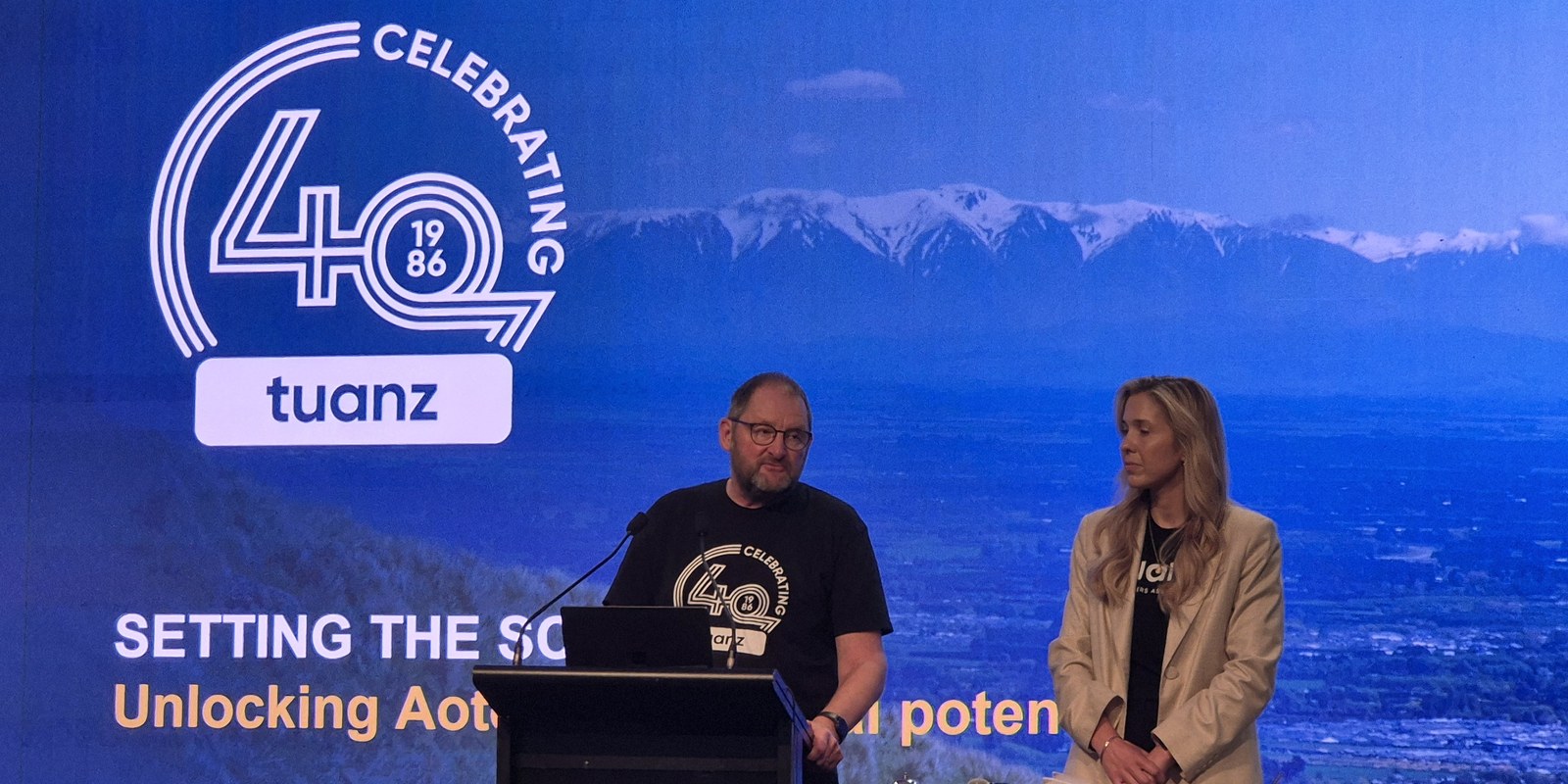
Craig Young has been chief executive of TUANZ for twelve years, which he noted is longer than he expected and possibly a sign it is time to retire. The organisation he runs turned forty this year, and he marked it by wearing one of only four commemorative T-shirts in existence and then making an argument that has outlasted every one of those four decades.
The argument is about time horizons, and it is the reason the association still exists.
"We can't afford to reset our national direction every three years while our global competitors move ahead."
He opened with the positive case, because it is genuinely available. Get technology right and it drives innovation, grows the economy, strengthens communities and improves life for all New Zealanders. The country has extraordinary foundations to build on, from its world-class fibre network to its increasing renewable generation.
“However, we’re not yet realising our full potential,” he said, “which is why TUANZ still exists.” It is a neat way of describing a job that is forty years old and unfinished, and the talent and capability are not the constraint. Short-term thinking is.
Forty years of the same mandate
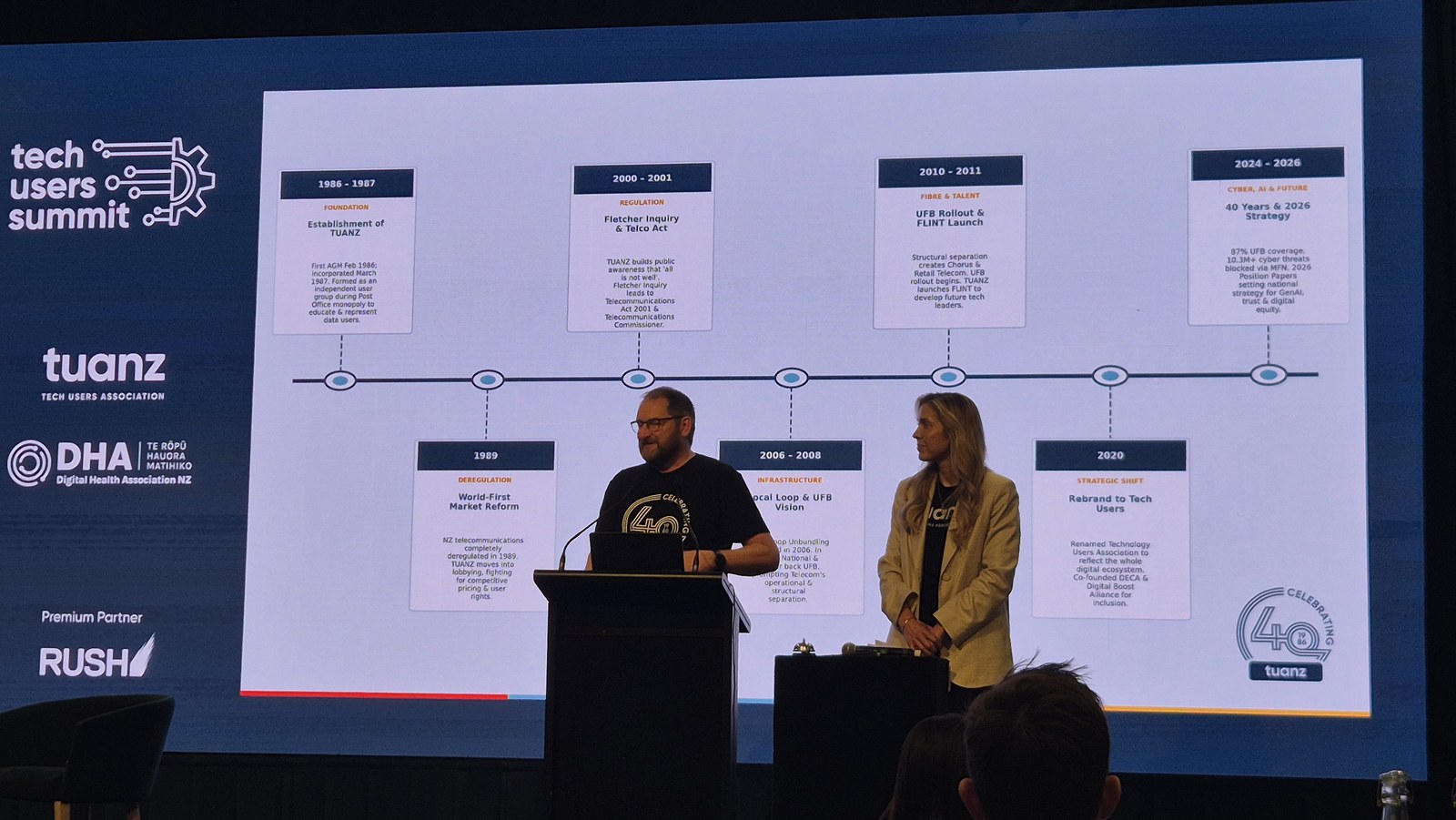
The timeline behind him settled a question that public sources have long disagreed on. TUANZ held its first AGM in February 1986 and was incorporated in March 1987, formed as an independent user group during the Post Office monopoly to educate and represent data users.
What followed reads as a history of New Zealand telecommunications policy. The world-first complete deregulation of 1989, after which TUANZ moved into lobbying for competitive pricing and user rights. The Fletcher Inquiry at the turn of the century, which TUANZ fed by building public awareness that all was not well, and which produced the Telecommunications Act 2001 and a Telecommunications Commissioner. Local loop unbundling in 2006. Both major parties backing ultrafast broadband in 2008, which prompted Telecom’s operational and structural separation. The UFB rollout and the launch of FLINT to grow future tech leaders. The 2020 rebrand from Telecommunications to Technology Users, to reflect the whole digital ecosystem.
Young was happy to claim a share of the credit, carefully. His predecessors and predecessor boards, he said, would take some for UFB, because a great deal of work went in before the Key government was elected on a national fibre network. The same goes for the split of Telecom into two organisations, and for mobile number portability. All of those happened on TUANZ’s watch.
He also made a claim worth noting. With IT Professionals NZ now closed, he believes TUANZ is the longest-standing technology association in the country. The context is that IT Professionals NZ, which began life in 1960 as the New Zealand Computer Society, was placed into liquidation by a members’ vote in December 2025 after sixty-five years.
The reason for marking the anniversary, he said, was not nostalgia. It was a reminder that big intergenerational progress happens when industry, government and users align around a shared vision.
TUANZ is releasing two documents on the day. The first is a booklet updating the history it wrote for its thirtieth anniversary, with a new chapter covering the last decade including the shift from telecommunications to technology. He promised it is not a long read.
The strategic imperative
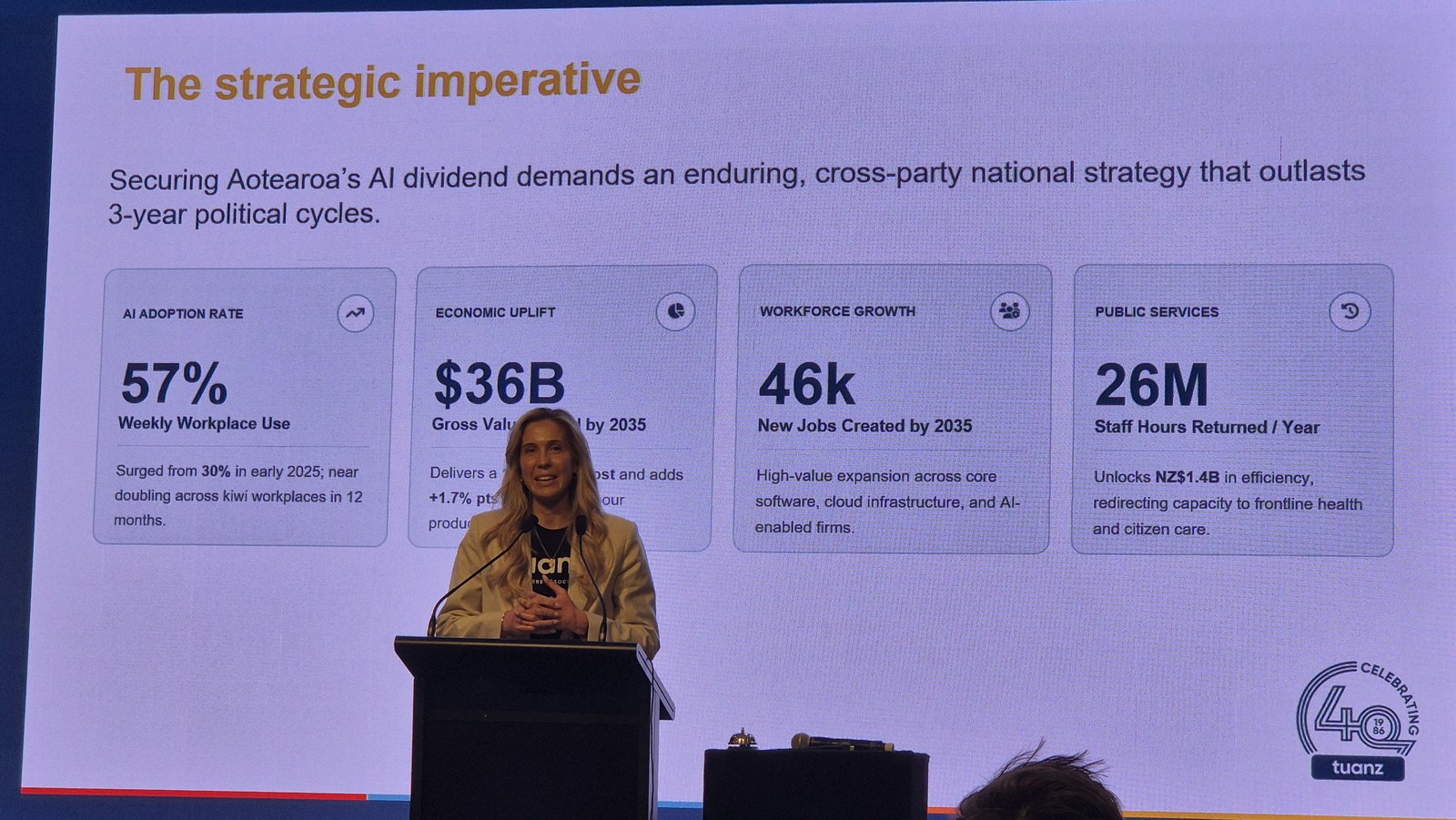
The slide put the case in four figures. Weekly workplace use of AI sits at 57 percent, up from 30 percent in early 2025, close to a doubling across New Zealand workplaces in twelve months. Full adoption is projected to add $36 billion in gross value by 2035 and 1.7 percentage points to productivity. It would create 46,000 new jobs across core software, cloud infrastructure and AI-enabled firms. In the public sector it would return 26 million staff hours a year, unlocking $1.4 billion in efficiency that could be redirected to frontline health and citizen care.
The line above the numbers was the point: securing Aotearoa’s AI dividend demands an enduring, cross-party national strategy that outlasts three-year political cycles.
Young put the economic weight of the sector alongside it, citing an estimated $76 billion of economic transformation from responsible AI adoption. That figure traces to a 2024 study projecting generative AI could add $76 billion to the New Zealand economy by 2038, with a best case above $100 billion. A separate study commissioned by Google puts its own estimate at $36 billion, which is the figure on the slide.
He was blunt about the policy record. Technology was one of the pillars in the government’s growth plan in its first year, and he said he has not seen much yet in that space. The national AI policy released last year was, in his view, underwhelming.
What is needed, he said, is certainty, coordination and commitment. The comparison he reached for was deliberately imperfect: New Zealand cannot run itself like China or Singapore, where stable governments can drive a programme straight through. But the parties here must still be able to think across the lines on something this transformational.
Theme one: empowering people
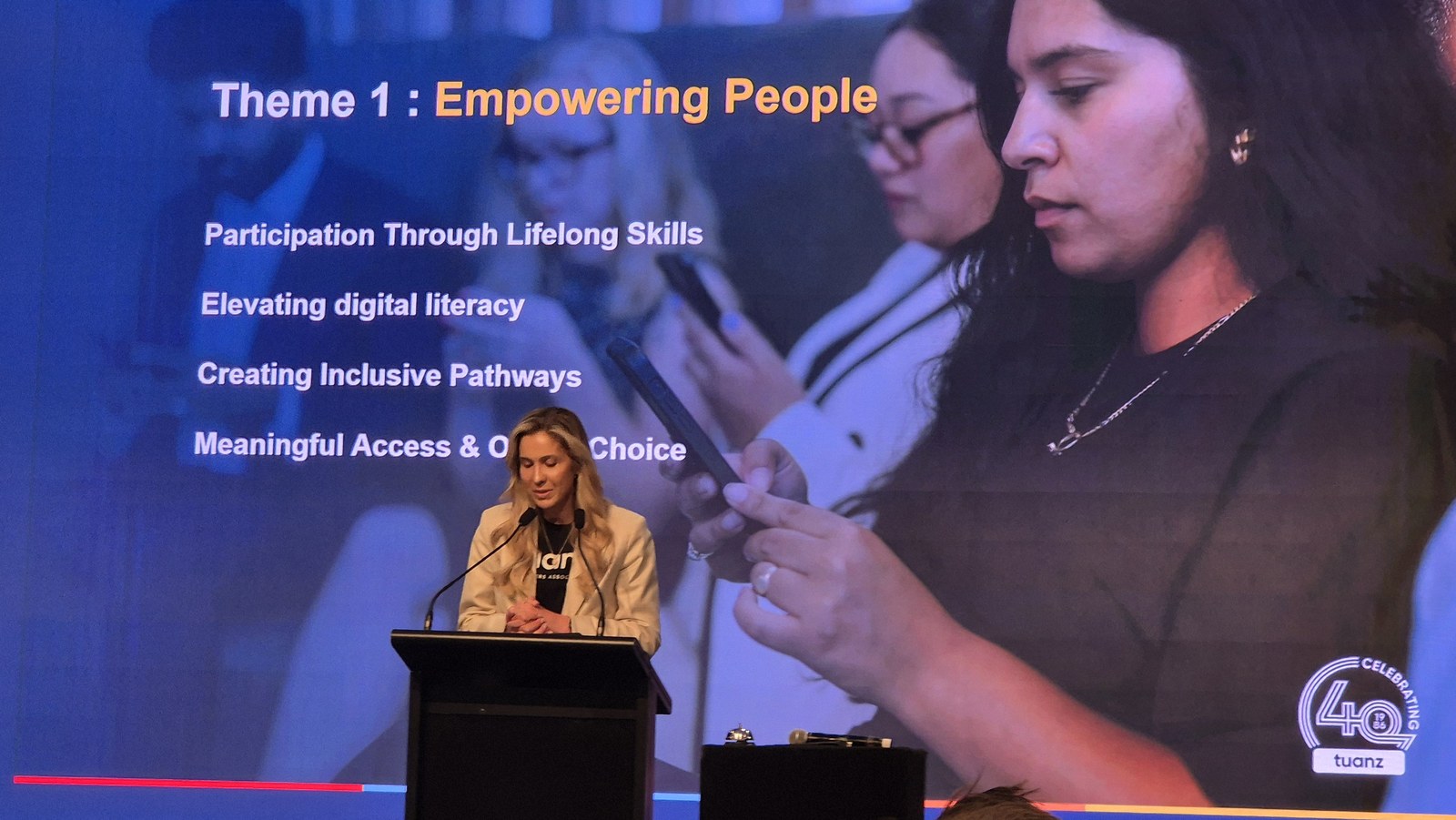
Young handed over to Haley Mortimer, a TUANZ board member appointed this year and, in her day job, General Manager Corporate Affairs at Z Energy. She has run external communications and government relations through the company’s acquisition by Ampol and New Zealand’s shift to an import-only fuel model, managed Fonterra’s New Zealand government affairs before that, and worked earlier as a press secretary and adviser to senior ministers. She introduced herself as, technically, Young’s boss for two hours every two months.
Her starting point reframed his.
"Technology doesn't create opportunity. People do."
If New Zealand genuinely wants the benefits of AI and digital technology, she argued, more infrastructure is not enough. People need the skills, confidence and opportunity to participate, the systems have to be resilient, and there has to be enough trust for innovation to grow. Those became her three themes.
On the first, she noted how much air time the technology itself gets compared with whether people can use it, access it, and feel they belong in decisions about their own future. Technology is only valuable if people can take part.
The opportunity is real, and she cited businesses reporting efficiency gains from AI at well over ninety percent. But adoption is not capability, and she named what she called the AI paradox: the same people are spending a great deal of time checking and correcting AI-generated work, while the country faces a skills shortage in the sector. You cannot buy your way out of a capability problem. It has to be built here, across schools, workplaces and communities.
Her framing of what that means was the sharper claim. Digital capability can no longer be treated as a specialist skill for people who work in tech. It is becoming a core workplace and life skill, sitting alongside literacy and numeracy.
On pathways for Māori and Pacific young people, she was precise about where the barrier really sits. It is not a shortage of interest, talent or ambition. It is whether they can see a pathway for themselves, and whether the environments they would enter are ones where they feel safe, supported and able to thrive. A strong domestic talent pipeline depends on workplaces and learning environments where more people can feel they belong.
Then the access figure, which is TUANZ’s long-running campaign. One in ten New Zealand households still lacks internet access, and rural families pay substantially more for what they do get. As more services move online, the consequences compound. Her point was that this is about meaningful participation rather than handing out a device, which means designing services around the reality of people’s lives and keeping appropriate offline choices so nobody is unintentionally left behind.
Theme two: resilience
Mortimer’s second theme drew directly on her work in and around critical infrastructure, and it opened with an observation that landed in a week when the lights had been out.
"Resilience isn't thought about until it's missing."
Nobody thinks about fuel infrastructure until supply is disrupted, or about electricity until the power goes off, as it did a couple of days ago. Digital infrastructure gets the same treatment: it becomes visible when a system fails, a service goes offline, or someone you know is targeted by a scam. Reliance on digital systems has grown enormously. Understanding of resilience has not kept pace.
Her conclusion was that cyber security can no longer be treated as an IT issue or a compliance exercise. It is an economic issue, a question of national resilience, and a human one.
The numbers she put behind that were concrete. New Zealanders are losing over $200 million a year to scams, and behind the figure sit people who have lost savings, businesses that have been compromised and families dealing with the fallout. Capability does work: she said the National Cyber Security Centre prevented close to $40 million in harm to major organisations last year.
The problem is that protection is not evenly distributed. Around a third of smaller businesses report their cyber security is insufficient, because they do not have the resources, people or systems that large organisations have. Mortimer called that a cyber equity gap, and argued it should concern everyone in an interconnected economy, where a vulnerability in one part is a vulnerability to all.
That led to her most pointed policy argument. It is not realistic to expect small businesses to defend themselves alone against increasingly sophisticated, AI-generated deception. Government, industry, telecommunications providers, digital platforms, businesses and consumers all have to play a part, because the best defence is the attack that never reaches someone in the first place.
Resilience also covers privacy and agency. The new information privacy principle 3A, which took effect in May, gives organisations greater responsibilities when they collect personal information indirectly rather than from the person concerned. Mortimer thought the change mattered, but that the signal from consumers mattered more: around three in five New Zealanders say they would walk away from a company over how it uses their data.
Privacy, in other words, is not a compliance obligation. It is a relationship. People want clear information about what is being collected, why, and what happens to it, and they want meaningful choices rather than pages of terms and conditions nobody can realistically read.
Theme three: earning trust through innovation
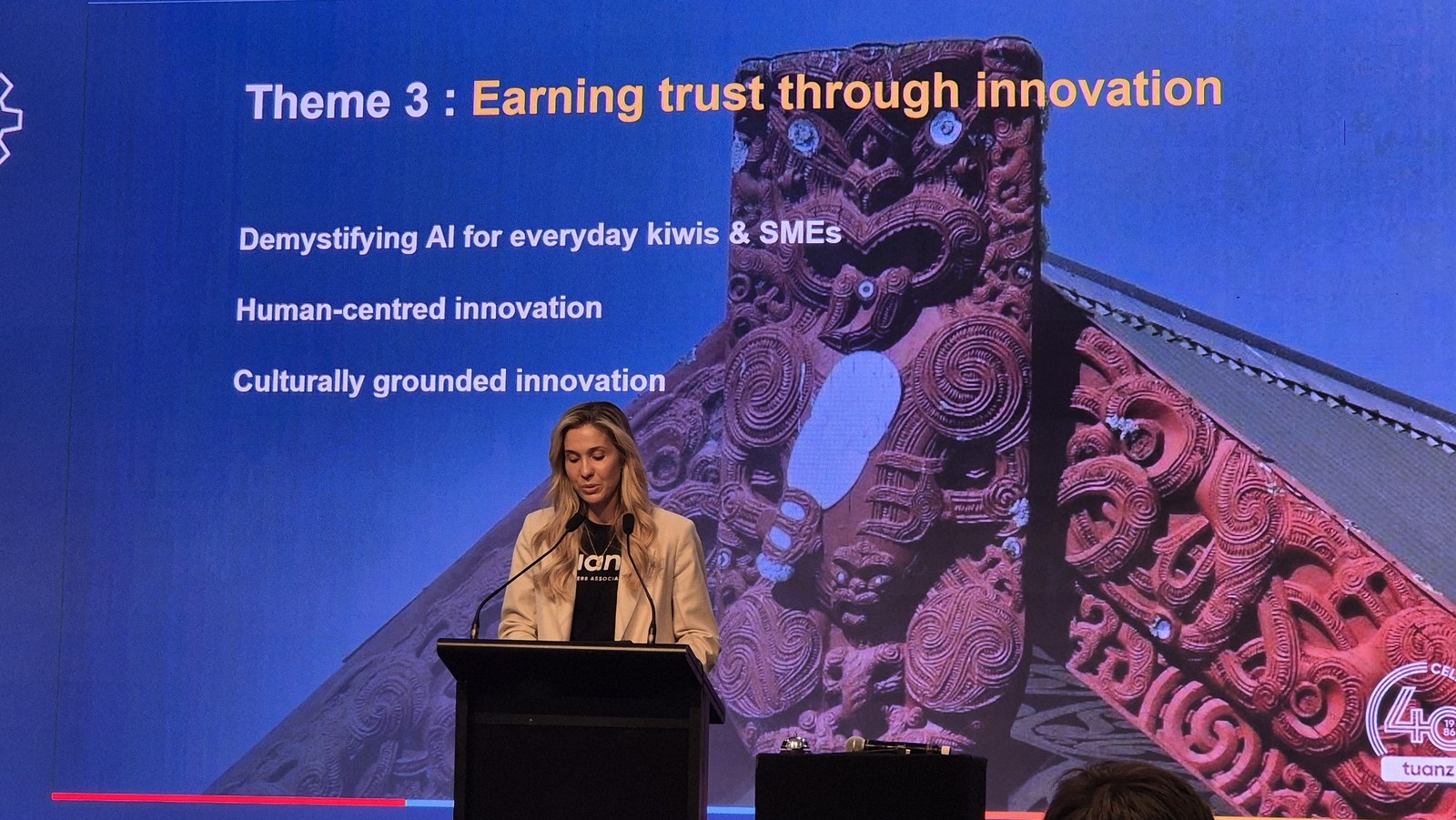
Trust, she argued, is what ultimately determines whether innovation succeeds. People do not adopt technology because it exists. They adopt it when they see value, understand how it works in their lives, and trust the organisations using it.
New Zealanders are already engaging. More than three quarters say they interact with AI in some form. But adoption is uneven, and a substantial share of small businesses remain hesitant to invest because of perceived risk and complexity.
Her answer was neither to talk down the risks nor to let uncertainty stop the country innovating. It was to create conditions in which people and businesses can adopt technology confidently and responsibly, and that requires transparency. People should know when AI is being used in a way that materially affects them. They should be able to understand in plain language how a significant automated decision was reached. And where a decision affects someone’s life, a person should remain accountable, with a clear way to question or challenge the outcome.
Human oversight, she said, has to be meaningful rather than a line in a policy, so that people are confident technology is supporting decisions rather than taking responsibility for them.
She closed on the opportunity in being small. New Zealand will never be the largest market in the world. It could be one of the most trusted. As AI spreads, that trust becomes genuinely valuable.
Doing these three things well, she argued, produces a stronger digital sector, a more productive economy, stronger communities, and a country better placed to take the opportunities in front of it.
A collection of policies is not a strategy
Young came back to close, and to release the second document: a single consolidated version of the five or six policy statements TUANZ put out through June and July, setting out what it wants from the next government.
His reasoning on timing was pure advocacy craft. It is too late to change what parties are thinking now. The moment to act is as soon as new ministers arrive, and then with the opposition for the following three years.
He had run a scan across the political spectrum, and found reason for encouragement. Somewhere across the parties there are commitments to an independent thirty-year infrastructure plan, a central office for AI, an online safety regulator and human oversight rules, an enforceable digital duty of care paired with offline public service options, a cross-party AI framework, a strengthened National Cyber Security Centre, and a financial innovation sandbox.
The problem is that none of it adds up.
"A collection of piecemeal party policies can't replace a single cross-party national technology strategy."
TUANZ’s call is for political leaders to work across party lines on a long-term strategy that matches the scale of the opportunity, and to provide the certainty that businesses need before they will invest.
He left the room with three questions to carry through the day: how do we build trust, how do we ensure AI adoption rather than suspicion, and how do we guarantee everyone has resilient and affordable connectivity. The last of those gets its own summit in May.
His final note was not about policy at all. One of the slides, he said, features someone talking about wanting her grandchildren to grow up in New Zealand. He has two of his own, currently living overseas. Which is the whole argument in domestic form: the country has to be somewhere people want to come back to.
Sources
- TUANZ: Tech Users Summit 2026 programme
- TUANZ: Governance
- TUANZ: About us and our objectives
- TUANZ: Aotearoa's Digital Priorities in 2026
- Reseller News: IT Professionals New Zealand enters liquidation after 65 years
- Microsoft New Zealand: Generative AI expected to more than double New Zealand's productivity
- Ministry of Justice: New privacy information principle now in force
- Office of the Privacy Commissioner: Privacy principles