
Waiting for Certainty Will Be a Long Wait: Sharon Zollner on the New Zealand Economy
13 October 2026· AFQY News
Sharon Zollner closed her economic outlook with a slide headed “The big picture”, and the last line on it was the one the room needed. Left well enough alone, she argued, this economy has a lot going for it. The question is whether it will be left well enough alone, and the honest answer is that nobody knows. So the practical conclusion was not a forecast at all.
"If we're just waiting for certainty, then we're making a decision to do nothing, and that's going to kill us in the end."
That is an unusual thing for a bank economist to tell a room of technology leaders during an oil shock, two weeks out from a Reserve Bank decision and a fortnight before an election campaign gets properly noisy. It was also the throughline of a presentation that spent forty minutes being considerably more cheerful about New Zealand than most people in the room expected.
The housework after the party
Her framing of the last five years was blunt and memorable. We had the boom. We had the bust. We have had the recovery, now four quarters of growth in a row, a full year of the economy expanding.
Recessions are horrible, she said, and this one caused a lot of hardship. But they are also necessary, and they achieve a great deal. New Zealand is in a better position now, in many ways, than it was before, because we have done the housework after the party.
The repair work shows up in the balance sheets, and this was the genuinely surprising part of the morning.
The current account, which Zollner described as the country’s credit card, has come down from over nine percent of GDP to around four. We were living beyond our means, putting the groceries on the card, and an export boom arriving at the same time as a recession meant we were importing a great deal less. Household debt is down relative to both GDP and household incomes. Corporate debt, she said, is the lowest it has been in twenty years.
The boom, in other words, was fuelled by government debt rather than private debt, which leaves private sector balance sheets in genuinely good shape. Small businesses are struggling more, but that is largely a reflection of the sectors they sit in. Construction, retail and hospitality are the most cyclical parts of the economy and they ride the biggest rollercoaster. The wider private sector has not been on that ride.
House prices: take the win
Then came the part of the talk that will annoy anyone who owns a rental and delight anyone who does not.
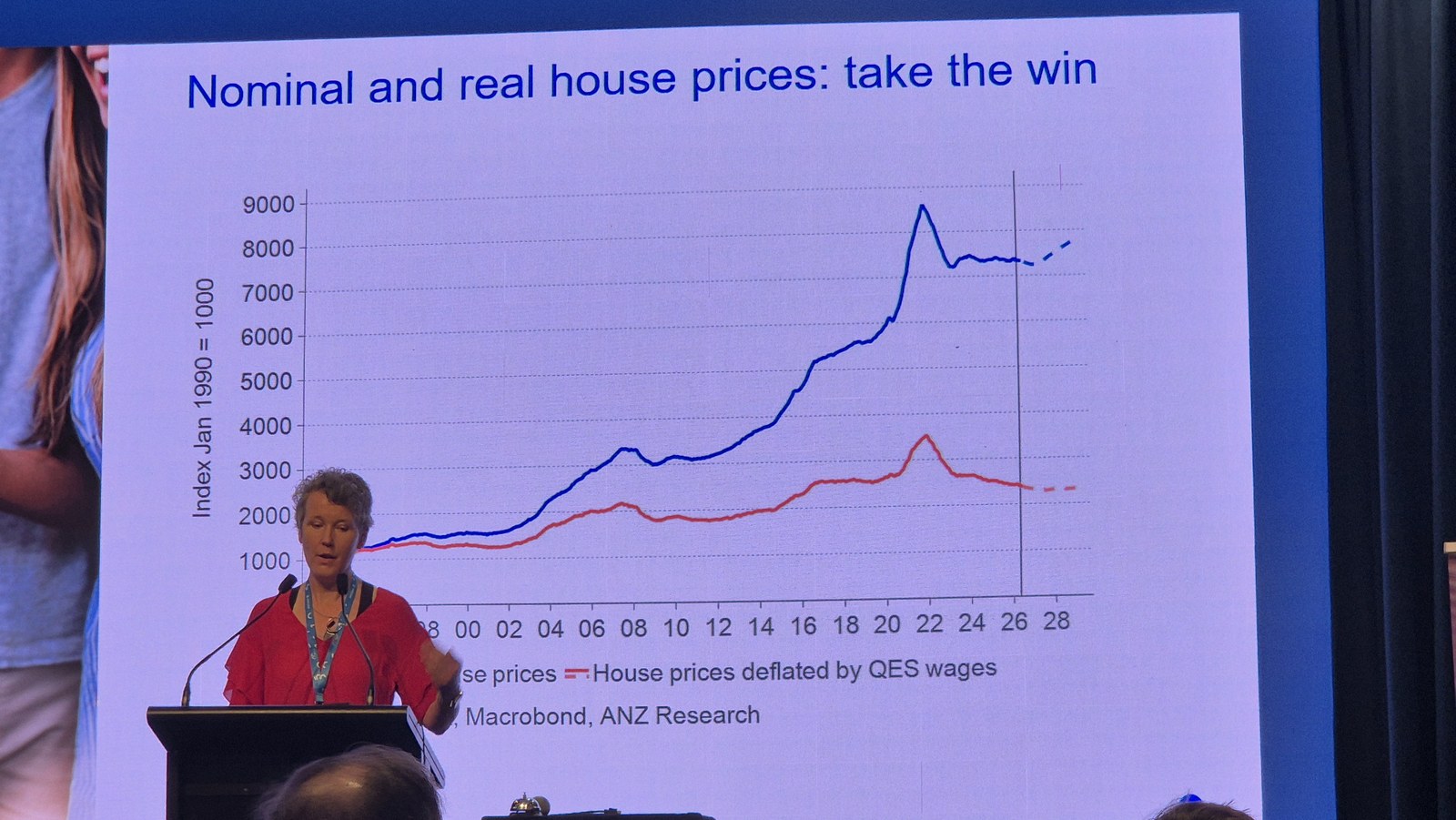
New Zealand had the biggest housing bubble in the world, Zollner said, and she did not soften it. House prices rose fifty percent in two years, from prices everyone already agreed were far too high. Real house prices, deflated by wages, are now back below where they were years ago.
The good news is how little of the nominal gain had to be surrendered to fix it. Prices only had to give up about half of that rise to bring the house price to income ratio back down, because incomes grew very fast at the same time, by almost ten percent. That wage growth was not really a gain in living standards, she noted, since it was compensation for inflation that was then handed straight over at the supermarket. But it did help people make the mortgage payment, and it meant house prices did not have to fall all the way back.
Her economist’s question followed immediately. If the debt was inflated away, who paid for it?
The savers paid. People holding deposits earning less than inflation watched their purchasing power erode. The effect was a wealth transfer from the older generation back to the younger one, which Zollner thought was rather nice given how much wealth has moved the other way in recent decades.
The outcome was that New Zealand dodged a bullet on financial stability. Very few people have struggled to pay their mortgage, despite a deep recession and a fast drop in house prices.
For buyers, the market has rarely looked more comfortable. Mortgage rates are rising again, so people are rolling onto higher rates rather than lower ones, which is now a headwind rather than a tailwind. Rates bills and insurance are climbing. Net migration is practically zero. And nobody expects the capital gains of the last thirty years to repeat.
"First home buyers have got all the time in the world. They've got all the power."
ANZ is forecasting house prices to go broadly nowhere, or slightly backwards. Sales have dropped recently, and the open question is how much of that is temporary election uncertainty, housing being one of the areas where party policy genuinely differs, and how much persists well beyond it.
There is a catch for the rest of the economy, and Zollner was careful to name it. An expansion without rising house prices is an expansion without the wealth effect that usually drives consumption. That means a slower recovery for retail, hospitality and anything that depends on people feeling richer. It also means a more resilient one, because spending built on wealth increases that are not grounded in fundamentals tends to be given back later.
The fly in the ointment
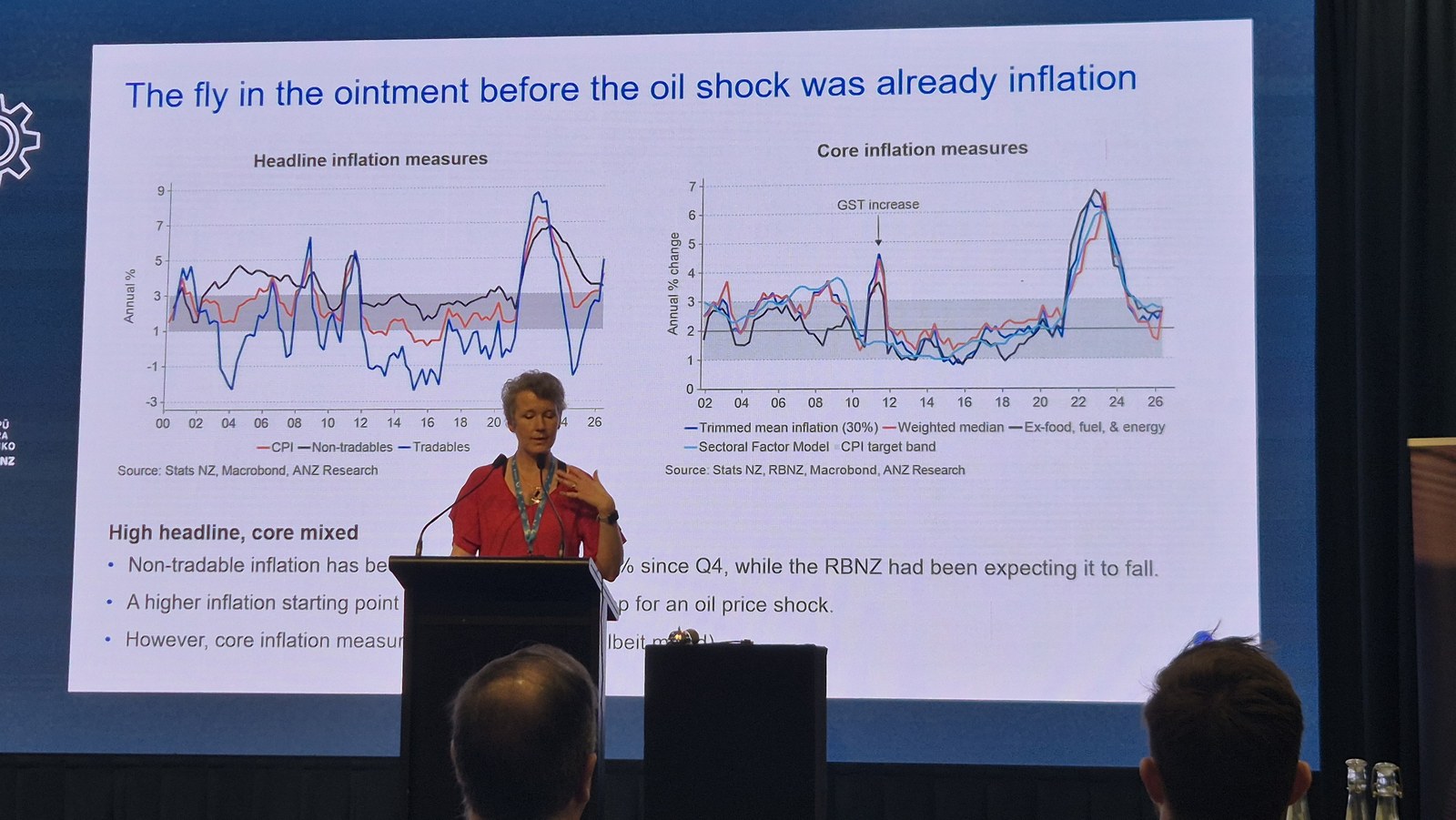
The slide title did the work: the fly in the ointment before the oil shock was already inflation. A higher starting point is a bad place from which to absorb an energy shock.
New Zealand went into this with annual inflation at 4.1 percent in the June quarter, above the Reserve Bank’s one to three percent target band, driven by fuel. Strip vehicle fuels out and the annual rate was 2.9 percent, inside the band, which is the distinction between a global price shock and a domestic price surge.
Zollner walked through why the pump price has moved so much, and it is four things stacked on top of each other rather than one. The crude price itself is not far off the highs it hit in the initial shock. The crack spreads, the gap between crude and refined product, and diesel in particular, have exploded because the world is short of refining capacity. Shipping and transport costs have jumped, with crews for oil shipping particularly expensive. And then there is the currency.
The dollar in the toilet
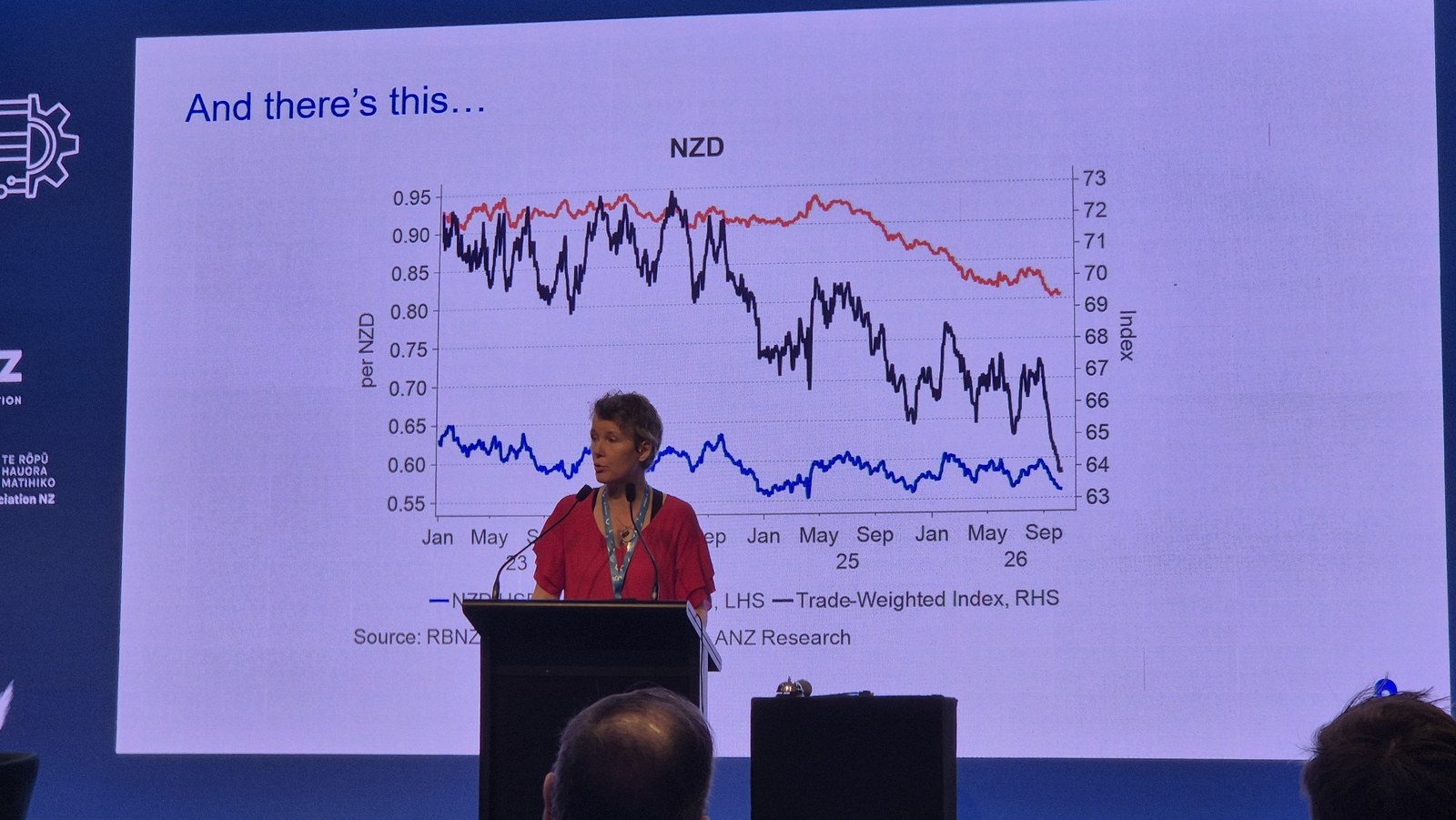
Her description of the exchange rate was less technical: it is in the toilet. For importers and for anyone filling a tank that is painful, since a weak dollar makes an expensive barrel more expensive again.
For the export sector it is wonderful, and that includes tourism. Australians arriving here cannot believe how cheap everything is, a reversal of the usual experience of walking into an Australian supermarket and blanching at the price of a loaf of bread.
The currency matters for the central bank too. The dollar is now nearly four percent below the level the Reserve Bank had assumed at its last meeting, the meeting at which it signalled it could probably pause rather than hike again this month. Oil is also well above the Bank’s assumption.
The call on 28 October
That sets up the most immediately useful thing Zollner said. Put the lower dollar and the higher oil price into the Bank’s own model, and ANZ’s read is that the pause does not survive contact with the data. The market is not convinced, with only fifteen basis points priced for the meeting.
The context from the public record is that the Reserve Bank has already moved twice, lifting the Official Cash Rate to 2.50 percent on 8 July, its first increase since May 2023, and again to 2.75 percent on 2 September. The next decision lands on 28 October.
Zollner was careful about how much weight to put on any of this. Take anyone’s forecast of how high rates will go with a large grain of salt, she said, including hers, and noted the professional hazard: once you start revising in one direction you will probably revise again the same way. ANZ’s forecast peak is a little above three percent, which is the top of the range of estimates for neutral and well below the peak of the last cycle, let alone the 2000s. The Bank is not trying to slow the economy down. It is trying to stop taking its foot off the accelerator while it works out where neutral sits.
She also pointed out something that gets lost in OCR commentary. Mortgage rates started rising well before the OCR did, exactly as they started falling before it. Markets are forward looking, and that tightening in financial conditions is one reason the Bank may not need to be aggressive.
Recovery, interrupted
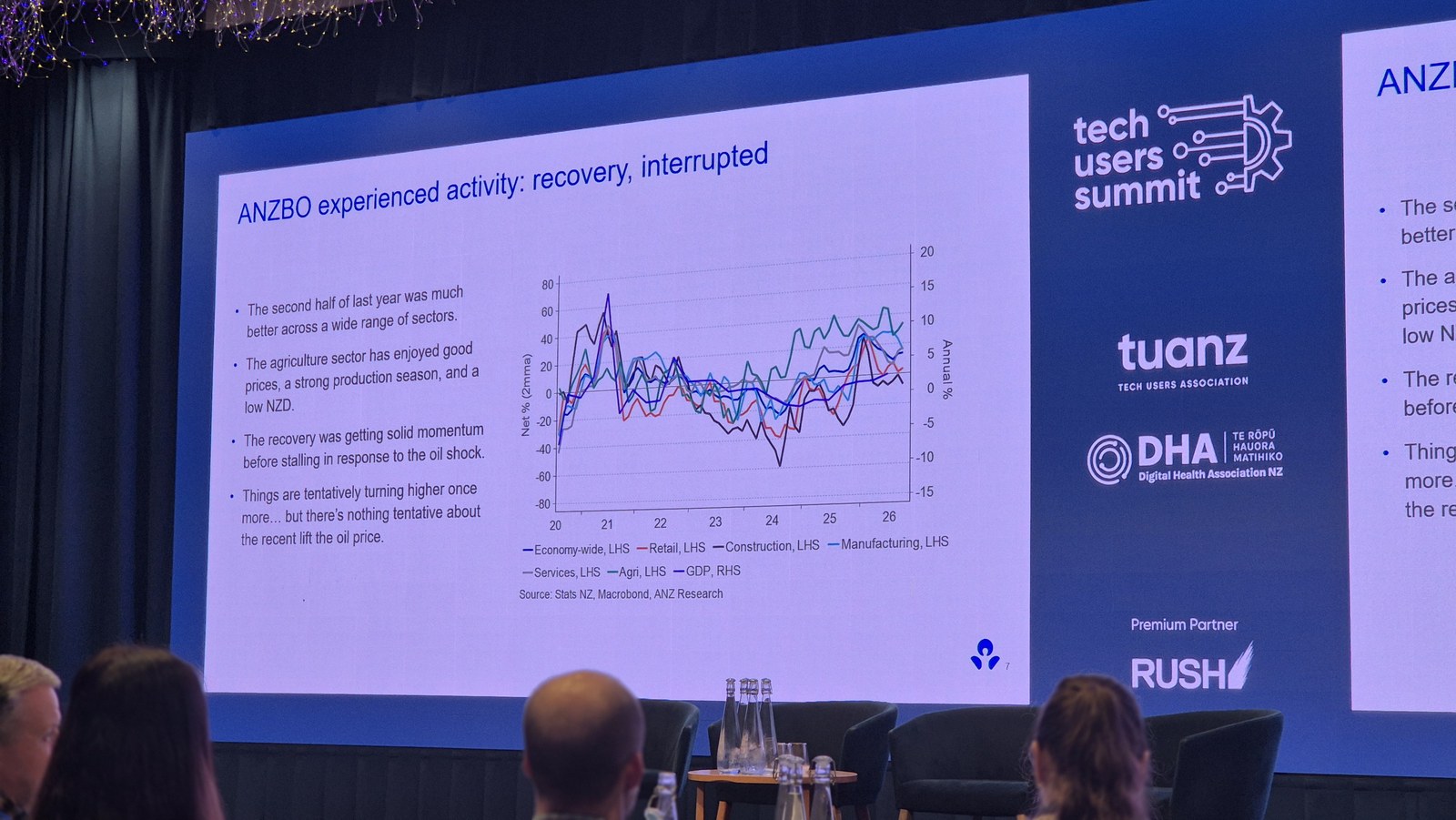
The business survey told a consistent story. The second half of last year was much better across a wide range of sectors. Agriculture enjoyed good prices, a strong production season and a low dollar. The recovery was building solid momentum before stalling in response to the oil shock, and things are tentatively turning higher once more, although as the slide noted, there is nothing tentative about the recent lift in the oil price.
Confidence at the start of this year was sky high, and Zollner was careful about what that did and did not mean. Nobody thought the economy was off to the races. What there was, finally, was very widespread agreement that the recession was over and that the green shoots would stick around this time. Then the oil shock arrived and that confidence dissipated. It has since come back to a solid level, which she found notable given the cost shock everyone is wearing.
What she is hearing from firms is the more interesting signal.
"The cost of not doing it is starting to outweigh the risk of doing it."
Businesses are not pretending the environment is benign. They have worked out that waiting is not risk free either, and in this world you are exposed one way or the other.
On whether firms will pass the cost shock through, the survey was reasonably reassuring. The gap between the number of firms expecting higher costs and the number expecting to raise prices is the widest it has been since the mid 1990s. Businesses are finding their customers extremely price sensitive, and know that pushing the full cost through means losing them.
The map is not evenly coloured
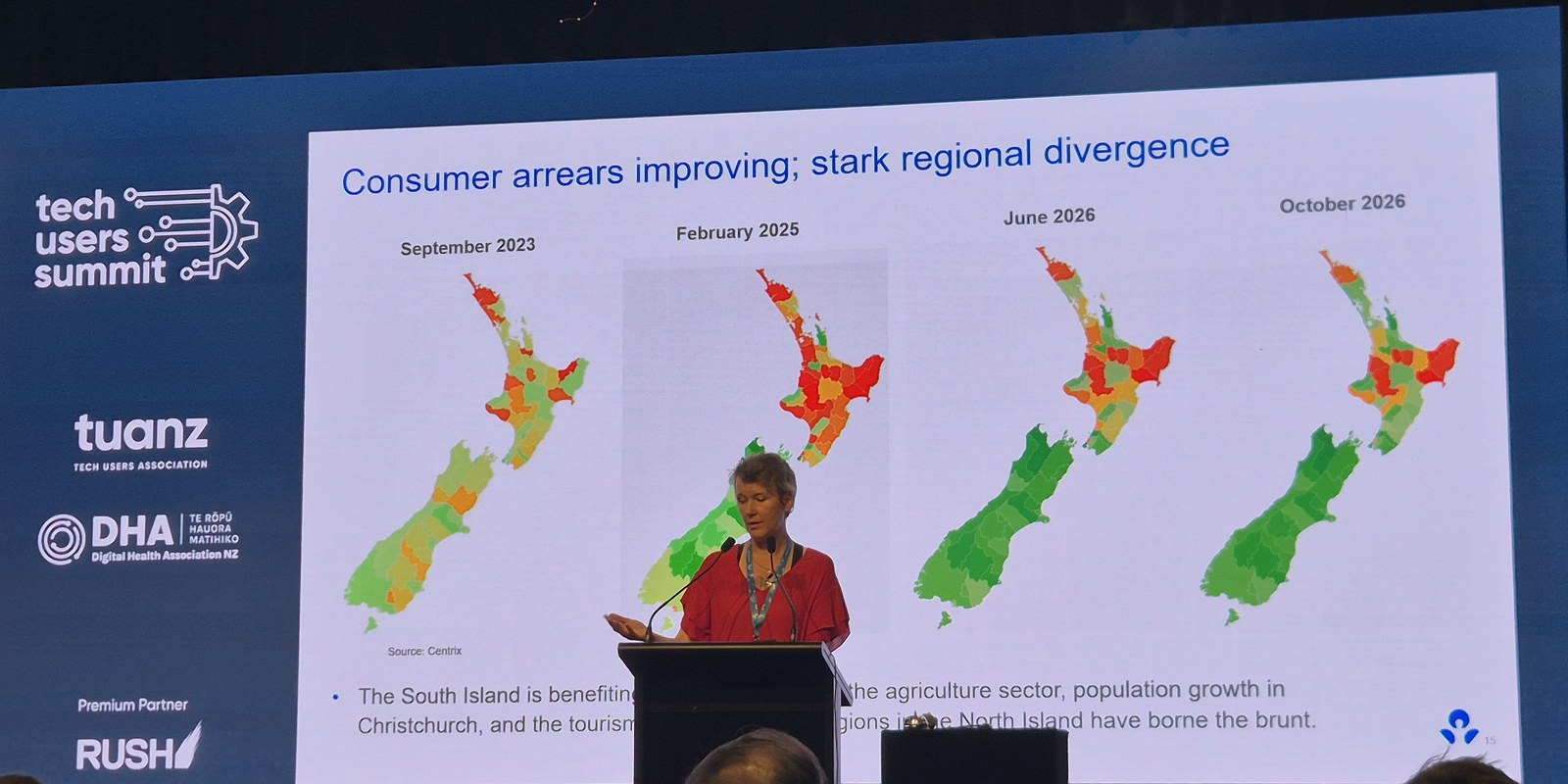
The regional picture, shown as four maps of consumer arrears from September 2023 through to this month, was stark. The South Island is almost entirely green. Much of the North Island, and the eastern regions in particular, is still red.
The explanation is straightforward. The South Island went all in on agriculture and tourism, which are exactly the two sectors doing well, and it is also benefiting from population growth in Christchurch. Within the North Island, the strongest jobs growth is in the regions rather than the cities, with Waikato helped along by dairy.
One number should worry a room full of technology employers more than any other in the presentation. Youth unemployment has risen sharply and sits well above average. Zollner was not willing to assume it falls away neatly as the economy recovers, and named the reason.
Graduate-level jobs, she suggested, are perhaps the ones most exposed to AI. How quickly youth unemployment comes down is therefore a genuinely open question, and one worth watching closely.
What the world is buying from us
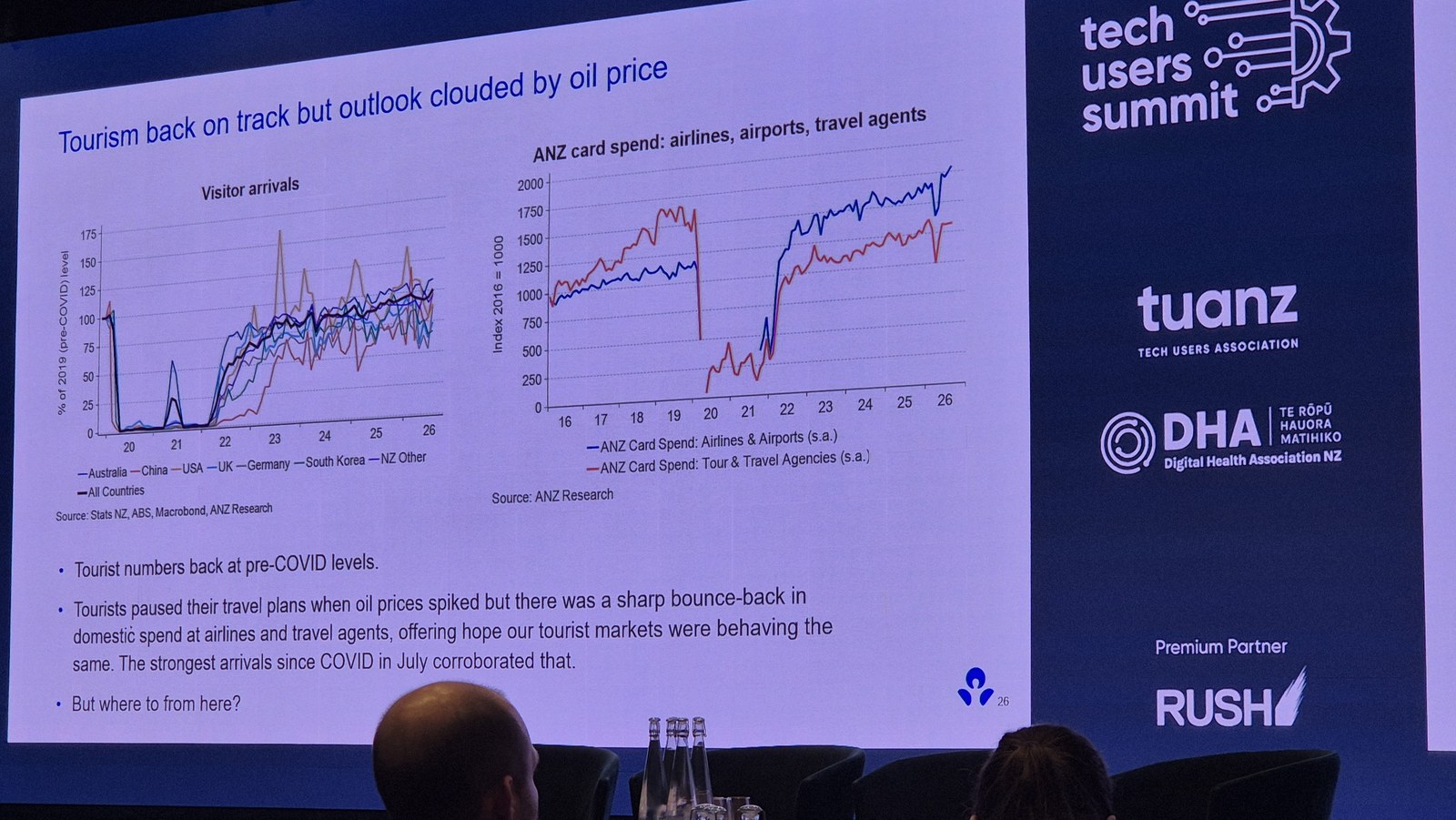
Tourist numbers are back at pre-COVID levels. When oil prices spiked, travellers paused their plans, but there was a sharp bounce-back in domestic spending at airlines and travel agents, and the strongest arrivals since COVID in July backed up the hopeful read. Airline seats into New Zealand are set to rise by six to eight percent this year. The slide’s own closing question was the right one: but where to from here?
Commodity prices are excellent and dairy is holding up well. Zollner described an unusual alignment for the agriculture sector: strong production, strong prices and a weak currency all at once. Normally the dairy price and the New Zealand dollar move together. This time the dollar had to choose between following commodity prices or following the economy and interest rates, and it followed the economy, handing exporters a combination they rarely get.
Then she offered the most unexpected tailwind of the morning. Reported take-up of appetite-suppressing weight-loss drugs in the United States is high enough that what people do eat has to be far more nutritionally dense. Demand for protein, including whey and milk protein, has gone through the roof. Products that used to be sold to bodybuilders are now in supermarket trolleys across America. That, she observed, suits New Zealand rather well.
The end of something bigger than a cycle
Underneath all of it, Zollner argued, is a change larger than the business cycle. For decades, a long decline in global bond yields meant that a household or a government could carry more and more debt for the same cost. That is finished.
Government debt is the real hangover from the pandemic policy response, it is a great deal higher, and it is already constraining choices. New Zealand’s is still low by international comparison, which matters more than usual because markets have suddenly started paying attention to who owes what. European yields now sit well above New Zealand’s, which is a reversal of the normal order of things.
Her point was about buffers rather than austerity. Crises do not politely wait until you have rebuilt your reserves. The reason to care about debt now is so that you have room when something goes wrong, and the cautionary example is a government that finds itself unable to deliver what voters expect because it has already spent the capacity.
For now, she said, the market is looking at New Zealand favourably. She is being asked to speak to global bond investors who have never looked at the New Zealand bond market before. That is a nice position to be in, and not a reason to relax.
The big picture
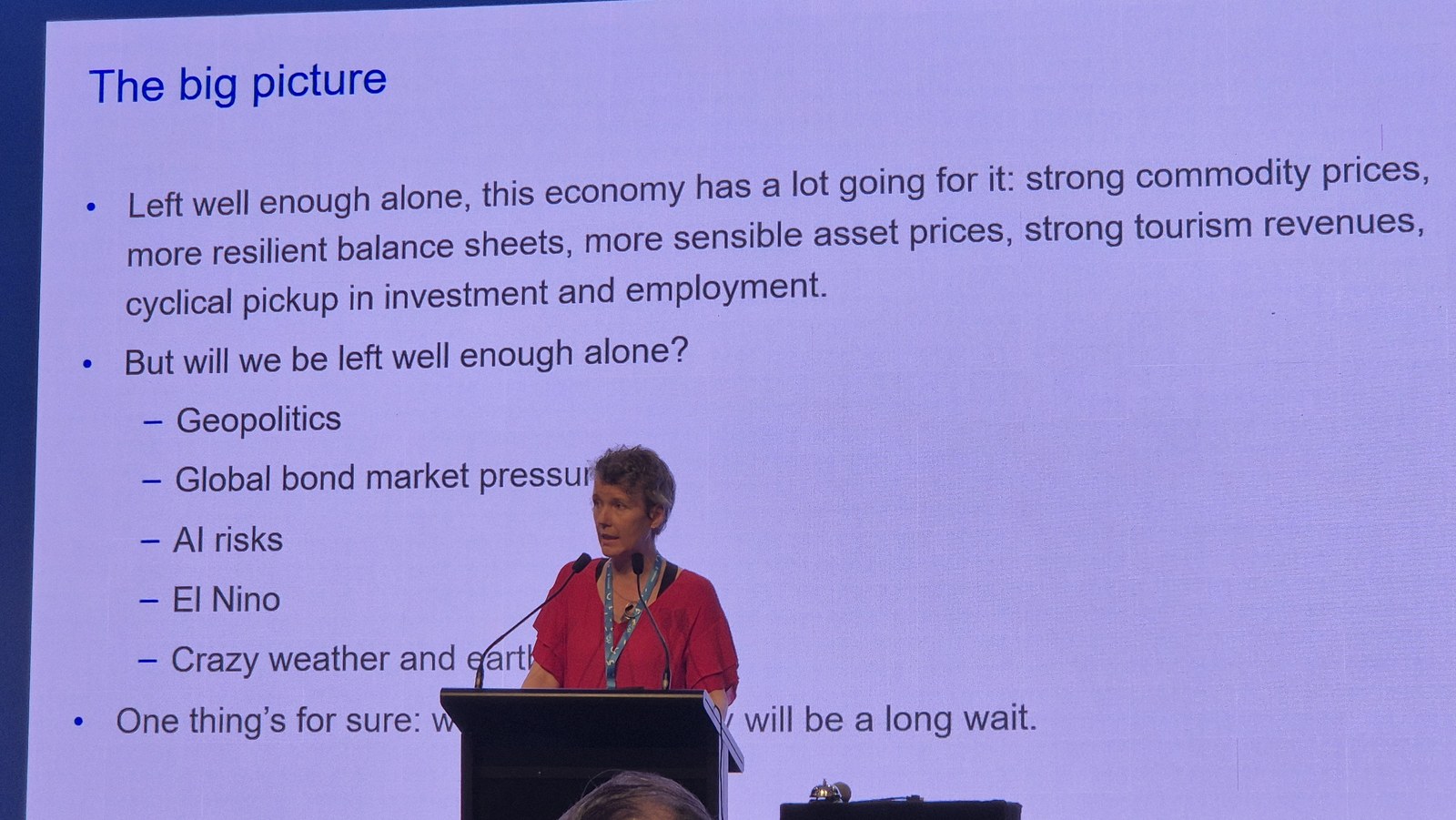
The final slide listed the strengths without hedging them: strong commodity prices, more resilient balance sheets, more sensible asset prices, strong tourism revenues, and a cyclical pickup in investment and employment.
Then it asked whether we will be left well enough alone, and listed the reasons we might not: geopolitics, global bond market pressure, AI risks, El Niño, and crazy weather. On the weather, she noted the temperature difference between the two oceans is one of the biggest seen in decades, which does not guarantee the worst weather in decades but is not a comfortable starting point either.
Her summary was that if the world holds together, New Zealand is in much better shape to grow, and if the world loses the plot, New Zealand is in much better shape to withstand it. Either way, there is no point waiting for things to settle down, because this is the new normal rather than a disturbance to be waited out.
Questions from the floor
On accelerating alternative energy while oil stays volatile. Zollner declined to wade into the politics of any particular project, but was clear about where the real constraint sits. Electric vehicle adoption is coming, helped along by a proliferation of cheap Chinese brands and by running costs that increasingly make the case on their own. Imported LNG is not the cheap answer people hope, because the same idea has occurred to a great many Asian countries and that pressure shows in global prices.
The thing that genuinely cracks the problem is storage. Go all in on renewables without enough of it and you can bring the grid down, because the grid was never designed for that. Whoever solves storage at scale changes the picture for everyone.
She then made a point that landed squarely in the room’s own territory. New Zealand needs its own data centres, as a matter of national resilience rather than economics. The cables carrying our connectivity sit on the ocean floor and are not hard to cut. Every bank and most businesses are building their systems in the cloud, and local backups for those systems are not optional. She acknowledged the other side of it too: data centres consume water and power, and some of the places they are being proposed are not where you would want them.
On why raising interest rates helps when the inflation is imported. This was the sharper question, and her answer was the clearest explanation of central banking anyone in the room was likely to hear this year.
Raising rates does nothing about the global oil price. What the Reserve Bank is relying on is a soft economy with spare capacity, so that while fuel prices climb, the price of everything else is under downward pressure. Firms are finding customers very price sensitive, and know that passing the full cost through means losing the sale.
What the Bank is guarding against is the second-round effect. You do not want an economy roaring along in an environment where everyone expects price increases, because then you start getting opportunistic ones. Her example was from construction, where she has heard of fuel adjustment factors being applied at levels far above fuel’s actual share of costs, because nobody can tell the difference.
She was equally clear about the other risk. An oil shock may well be net disinflationary, if the hit to growth outweighs the push on prices, and if oil merely stops rising it removes a chunk of inflation a year from now. The Bank is weighing those two risks every time it meets.
Oil shocks are difficult, she added, mostly because of what they do to politicians. The temptation to stimulate the economy in response is strong, and that is what turns an energy shock into a genuinely inflationary one. Some countries are now subsidising fuel outright, which she characterised with a certain economist’s relish as taking something expensive and hard to get, and encouraging people to use more of it.
Sources
- TUANZ: Tech Users Summit 2026 programme
- Reserve Bank of New Zealand: The official cash rate
- Reserve Bank of New Zealand: OCR increased to 2.50% to return inflation to 2%
- Reserve Bank of New Zealand: OCR decision dates to February 2028
- Bloomberg: New Zealand delivers back-to-back rate hikes to curb inflation
- interest.co.nz: Although the latest CPI inflation data wasn't worrying, it could have been
- ANZ Research