
She Has a Name and a Personality: Inside Datacentre220's AI Employee
13 October 2026· AFQY News
The best moment in Ross Delaney’s talk came when he stopped talking and let his AI employee finish the presentation.
The chief executive of Datacentre220 had spent ten minutes explaining how an agent called TwoTwo works alongside his operations team. Then the slide changed, and TwoTwo’s own words came up: she can watch thousands of signals, spot what matters, and give engineers time back. Team members like her support staff rather than replace them. The engineers stay in control. And Ross can stop pretending his colour-coded spreadsheet is artificial intelligence.
It would have been rude, Delaney said, to take all the credit for a presentation about how she works.
A couple of hundred metres down the road
Datacentre220 is small, as he put it, but very mighty, and it sits a couple of hundred metres from the summit venue in central Auckland. The company is New Zealand-owned and describes itself as the country’s most connected data centre, hosting more than ninety networks, internet exchanges, service providers and content networks. It was chosen for the site because it sits directly on top of two fibre routes.
A significant share of Auckland and national internet traffic passes through the facility every day. Delaney put an anonymised view of just three customers on screen to make the point about scale, and the number behind it was 168.8 gigabits per second.
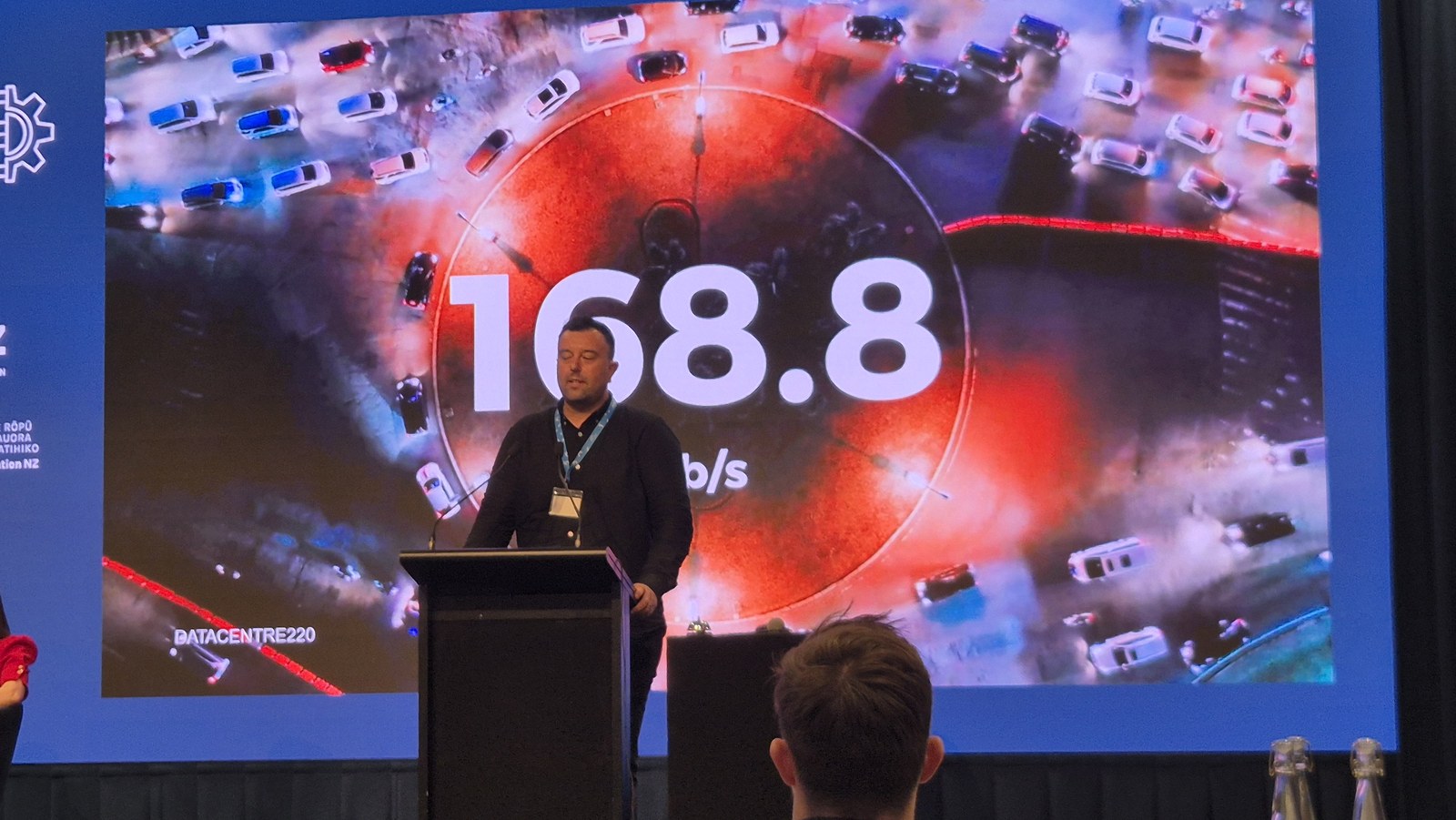
That traffic carries the cloud platforms underneath a good deal of New Zealand’s innovation, which is why Delaney framed the responsibility in plain terms. A small leadership team has to keep the data moving, every day, without fail.
Which left him with a leader’s problem rather than a technologist’s one. How do you look after infrastructure at that scale, and free your team up at the same time?
Not a chat bot. A colleague.
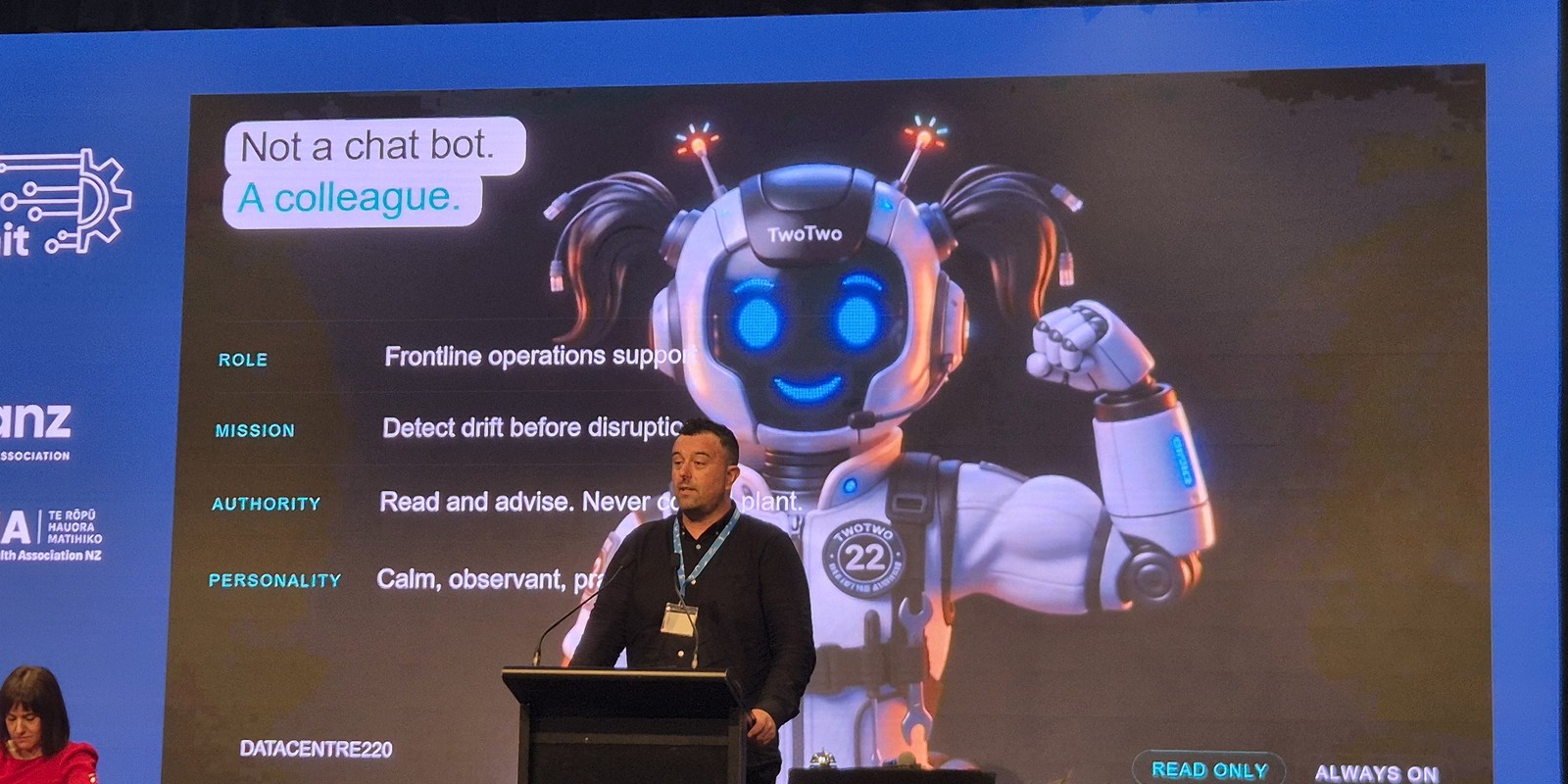
TwoTwo is an assistant AI agent working alongside Delaney and his team, and he was firm that she is more than a chat box. The slide at the top of this page gave her a job description: frontline operations support, with a mission to detect drift before it becomes disruption, authority limited to reading and advising, and a personality described as calm and observant.
Two words sat in the corner of that slide and did a great deal of work: read only, and always on.
The security position is deliberate and conservative. TwoTwo cannot touch the plant. Delaney said writing would be riskier and he is not quite there yet, which is a notably unfashionable thing to say on a conference stage in 2026.
What she can do is watch. A data centre is full of cooling, electricity, batteries, pumps and a great many other things that matter deeply to the person responsible for them, and TwoTwo has real-time access to more than 360 data points across that plant. She analyses them with what Delaney described as a data engineer’s personality.
She also, unusually, lives at home. TwoTwo runs on Datacentre220’s own infrastructure, in Datacentre220’s own data centre, built on open source wherever possible, which Delaney favours partly because it lets you make the thing genuinely your own. And she works where the team already works, which in practice means a Slack channel.
The result is that interacting with her is a normal conversation. He showed a thread where the team asks her things on the way into a meeting, and where she has started asking them to go and physically look at something in the room. As an operator, she will proactively flag things worth checking before they become issues.
What happens behind one question
Delaney’s clearest explanation was of what sits under a single query. Ask why something is running hot, and she will work through a whole range of inputs, checking and discarding, until she finds the one that is not as it should be. She triangulates across the data in something close to real time.
His reflection on that was a leadership one rather than a technical one. You could ask people to do the same thing, in a high-stakes environment, and something would eventually go badly wrong. Not because the people are not good, but because the task is relentless and the data is large.
What it has bought, in money and in time
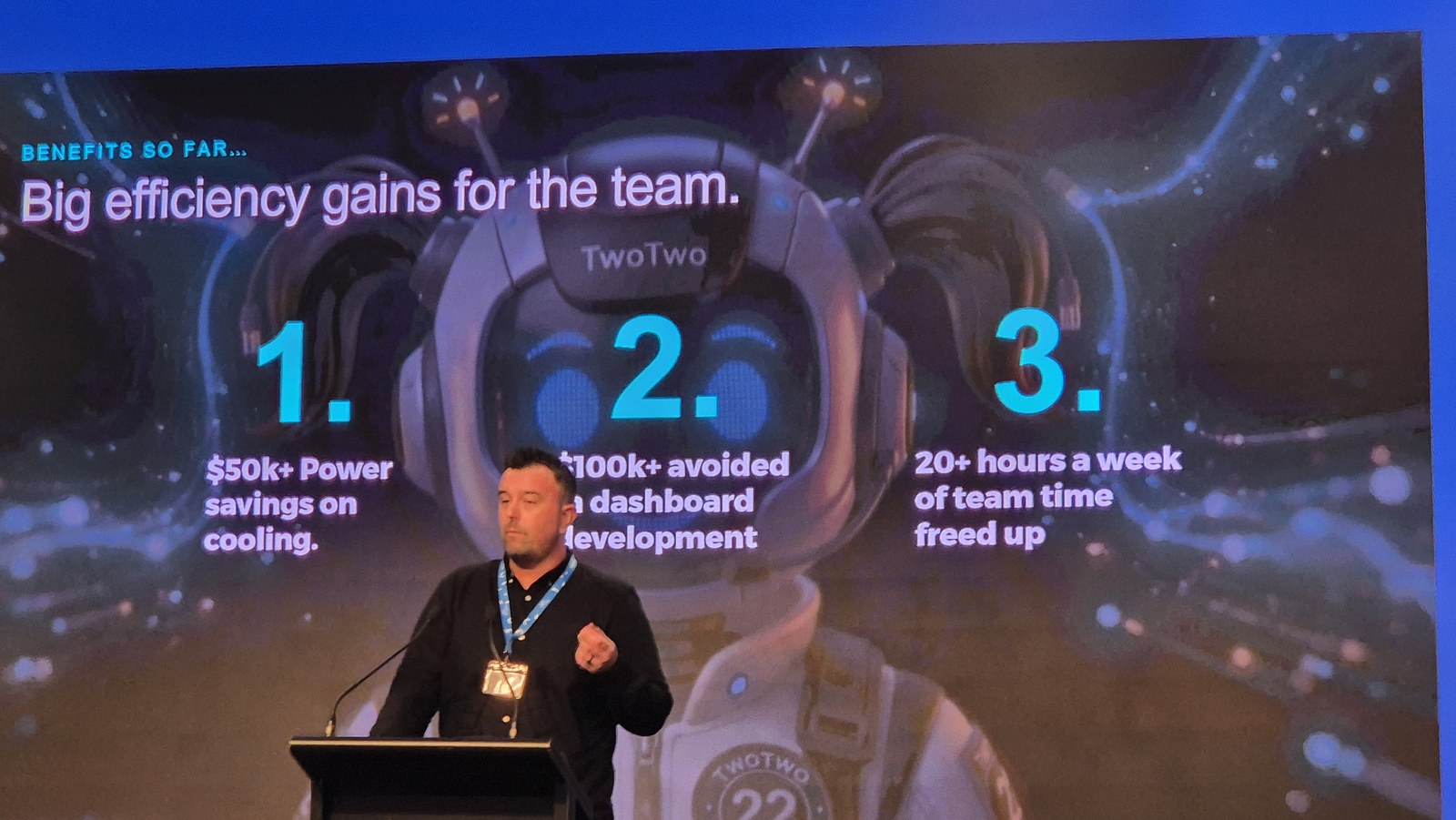
TwoTwo is about six months old, and the slide put three figures against her.
More than $50,000 in power savings on cooling, which Delaney was careful to frame as an environmental and sustainability win as much as a financial one. More than $100,000 avoided in dashboard development, work that would previously have gone to consultants. And more than twenty hours a week of team time freed up.
That last one was the one he cared about. The best thing she has done, he said, is free his team to be better at what they already do.
The honest part
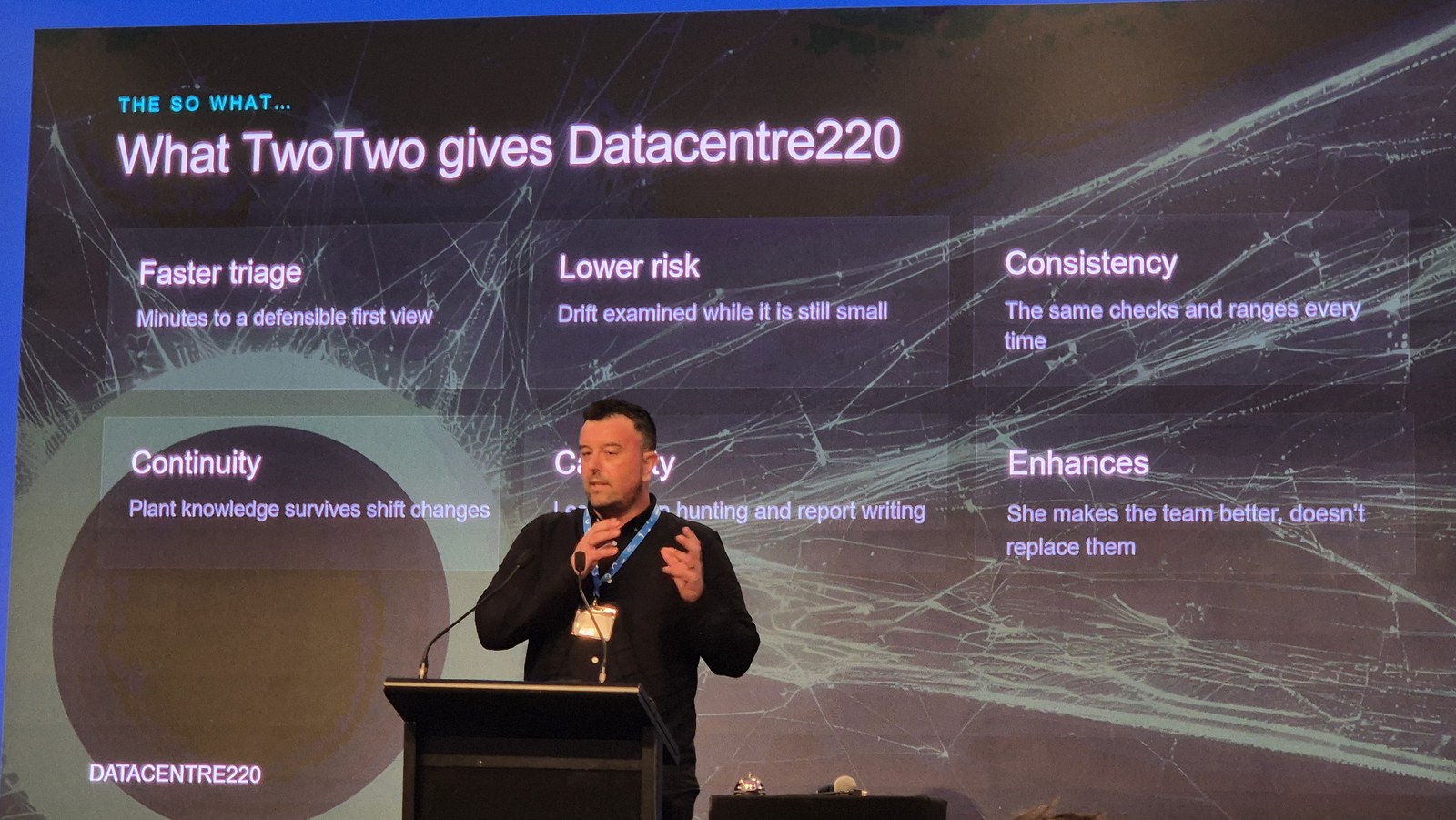
The “so what” slide listed the operational gains without inflating them. Faster triage, measured in minutes to a defensible first view. Lower risk, because drift gets examined while it is still small. Consistency, because the same checks and ranges run every time. Continuity, because plant knowledge survives shift changes. And less hunting and report writing.
The last box on the slide was the one Delaney wanted the room to take away, and it is the question every team asks before anybody says it out loud.
"She makes the team better. She doesn't replace them."
He named the fear directly. When you introduce something like this, people assume they are about to be made redundant. What happened instead, he said, is that the team now feels it could not do without her.
"How do I free my team up to look after the data at scale?"
That was the question he started with, and it is a more useful starting point than most. He did not set out to deploy AI. He set out to solve a staffing and attention problem in a facility where attention cannot lapse, and arrived at an agent as the answer.
For a room full of organisations wondering where to begin, his example has an unglamorous appeal. One narrow domain. Read-only access. Local infrastructure. A clear job description. A name, and enough personality that people talk to her.
Including, apparently, letting her write her own closing remarks.