Adopting Is Not Adapting: Datacom's Morgan Clearkin on the AI Gap
13 October 2026· AFQY News
Morgan Clearkin has seen both ends of the same journey. In a previous role he led an organisation through its adoption of Copilot, establishing the risk assessment and guardrails before rolling it out to more than a thousand people. He now heads Datacom’s AI Lab, where his team’s job is building what the company calls Datacom 2.0.
That gives him an unusually clear view of the gap between those two states, and his talk was about why so many organisations are stuck in it.
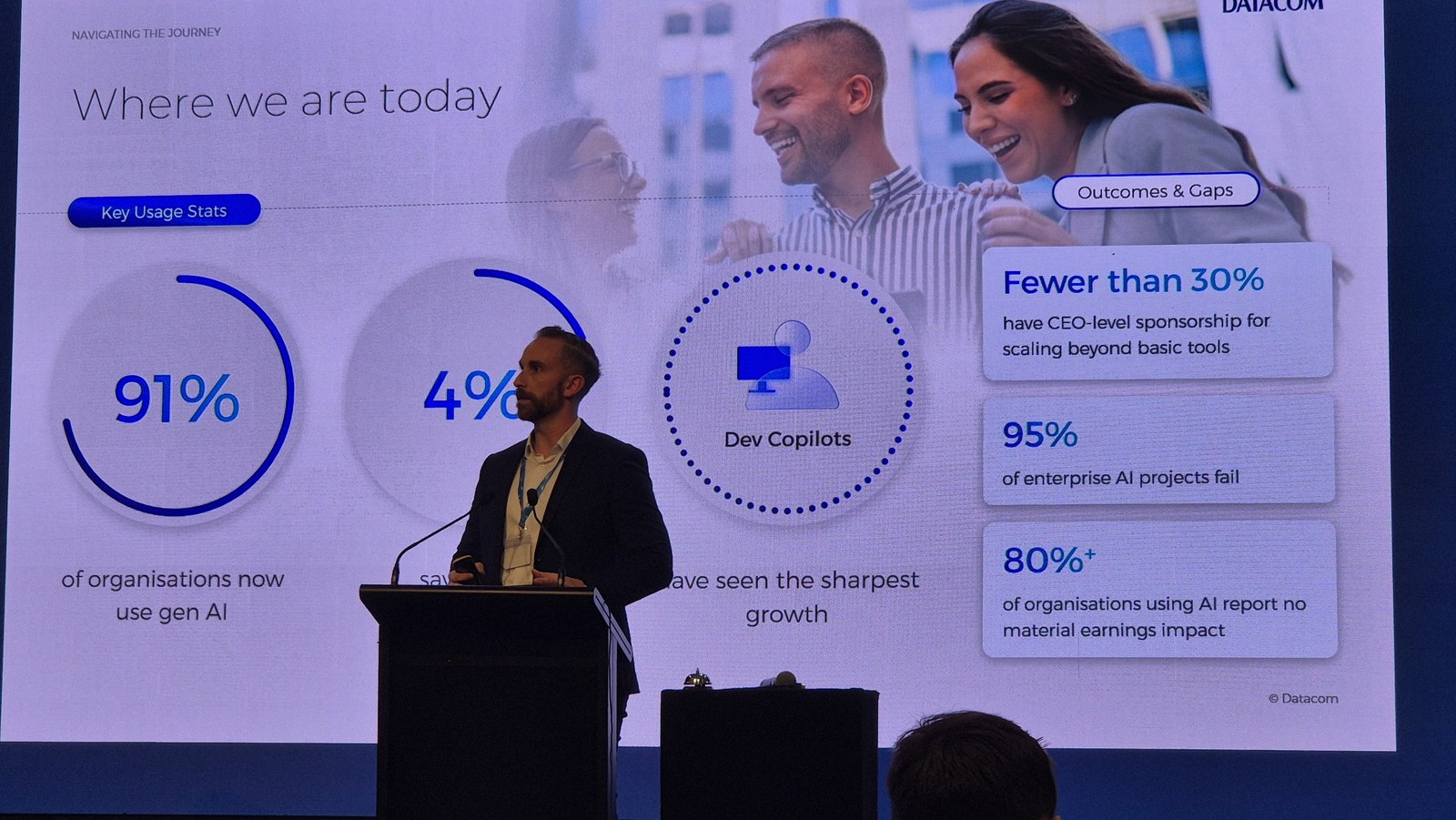
The numbers on his opening slide are worth sitting with. Ninety-one percent of organisations now use generative AI, with developer copilots showing the sharpest growth. Against that: fewer than thirty percent have chief executive sponsorship for scaling beyond basic tools, ninety-five percent of enterprise AI projects fail, and more than eighty percent of organisations using AI report no material earnings impact.
Everyone has started. Almost nobody has crossed from summarising emails to the kind of change a business notices.
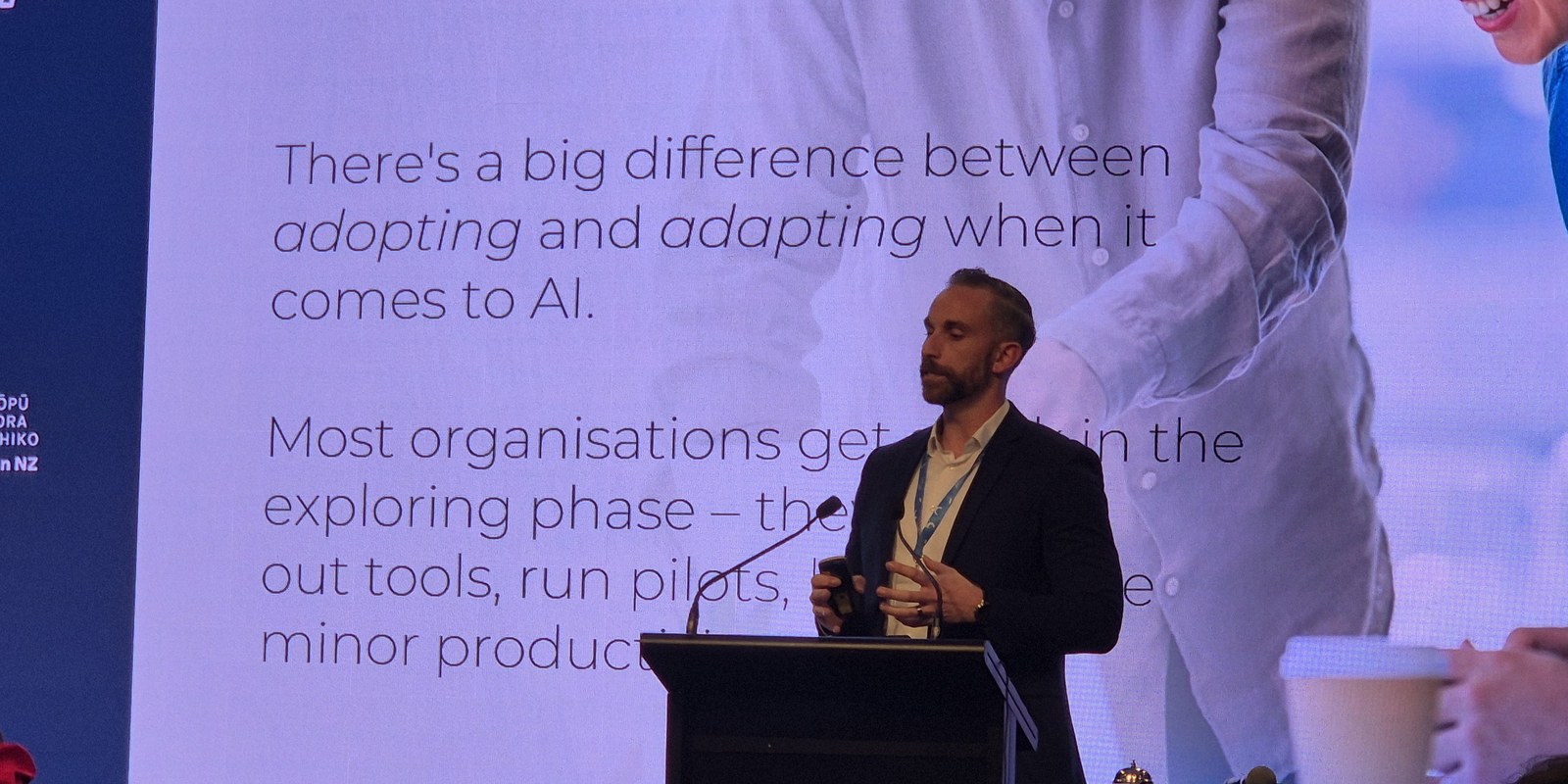
"There's a big difference between adopting and adapting when it comes to AI."
Most organisations, the slide went on, get stuck in the exploring phase. They roll out tools, run pilots, and see minor productivity gains. Clearkin offered three things that move an organisation out of it.
One: people and process before technology
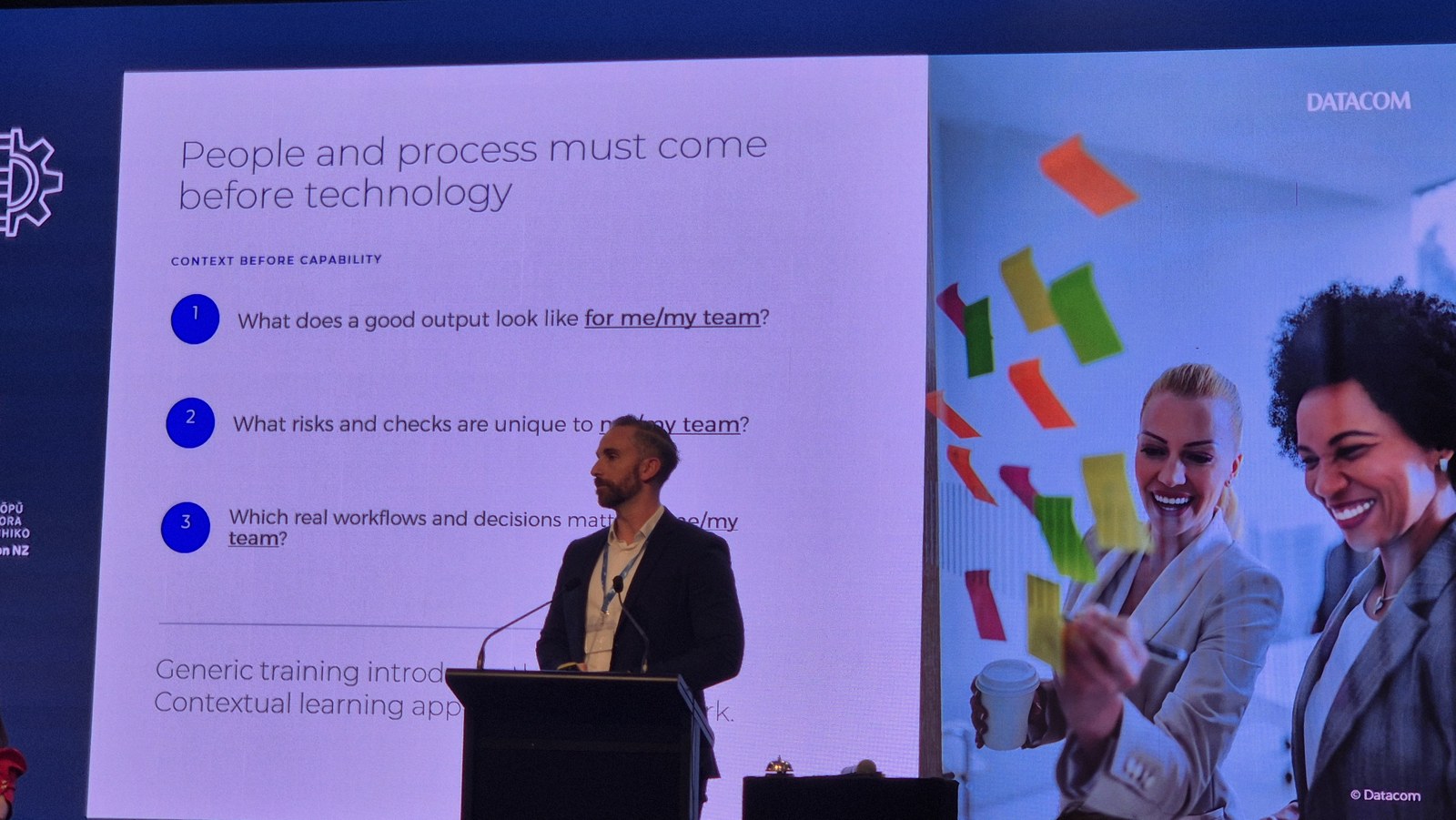
He acknowledged this is a tired phrase for anyone who has been in technology a long time, and then explained why it is not optional here. The tempting path is to choose a product, buy licences, run a rollout and then measure who is using it. That is not a long-term strategy.
What is required is harder and far more specific. What does AI mean in the context of someone’s actual work? What does it mean for someone in marketing, as distinct from someone in finance? What are the risks, responsibilities and decisions unique to those roles, and how do you get the technology to those people in a way that is meaningful in their context?
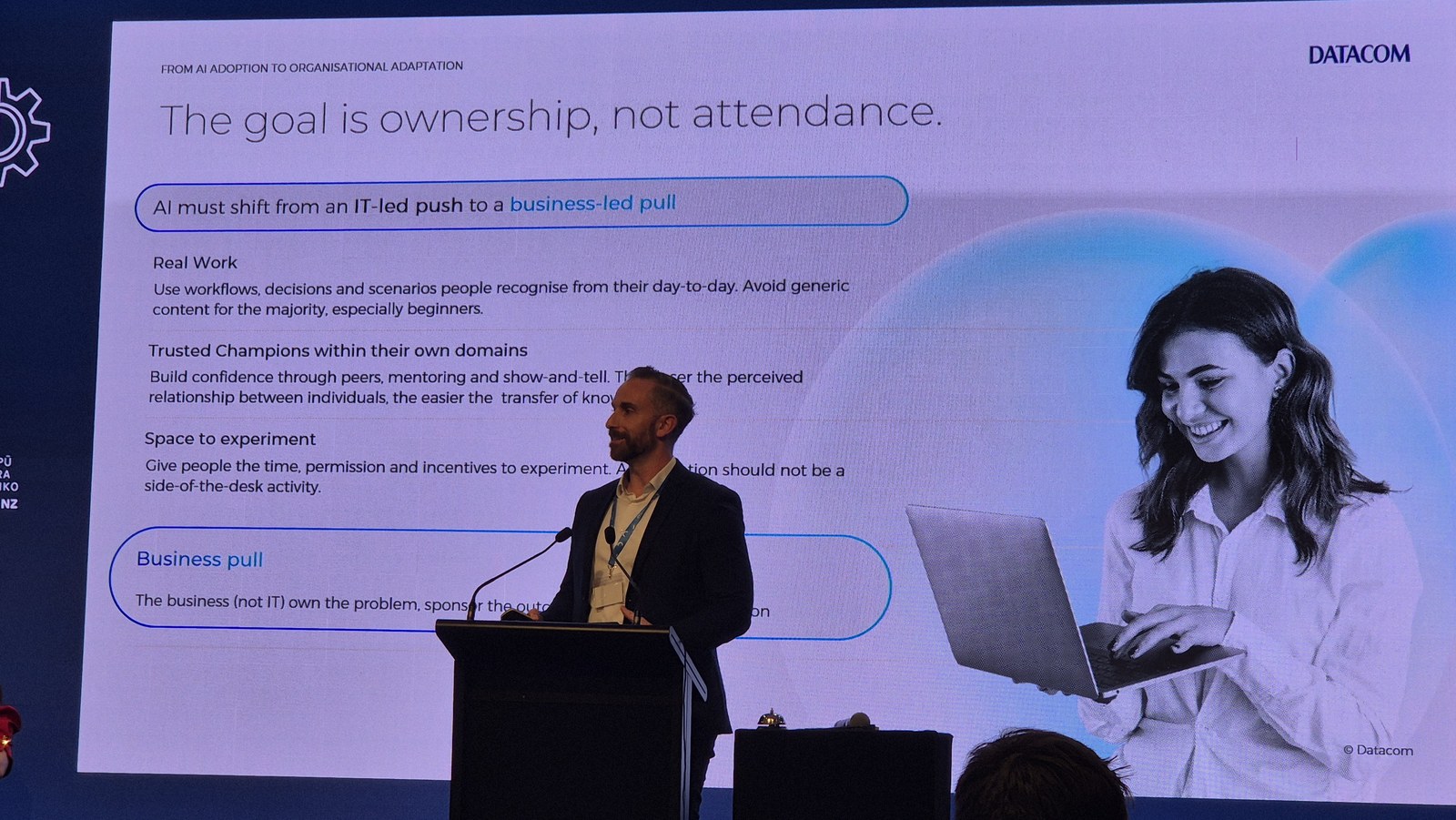
His framing for that was the sharpest line on any of his slides: the goal is ownership, not attendance. AI cannot be an IT exercise, with central IT pushing tools at the business. The business has to own the problem, sponsor the outcome and identify what it wants to achieve. Technologists bring specialist skills, but the people who understand the work have to lead the change.
Then came the part that landed hardest in the room, because it named something everyone recognised.
"What comes first? AI innovation, or a client deliverable? It's always the client deliverable. I'm not saying that's right. I'm saying that's the reality."
He asked how many people had been handed an instruction to go and innovate with AI on top of their existing role, as a side-of-the-desk activity. Innovation that competes with urgent client work loses every time, and pretending otherwise is how AI programmes quietly die. People need the space to do it, not just the permission.
He also made a point about who people trust that should change how organisations staff this work. People are more likely to trust the person sitting next to them, or in their team, than someone from central AI. Including, he noted, him.
Two: proportionate governance
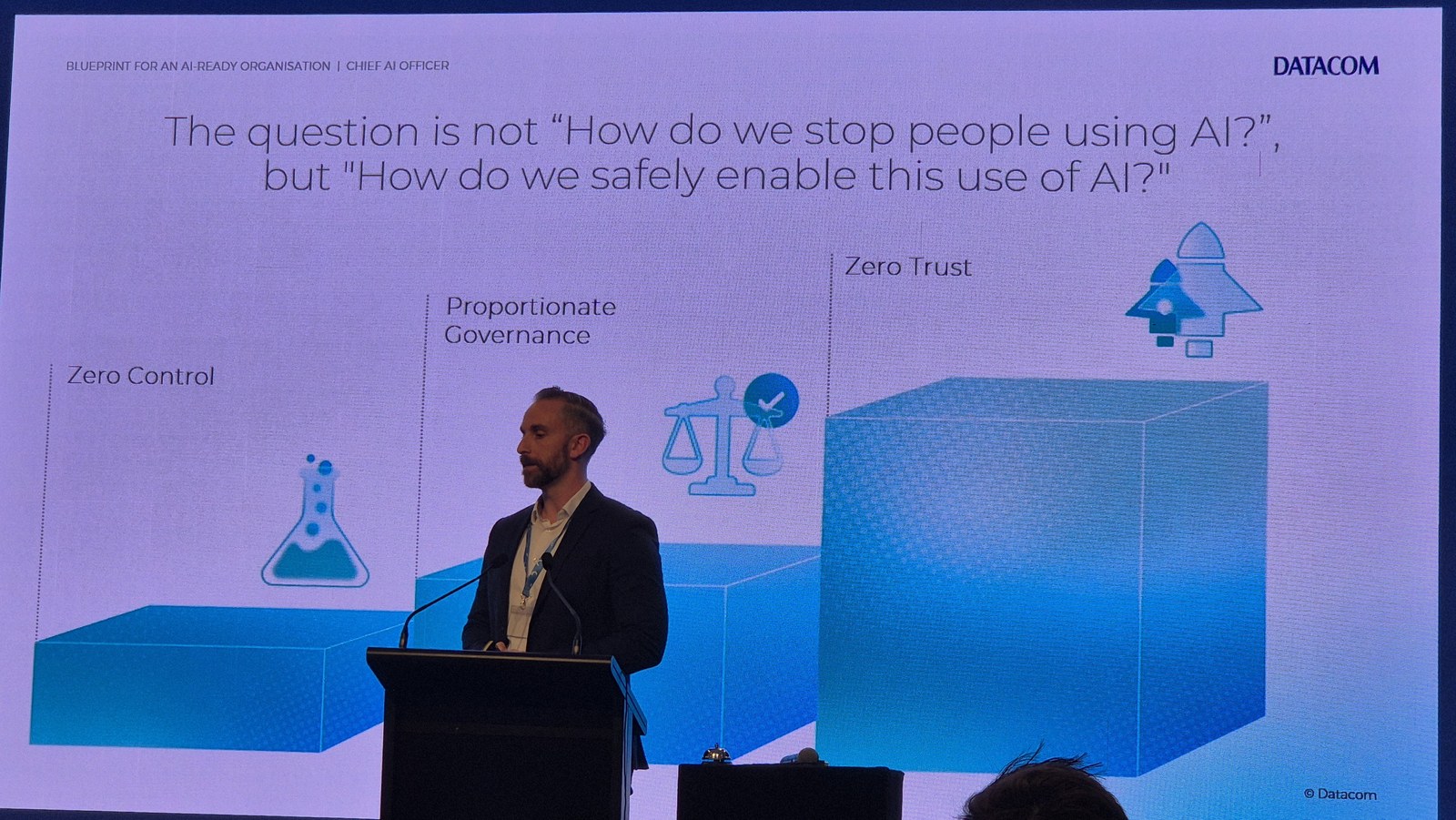
Governance, he argued, is a spectrum with two unliveable extremes.
At one end, everything is locked down under a zero-risk posture: no exposure to the EU AI Act and its consequences, no chance of a data breach in the headlines. At the other, people are quietly using personal accounts on work problems, which means no control at all. Neither is sustainable.
The question he put on screen reframes it usefully. It is not “how do we stop people using AI”. It is “how do we safely enable this use of AI”.
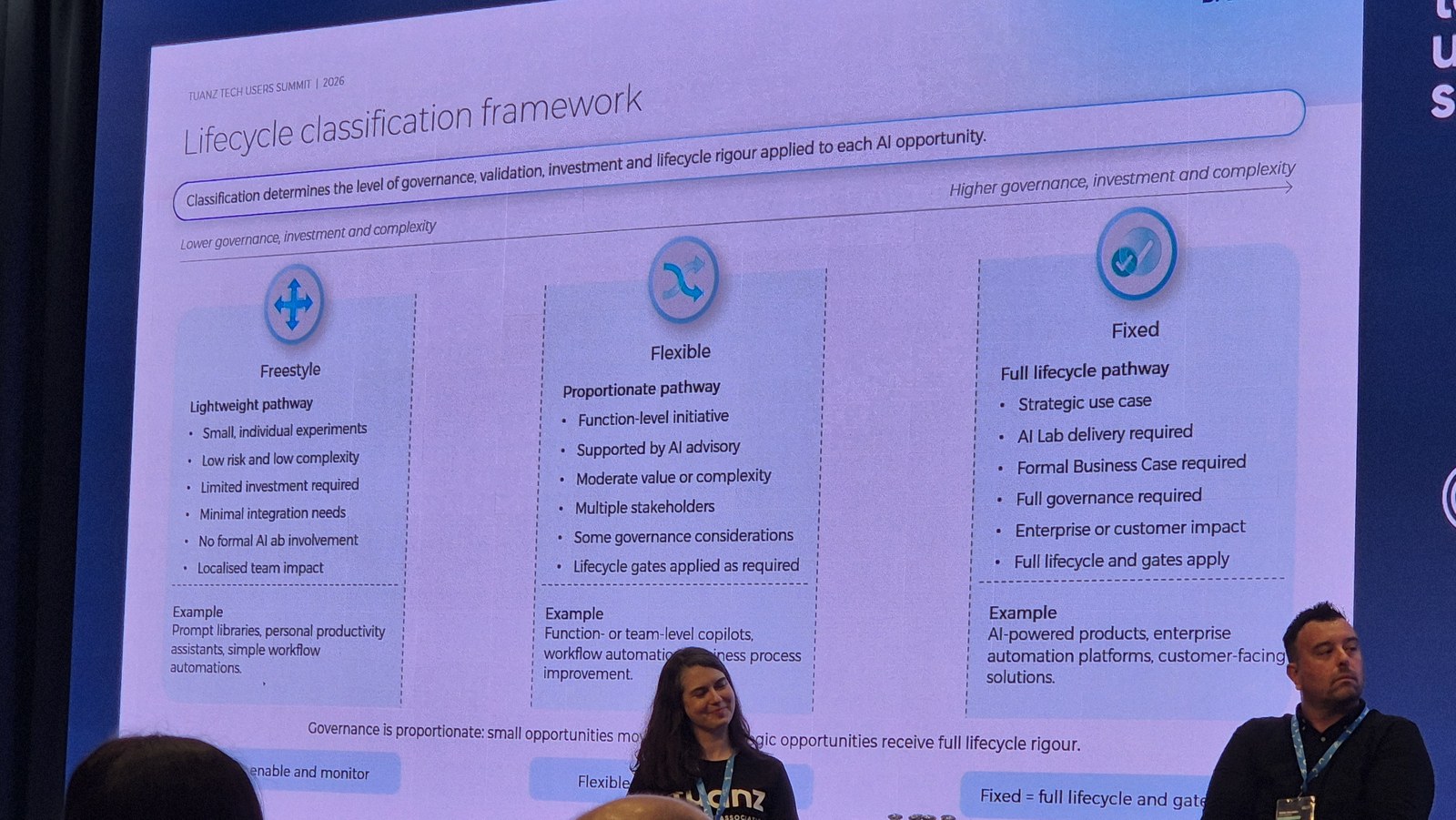
Datacom’s answer is a three-tier lifecycle classification framework, where the classification determines how much governance, validation, investment and rigour each AI opportunity attracts.
Freestyle is the lightweight pathway: small individual experiments, low risk and complexity, minimal integration, no formal AI lab involvement, localised team impact. Prompt libraries, personal productivity assistants, simple workflow automations.
Flexible is the proportionate pathway: function-level initiatives supported by AI advisory, moderate value or complexity, multiple stakeholders, lifecycle gates applied as required. Team-level copilots, workflow automation, business process improvement.
Fixed is the full lifecycle pathway: strategic use cases with AI Lab delivery, a formal business case, full governance, enterprise or customer impact, and every gate applied. AI-powered products, enterprise automation platforms, customer-facing solutions.
The principle underneath is that one governance umbrella cannot cover everything. It has to be tailored and proportionate to the risk being managed.
He then made an argument about people that most governance discussions miss. Technical and access controls matter, but people are a massive enabler of good governance. Put trust in a group of people, give them clear boundaries and genuine freedom to experiment inside them, and bring them into the conversation, because they are the only ones who can tell you what the risk looks like on the ground.
His example was cultural inclusiveness in the use of AI. The people doing the work are in a position to tell you where that goes wrong. Someone far removed from the work is not.
His last governance point was about policies nobody reads. An AI policy published once by email and accepted without being read does not govern anything. People need to know what it says, because they genuinely want to use these tools and are unsure whether they are allowed to. Make the policy real in the context of people’s work.
Three: redesign the operating model
This was the one he considered most important for moving beyond productivity tools, and it opened with a diagnosis he says he sees everywhere he goes.
Organisations arrive with a list of thirty individual AI use cases they want delivered tomorrow, convinced these will fundamentally change the business. They will not. They might produce small improvements and small cost savings, but they are not transformation, and they will not take an organisation to the next level.
"Are we using AI in the way the business currently works, or to shape how the business should work in future? Those are very different conversations."
What organisations are not doing, he said, is stepping back and asking the first-principles question: if we designed this process, this workflow, this function from the ground up, knowing what the technology can now do, how would we do it differently?
AI does not care about organisational silos. It cares about outcomes. Which means the exercise is not to improve today’s business. It is to design tomorrow’s.
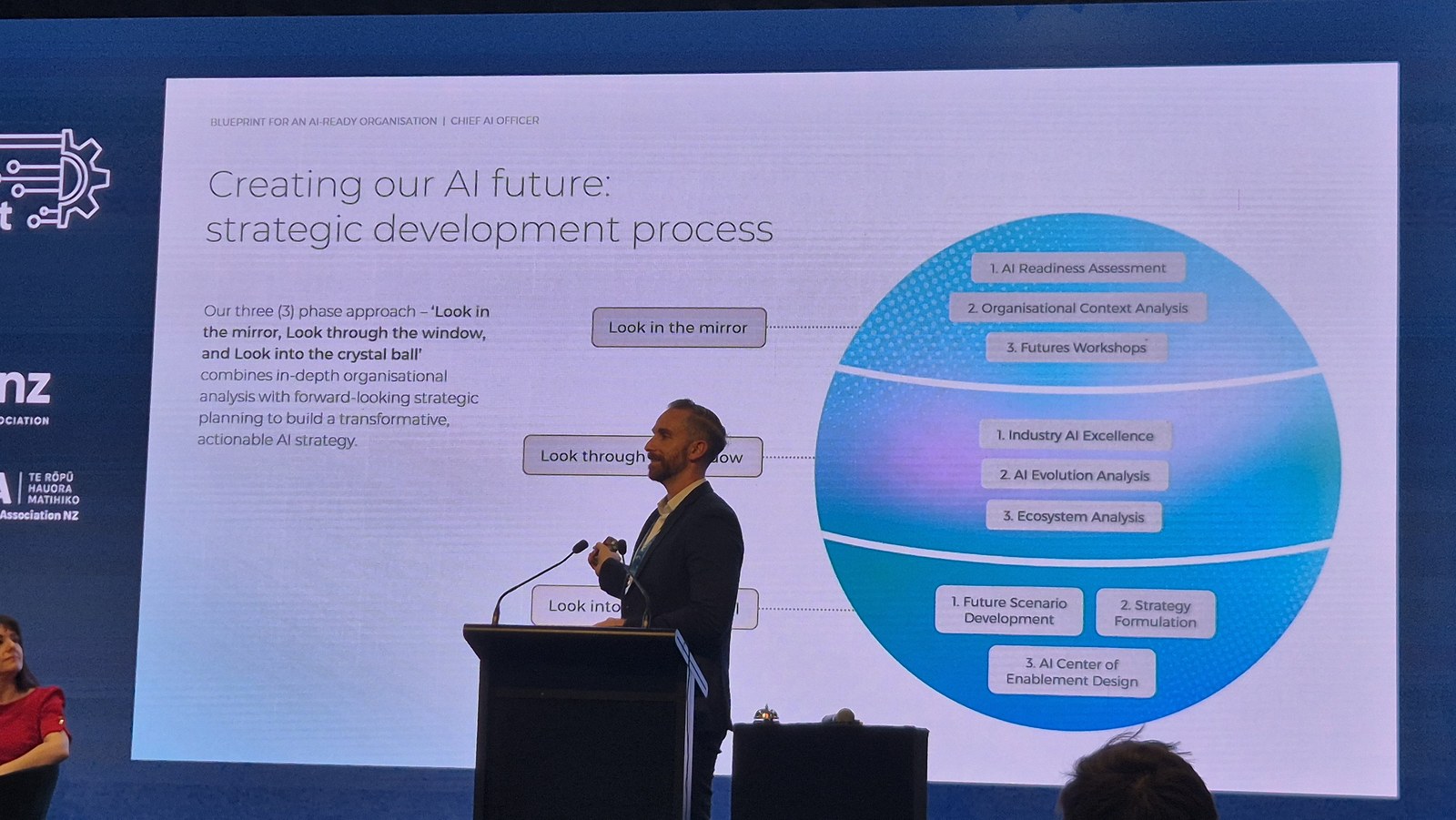
Datacom’s structured version of that runs in three phases. Look in the mirror, through an AI readiness assessment, organisational context analysis and futures workshops. Look through the window, at industry AI excellence, how AI is evolving, and the surrounding ecosystem. Then look into the crystal ball, through future scenario development, strategy formulation and the design of an AI centre of enablement.
What it is worth
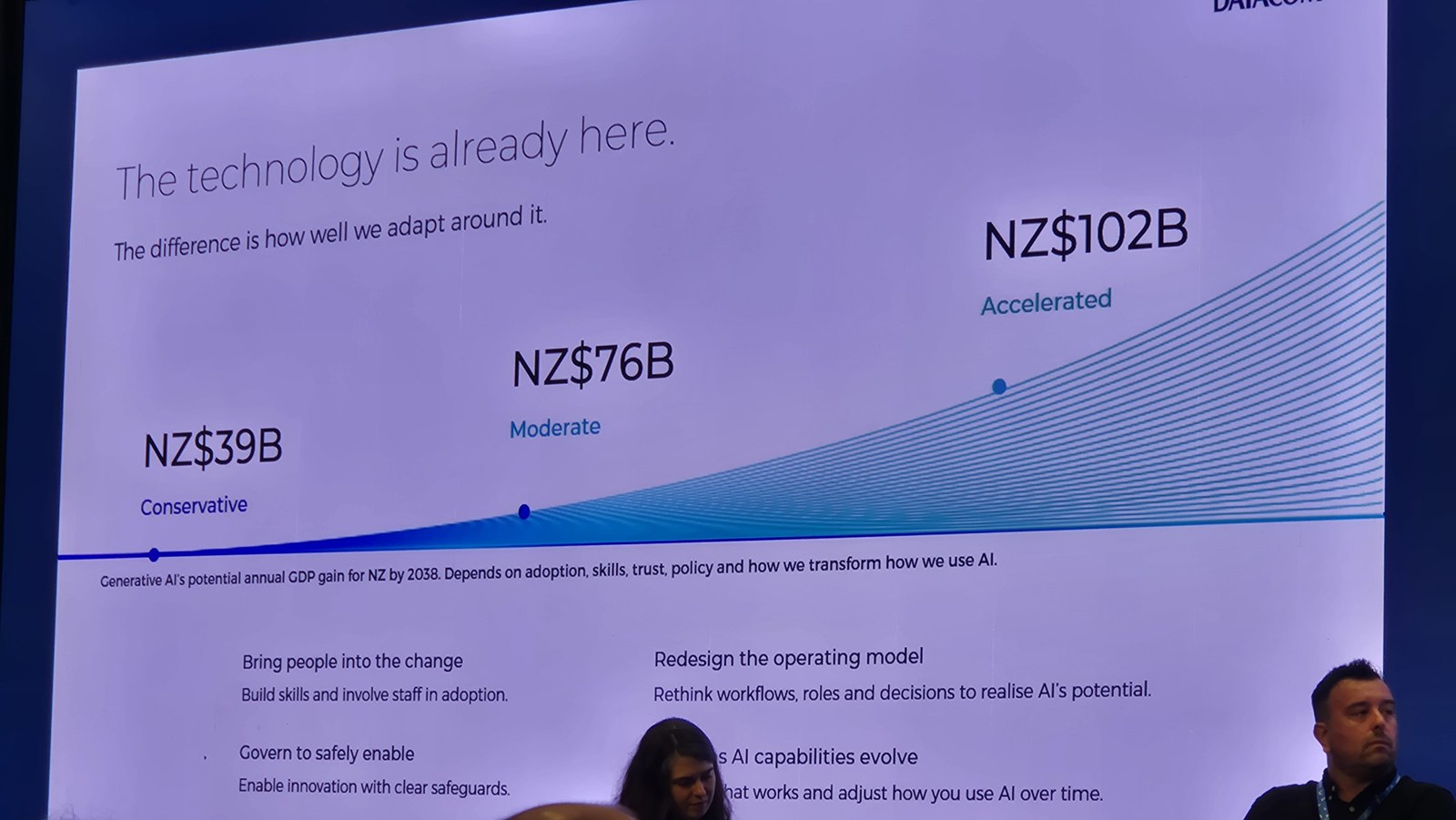
His closing slide put the national stakes in three numbers: generative AI’s potential annual GDP gain for New Zealand by 2038 is NZ$39 billion on a conservative path, NZ$76 billion on a moderate one, and NZ$102 billion on an accelerated one. Which one the country lands on depends on adoption, skills, trust, policy, and how far organisations are willing to transform the way they use AI.
That middle figure is the one Craig Young had cited earlier in the morning, and seeing all three together is more useful than seeing one. The difference between the conservative and accelerated paths is more than sixty billion dollars a year, and it is not a difference in available technology.
"The technology is already here. The difference is how well we adapt around it."
His three take-aways were deliberately plain. Put people and process up front. Use proportionate governance. And when you want to scale, think about your operating model, which means redesign rather than improvement.