
The Destination Is Not the Technology: Mark Darrow's First Six Months Chairing Health NZ
13 October 2026· AFQY News
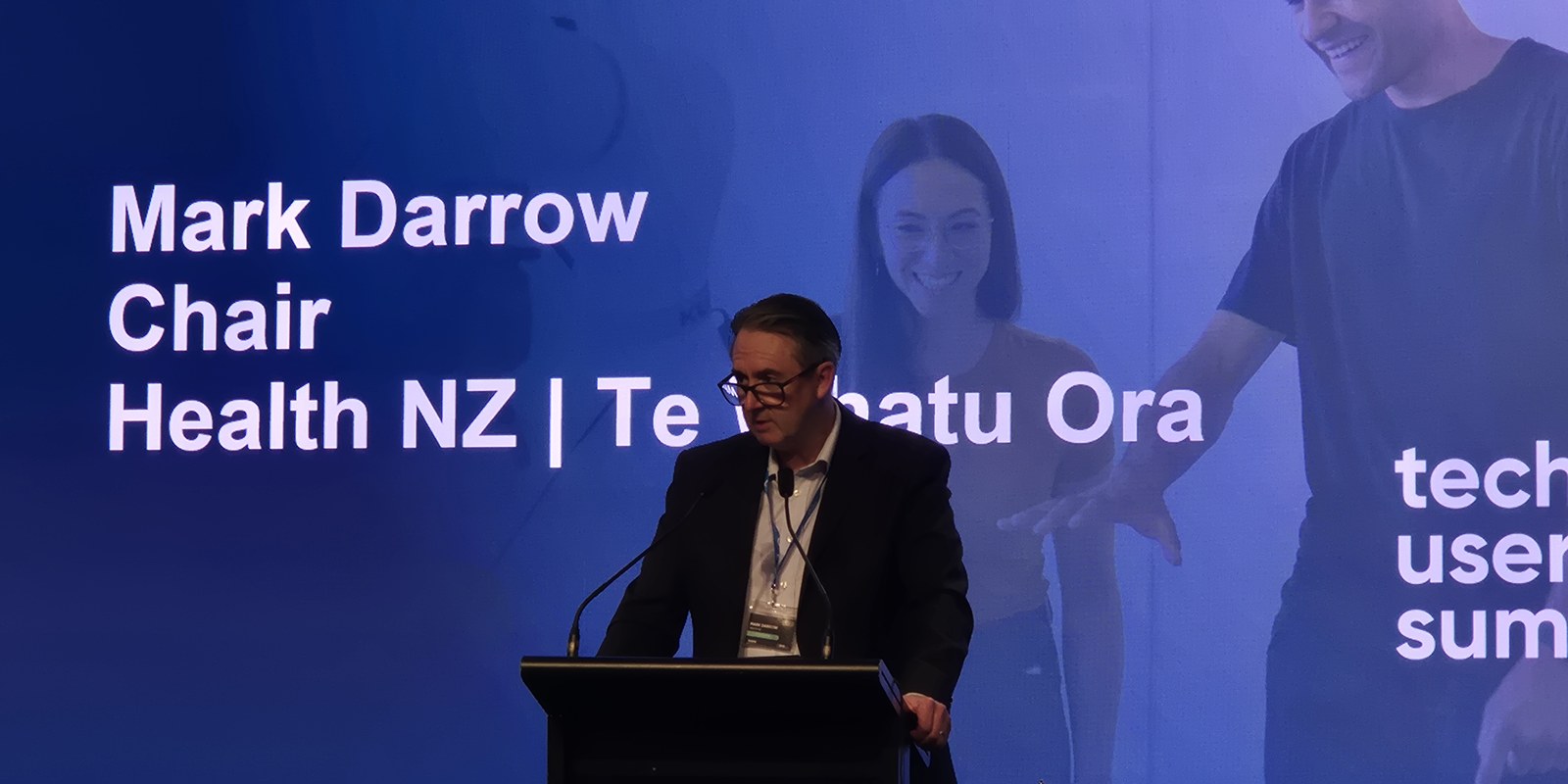
Mark Darrow has been chair of Health New Zealand for a little under six months, and he came to the Tech Users Summit with first impressions rather than a finished plan. That turned out to be the more useful thing to bring. What he described was an organisation that knows exactly where it wants to go, has written down how to get there, and is still some distance from being able to afford it.
He began by taking technology off its pedestal.
"The destination is not better technology in itself. Our destination is better care."
Technology, digital and AI can help get there, he said, more than any other lever available. In his view the biggest contribution they make is to reinvent how care is provided: by whom, where, and with what support.
The near future, already arriving
Darrow then described a patient journey that sounds speculative until you notice how much of it already exists. Book a GP appointment online and see a doctor by video link, same day. The consultation is transcribed by AI. The prescription goes automatically to your chosen pharmacy and is delivered. A diagnostic referral is reviewed by AI that picks up anomalies the human eye cannot yet detect, and compares them instantly against your previous images to highlight what has changed. If surgery follows, you check in at a kiosk and the hospital knows you are on site. The chances of the procedure being performed by a robot or a remote surgeon rise every year.
All of this is happening today, he said, and it is the tip of the iceberg. Which is why he regards technology as the single biggest opportunity to improve health outcomes, and to do it more efficiently than any other lever the system has.
He did not leave it there. The same front, he said, is challenging the system’s models of care, what clinical roles are and do, and how patients experience healthcare. It will challenge how the organisation invests in infrastructure, in technology and in its people. And it has to be done while addressing access inequity along the way.
What six months found
The health sector has had a rough five or six years, rocked by COVID and then by structural reform. Darrow paid tribute to the executive leadership team and the wider workforce for not merely holding things together but improving results and stabilising the base, which he described as a platform to move from.
One consequence of that history is less comfortable. There is a profound lag across the organisation in infrastructure and in skills.
The Health Digital Investment Plan is the response: a ten-year, multi-billion dollar roadmap and the first national plan of its kind for the New Zealand health system. Darrow was candid about its state. There is a plan. It is still largely unfunded, it needs more specificity and prioritisation, and it needs a lot more work. Good work has been done by skilled people, he said, and the new board is challenging all of it.
That assessment squares with the public record. Budget 2026/27 provided $300 million to support the first three years of the plan, with a separate cyber security package of $153.6 million over four years. Three years of funding against a ten-year roadmap is, as the chair put it, largely unfunded.
He made a second point about the plan that applies well beyond health. With technology moving at this speed, a ten-year forward view is near impossible. The plan has already been reimagined and reworked a year after it was written, and he expects it will be a living document indefinitely.
Governance as the first fix
The board’s answer has been structural. It has established a digital transformation committee to provide oversight, and approved a technology pathway to invest in an integrated digital platform covering finance, workforce and supply chain in the first instance.
Darrow was precise about what a board is for. Its role is to set direction, provide oversight and hold the organisation to account, while giving executives the time and space to do the job. Digital transformation is now a strategic priority for the board as part of normalising governance.
The committee has been staffed deliberately. Its members come from health, government and technology, and Darrow noted that several of the people now leading the work, on the committee and in the national digital leadership, were part of the team that delivered Inland Revenue’s business transformation. That lineage, he said, is no coincidence.
The clearest example started at the end of August, when Gary Baird took up the newly created role of National Director, Digital Services and Technology at Health New Zealand. Baird was previously Inland Revenue’s chief technology officer and deputy commissioner for enterprise services, and before that held senior digital roles at ANZ. Darrow chaired Inland Revenue’s risk and audit committee through most of that transformation programme. As a professional director, he said, almost every board he sits on has digital transformation coming through in some form, and he has been involved in five or six in recent years alone.
Health New Zealand operates one of the country’s largest and most complex digital environments. Sustaining service performance while modernising it is, he said, a core responsibility rather than a project.
The unglamorous half
Then came the part that does not make conference keynotes often enough. Health New Zealand runs more than twenty HR systems, many of them no longer supported, alongside a scatter of legacy finance systems. Consolidating them is the priority that enables everything else. Better payroll means better workforce planning, time management and rostering. The current systems, and the risks and poor information that come with them, are just not acceptable.
He drew the line from there to the national conversation in one sentence that landed hard in the room: the real reason politicians argue about nurse numbers is that the system cannot produce clear information about them. The reporting systems are no longer fit for purpose and it is near impossible to extract quality data from them.
Rationalising and stabilising is therefore the priority, not because it is exciting but because nothing else is reliable until it is done.
One patient record
Darrow’s best story was about a question he asked rather than an answer he gave. In his first induction meeting six months ago, he asked to see the digital strategy and started asking what it was for. What are we here for? Who are our partners? What are we aiming at?
He has used the same approach before. He recalled a digital committee session where he asked the room what the central truth was that they were all working towards, and nobody could answer it. After twenty minutes of circling, he kept pushing to distil it into as few words as possible, until one person in the room said it.
"One patient record."
His next question was the one that did the work: what has to be true to achieve that? That, he said, is where the cogs started turning and people understood the enormity of the task.
It also aligns with the system’s overall ambition, which is to stop operating as what he frankly called a siloed and self-interested set of parts, and to behave as one system. Sharing private health records safely and in a coordinated way will take enormous collaboration from the people in this room, minimum data integrity standards, and higher cyber security protocols.
He made it concrete, and he used himself as the example.
"If I was admitted to Queenstown Hospital unconscious tomorrow, they would have no records."
They would not know his history, his medications or what might be life threatening. He was pleased the issue of fragmented records had been raised in the summit briefing, because it is the fact of the matter.
What the ten-year plan buys
The modernisation programme is designed to replace ageing and fragmented technology with modern, secure and scalable platforms. It spans radiology modernisation, cloud transformation, clinical desktop rationalisation, cyber security, data and analytics capability, and the digital infrastructure needed for future care delivery. The published plan adds a single electronic medical record across the sector, remote patient monitoring to support earlier discharge, and a national radiology system to prioritise urgent cases, delivered in three phases: stabilise, modernise, then enable new models of care.
A Centre for Digital Modernisation of Health has been set up to lead delivery and coordinate across the portfolio, so that individual programmes are not viewed in isolation. Cloud, cyber security, workforce systems, radiology and analytics all belong to one programme of health system modernisation rather than to themselves.
Darrow’s framing of why this order matters was the line of the morning.
"AI may capture the headlines, but modern digital foundations will make innovation possible."
His example was the new Dunedin Hospital outpatient building, which he said he helped open last month. What impressed him was not the building but the fact that it had been designed around the technology, connectivity and flexibility needed to support future models of care, and that it will open with the digital infrastructure required to operate safely from day one while laying foundations for capability that does not exist yet. The $440 million, 15,000 square metre outpatient facility was blessed in late August and drew around 1,300 people to a community open day in September.
The pressure behind all of it
Like health systems everywhere, New Zealand faces long-term demand growth driven by a growing and ageing population and longer life expectancy. Demand is not a simple function of inflation, Darrow said, and New Zealanders expect timely access to high quality care. Services have to become more efficient and sustainable without giving up quality or safety.
Meanwhile the people delivering care face rising demands on their time, and administrative burden eats directly into the hours available for patients. Supporting that workforce, he argued, is critical to the sustainability of the whole system.
This is where the current tools come in: electronic prescribing, clinical forms, AI scribes that cut documentation time, and productivity tools including Microsoft Copilot. Darrow said early adoption has been remarkable, putting usage at around 20,000 people, and that AI is now being used to assist back-office processes too.
Publicly reported figures give a sense of the scale underneath that. AI scribes are in use by roughly 1,250 emergency doctors and frontline staff across every public emergency department, with a further 1,000 licences being procured for mental health teams, and a Hawke’s Bay pilot reported clinicians saving around eleven minutes per consultation with after-shift documentation time halving.
He closed where he started. The destination is better care, and everyone in the room has a part in getting there. Health New Zealand hosts a health forum at AUT in Auckland in December to continue the conversation. If there was ever a time for leadership, collaboration and operating as one system, he said, it is now.
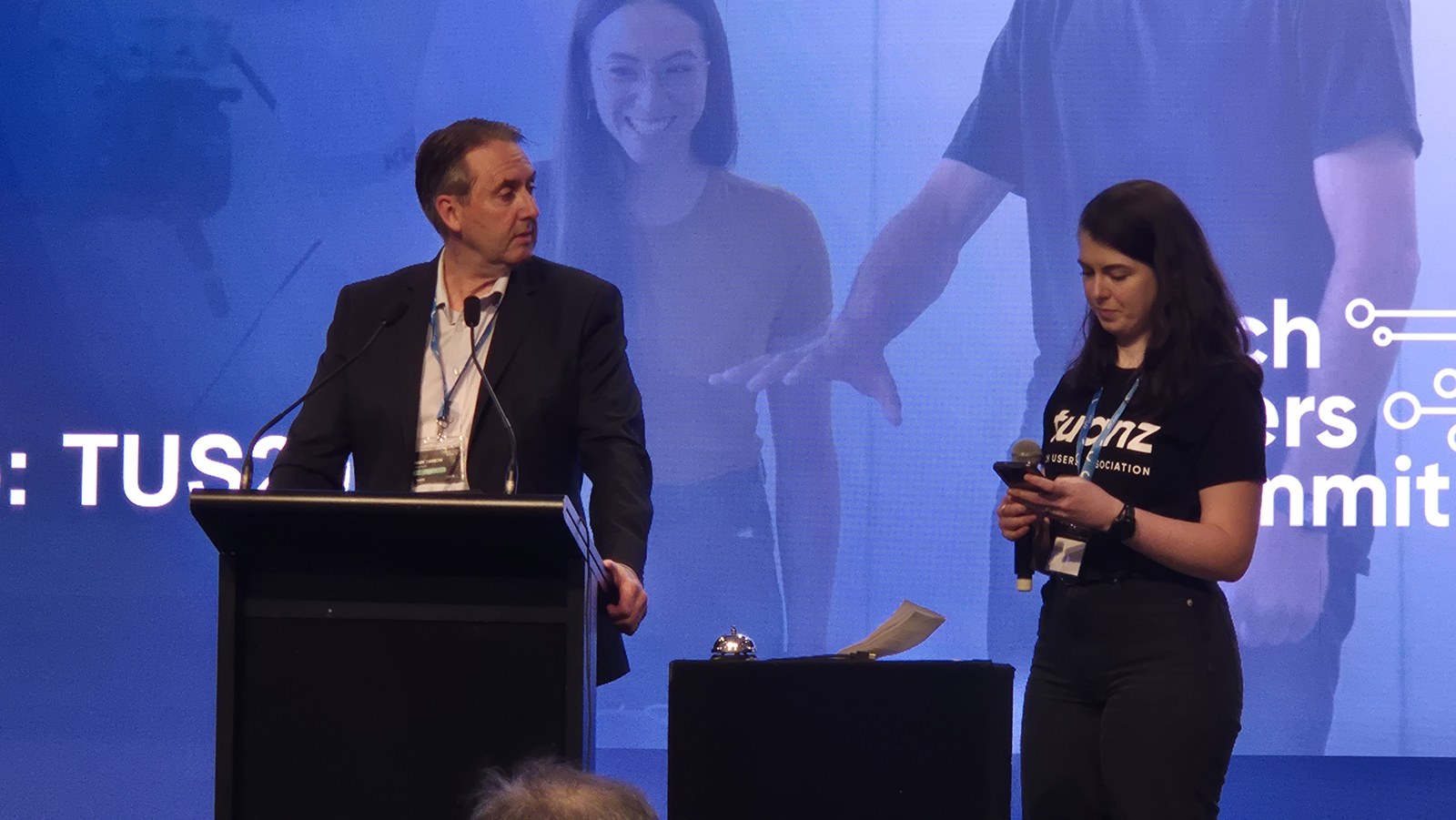
Questions from the floor
On funding digital when digital is always first to be cut. Darrow pushed back on the premise. The first few years are funded, he said, and a significant share of capital is being prioritised towards it. There is strong backing from the Minister of Finance and the Minister of Health, and from the Public Service Commission, which is leading cross-government work on digital improvement. His framing was invest to save, and he said that argument is now landing far better with government and funders than it used to.
On balancing security and privacy against the pace of innovation. He called this fundamental hygiene that has to be got right. People’s privacy in their records has to be protected, and that cannot be done without setting minimum standards. As both a regulator and the leader of the system, Health New Zealand will have to insist on certain protocols and standards that everyone adheres to. Losing people’s data, he said, is not an option.
On the digital skills the workforce most urgently needs. His answer started with staff rather than systems. As a board member, his first priority is looking after people, and that means fixing payroll and human capital management before anything else. Digital capability is an ageing area and a priority, but the organisation has to find things that make a difference quickly while the base infrastructure is being rebuilt underneath. He described the Health Digital Investment Plan as a ten-year, multi-billion dollar programme and the biggest technology plan in New Zealand’s history, which is also the reason it cannot be fixed in advance. Technology is moving so fast that nobody can say today what every component of it should be, and even in his six months that has kept shifting. The plan, he reminded the room, is a living document, and the decisions already taken on capital management, procurement and core systems have been made with flexibility deliberately retained. There will still be the ability to pivot inside the plan. Absolutely, he said.
On what New Zealand should copy from overseas. Parts of the Australian system and parts of Europe are being looked at, but his answer was more interesting than a shopping list. Because New Zealand is so far behind, carrying so much legacy debt, there is a genuine opportunity to leapfrog systems that other countries are now stuck maintaining. Rather than wholesale following another country, Singapore being the example people reach for, he argued the country has a chance to forge its own path. He paired that with a warning about discipline: technology is getting cheaper and can be done at scale, but the system is under enormous financial pressure, spending in the order of thirty billion dollars a year and able to absorb twice that without meeting demand. Being prudent about where the money goes applies to technology as much as anything else.
On the project he is personally most excited about. HealthX, the organisation’s technology innovation programme, which he called the most cutting edge thing they have and the one genuinely pushing boundaries on AI. He said usage has gone from zero to around 20,000 people this year across a workforce of roughly 80,000 full time equivalents and about 100,000 people, and that users report saving in the order of forty minutes a day. Scaled across the workforce, he said, the advantages are massive.
On whether the frontline is genuinely enthusiastic. This was where the chair stopped talking about systems. Enthusiasm among line staff is high, he said, and he went further than the question asked.
"I have never seen a more caring, career-minded group of people working in any industry ever."
He described opening a new acute mental health unit the week before, and the people working in what he called the most difficult part of the health system, who he said are passionate about what they do. New Zealand, he told the room, should be very proud of its health care system and the people in it.
It was an unusual note on which to end a keynote about payroll systems and legacy debt, and it was the right one. The chair of Health New Zealand had spent half an hour describing a technology estate in genuine disrepair, and finished by saying the hardest part of the job is already being done well by the people on the floor. The rest is foundations.
Sources
- TUANZ: Tech Users Summit 2026 programme
- Ministry of Health: Appointment as Chair and member of the Board of Health New Zealand, Mark Darrow
- 1News: New Health NZ chair and board members announced
- Health New Zealand: Health Digital Investment Plan
- Health Informatics New Zealand: Minister launches 10-year Health Digital Investment Plan and Centre for Digital Modernisation
- Pulse+IT: NZ Budget sets out $450m+ for digital health and cyber uplift
- Health Informatics New Zealand: Gary Baird appointed national director digital services and technology at Health NZ
- Healthcare IT News: New Zealand expanding national AI scribe rollout to emergency mental health
- 1News: Hundreds flock to Dunedin Hospital's new outpatient building
- Beehive: Digitising healthcare to put patients first