
EonFibre Opens 400G Across the Tasman as New Zealand Courts Data Centre Investment
13 November 2026· AFQY News

For most of the past decade, the question about hosting data in New Zealand was whether there would be enough local capacity. Increasingly, the question is how quickly data can get in and out of the country once it is here.
On 4 November EonFibre, the wholesale fibre business within the One New Zealand group, said it had expanded its trans-Tasman network to offer 400G connectivity between New Zealand and Australia. That means links capable of 400 gigabits per second, aimed at organisations moving very large volumes of data across the Tasman: data centre operators, hyperscalers, cloud providers, carriers and enterprises running AI and other data-heavy workloads.
The upgrade lands as New Zealand pitches itself to the world’s data centre builders. This piece covers what EonFibre has added, how it fits with its push into the country’s proposed data centre zones, and why international capacity has become part of the hosting conversation.
TL;DR
- EonFibre now offers 400G connectivity between New Zealand and Australia, available to customers from November 2026.
- The upgrade adds new high-capacity optical equipment and extra land-based capacity linking international cables into EonFibre’s New Zealand network.
- EonFibre runs more than 11,000 kilometres of fibre, reaches more than 30 data centres and exchange sites, and co-owns the Tasman Global Access submarine cable to Sydney.
- In October it launched Zone Direct, a connectivity service for the six “advantaged” data centre zones Invest New Zealand is promoting to overseas investors.
- An industry-led national data centre strategy, released in August by DataCentres New Zealand, argues the country should treat data centres as essential infrastructure and attract investment in international connectivity.
What EonFibre added
The expansion includes new high-capacity optical capability and additional terrestrial transport capacity that connects international infrastructure into EonFibre’s New Zealand network. The company says the work included installation, commissioning and end-to-end testing across both the international and domestic paths. The 400G service sits alongside its existing international bandwidth products, and each service is engineered to the customer’s location, capacity, resilience and routing requirements.
"AI, cloud and data centre growth mean that customers increasingly need to move very large volumes of data reliably both between their sites in New Zealand and to international markets."
The investment, Mooney said, gives EonFibre significantly more capability across the Tasman and puts it in a strong position to meet demand as it grows. EonFibre has not said what it cost or named any customers.
EonFibre opened for business in November 2024 as a dedicated business unit within the One New Zealand group, selling fibre to wholesale customers including hyperscalers. At launch it began deploying Ciena’s WaveLogic 6 Extreme optical technology, which it said would double traffic capacity on parts of its network to 1.6 terabits per second for each wavelength.
The network behind it
EonFibre operates more than 11,000 kilometres of fibre from Whangārei to Invercargill. It includes a core backbone, metro fibre rings in Auckland, Hamilton, Wellington and Christchurch, three separate routes between the North and South Islands, and the Aqualink domestic submarine cable. It reaches more than 30 data centres and exchange sites, including the Auckland data centre clusters at Albany, Westgate, the CBD and Silverdale.
Internationally, EonFibre co-owns the Tasman Global Access cable to Sydney and provides capacity on the Hawaiki and Southern Cross systems, with points of presence in Australia and the United States. It also worked with Google to build new fibre for the Honomoana cable, which lands north of Auckland. It sells dark fibre, managed wavelengths, data centre connections, Ethernet and mobile backhaul on a wholesale, carrier-neutral basis.
Building for the data centre zones
The 400G service complements a product EonFibre launched in October, Zone Direct. It is built around the advantaged data centre zones identified in Invest New Zealand’s sector overview for data and digital infrastructure: North Waikato, Taupō, Taranaki, Manawatū, South Canterbury and Central Otago. Invest New Zealand chose the zones for how quickly power can be connected, access to high-voltage infrastructure, and backhaul fibre.
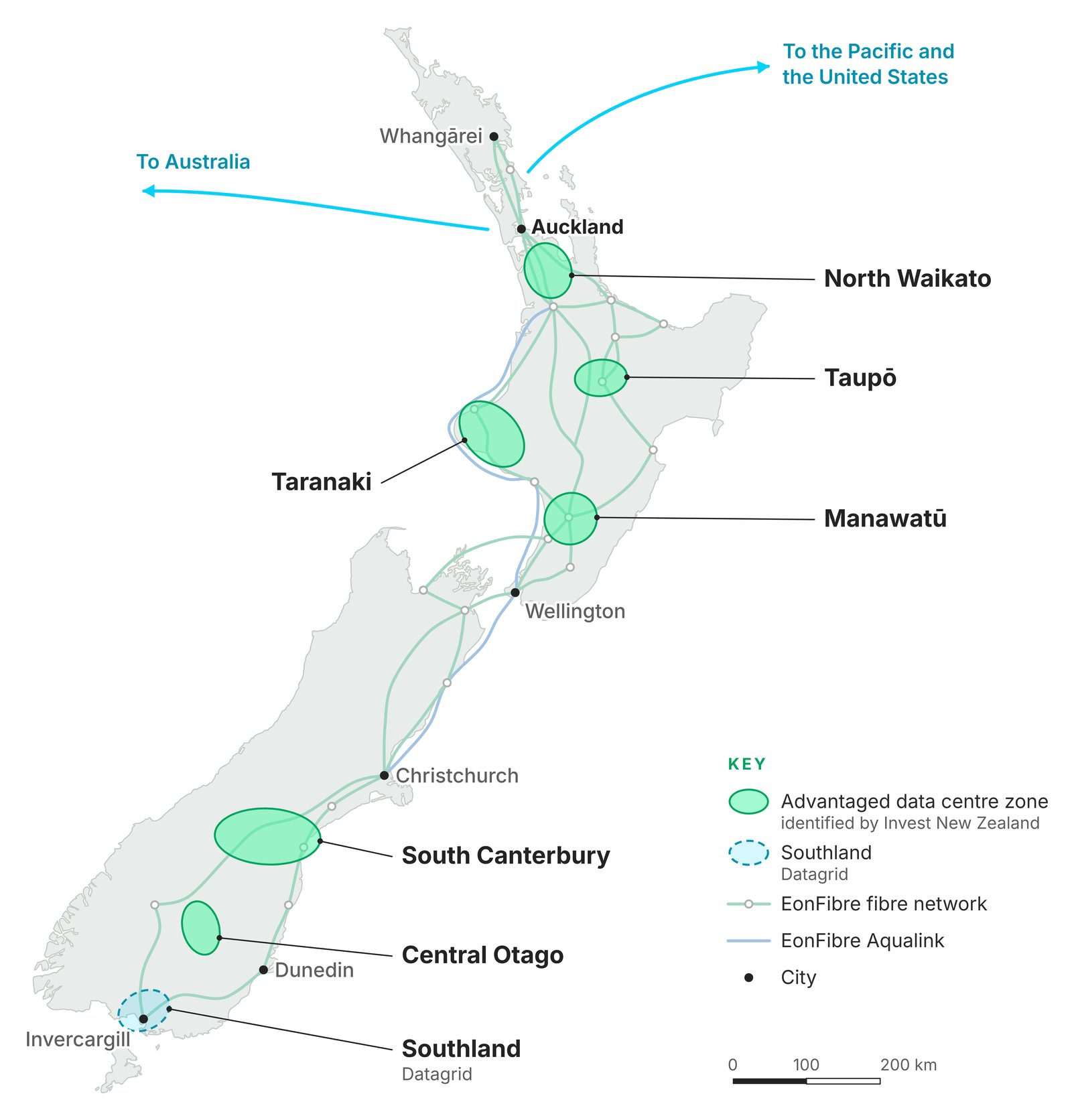
Zone Direct offers developers a connectivity brief for each zone, mapping route options, physical diversity and indicative latency to the international cable landing stations and on to Australia and the United States. It includes an assessment of fibre routes and resilience for each prospective site, a single point of contact from site selection to delivery, and the option for EonFibre to design, build and run a campus’s connectivity.
"Developers want to know how many physically separate routes reach a site, how far it is to the international cables, and how quickly capacity can be delivered."
“New Zealand is a great option for those looking to build data centres and take advantage of the opportunities AI is creating,” Mooney said this month. “But those opportunities depend on having the right infrastructure in place.”
Why international capacity matters now
The industry has been making the same case. In August DataCentres New Zealand, part of Tech New Zealand, launched a national strategy for the sector. It argues the country should treat data centres as essential infrastructure and build more local capacity, and presents the sector as an export opportunity too, drawing on New Zealand’s renewable electricity, cool climate, political stability and reputation as a trusted jurisdiction.
The strategy cites industry estimates that data centres and related services already employ about 6,800 people in New Zealand, and cites forecasts that global data centre investment could reach US$6.7 trillion by 2030. Its three priorities are stronger coordination across the sector, including designated development zones; promoting New Zealand as a location for trusted and sustainable compute; and attracting investment in facilities, renewable generation, international connectivity and workforce development.
For tech leaders the practical point is simple. Where an organisation hosts its data and AI workloads now depends on more than the price of a rack and the source of the power. It depends on how many separate paths lead out of the building, how quickly capacity can be added, and how far it is to the next country. A 400G link across the Tasman does not answer all of that, but it moves one constraint further out of the way.
Sources
- EonFibre: EonFibre adds 400G trans-Tasman connectivity
- Reseller News: EonFibre boosts trans-Tasman connectivity to meet AI, cloud and data centre demand
- TelcoNews: EonFibre adds 400G trans-Tasman link for data demand
- One NZ: EonFibre launches Zone Direct for data centres in New Zealand's advantaged zones
- One NZ: EonFibre is now open for business
- IT Brief New Zealand: New Zealand data centre strategy backs AI expansion