Belief Is Built, Not Briefed: Culture Amp on AI in HR
11 October 2026· AFQY News
Close to 500 HR and people-and-culture leaders from across Australia and New Zealand joined Culture Amp’s APAC session “AI in HR: Promise vs. Reality” to hear what its research found about who is actually getting value from AI, and who is still waiting. Lauren Oldham walked the room through the data, Deepak Singh added the practitioner’s read, and Melissa Bouffler hosted.
The final segment was the one with teeth. Culture Amp called it the believer blueprint: not what AI might do, but what the people who have already made it work are doing differently.
Believers, sceptics, and the movable middle
The categories came out of the data rather than opinion. Believers are the people who agreed they had seen a core HR process genuinely transform. They have lived proof. Sceptics said they had not seen it happen. In between sit the neutrals, roughly a third of the entire field, and Oldham argued they are the most important group in the room.
Believers do not need convincing. Sceptics will not move on data alone, because they need to see it rather than hear about it. The neutrals, though, are genuinely persuadable, and what moves them turns out to be specific and knowable.
Two different versions of 2026
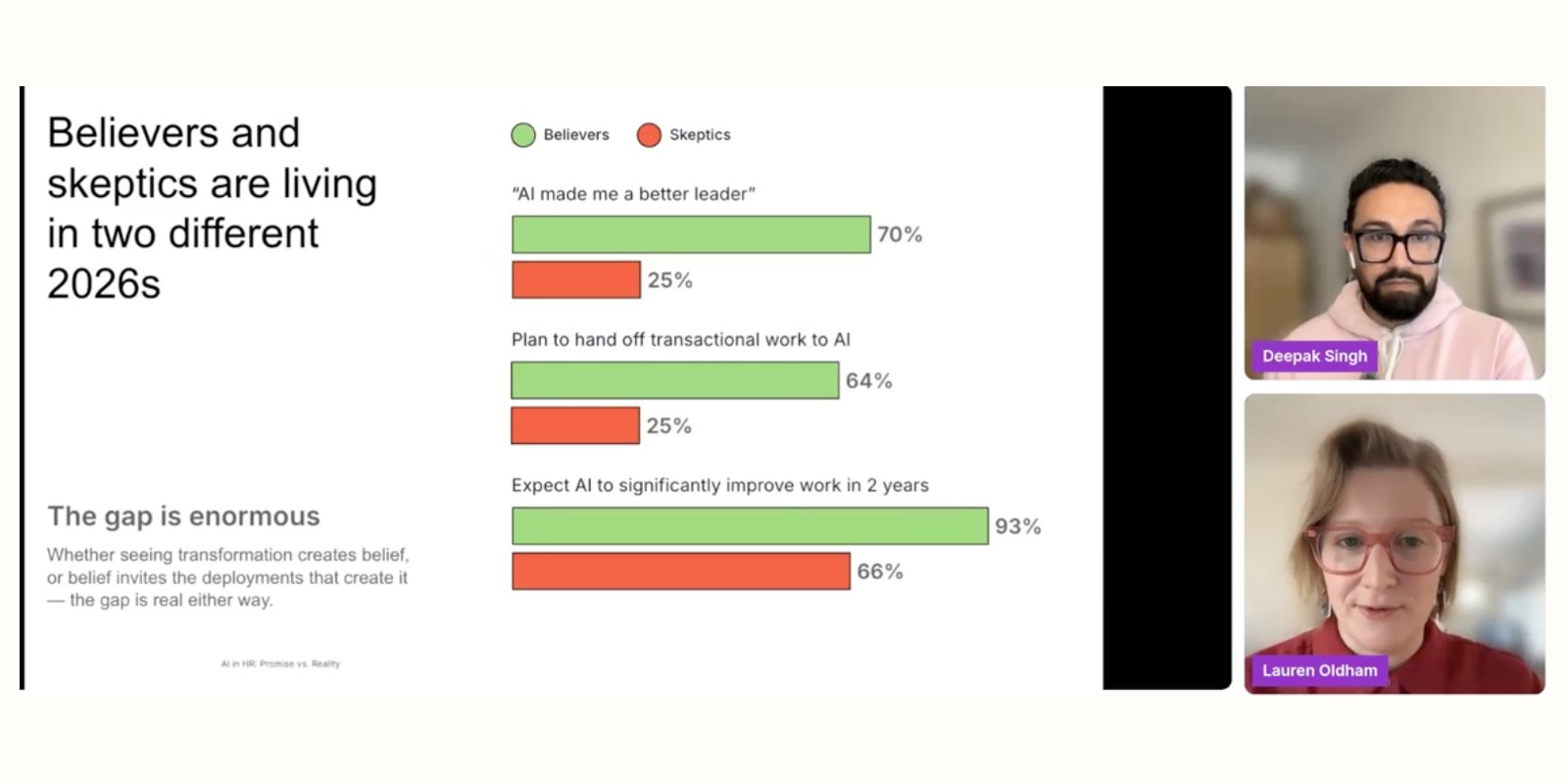
The gap between the two groups was wider than the research team expected. On “AI made me a better leader”, 70 percent of believers agreed against 25 percent of sceptics, a 45 point spread. On planning to hand transactional work to AI, 64 percent against roughly 25. On expecting AI to significantly improve how they work within two years, 93 percent against 66.
Oldham was careful about causation. It is entirely possible that seeing transformation creates the belief, or that holding the belief is what gets you access to the deployments that create transformation. Probably both. Either way, as she put it, believers and sceptics are functionally living in two different versions of 2026.
That “better leader” number is where the chat lit up, and it did not go easy on the finding.
"I feel like I am missing something. How can AI make someone a better leader, for real?"
Matthew Proctor went straight for the logic: “Haven’t you created a tautology here? Those who believe AI has made them a better leader believe AI has made them a better leader.” Katie Meadows and Kate Greenall both wanted to know what the survey question was actually designed to pick up, and David Schofield asked what the hypothesised relevance to AI use had been. Nickie Kemp drew a harder line, saying AI can make you more efficient but does not replace the people leadership and emotional intelligence central to inspiring anyone.
Others answered from their own practice. Julie Ashcroft pointed out that AI improves communication quality, which is a leadership competency in its own right. Matt Lock listed what it does for him: “Coaching; focus; scrutiny; consulting challenge and thought partner.” Grace Lococo noted that AI is good at neutralising emotional responses, which can help leaders handle difficult conversations differently. Sarah Calder was the most concrete: by using AI to cut admin, sharpen communication and structure her thinking, she spends more time actually leading, and recording a meeting for notes lets her be present in the conversation instead of writing during it.
Underneath the debate, two comments reframed the whole thing. Alisha Benson: “This feels less like an AI adoption gap and more like a work redesign gap.” And Charlie Durber, whose line drew the most agreement of any in the chat: “We are told to review everything coming out of AI then told to allow agents to work on their own. It’s difficult for people to know who or what they can trust.” Damian Kelly put the accountability plainly: if an AI agent gets HR advice wrong, the AI does not wear the consequences. The organisation and the human decision maker still own the outcome.
Belief is built by three experiences, not by messaging
This was the most actionable finding of the session. Culture Amp tested a long list of variables, and only three had meaningful predictive power for belief: having become a better leader with AI, having already seen benefits at your organisation, and having seen AI positively transform a core HR process.
Not more training. Not more messaging from leadership about how important AI is. Not another all-hands on the AI roadmap. Belief gets built through one of those three lived experiences or it does not get built at all. Between 34 and 38 percent of the field still sits neutral on exactly those three drivers, which Oldham framed as opportunity rather than obstacle.
Singh added the question that reframes the lot of it.
"When someone uses AI, do they feel more valuable or less valuable? If AI amplifies me, I'm in. If it diminishes me, then another course is not going to fix that."
He pointed to research showing the dominant worry among tech workers was not only that AI would take their job, but that they would be expected to do more for the same pay. Benson had already asked the version of this that lands in a people team: if we plug everyone into AI and it does all the tasks we have been trying to automate, what are we redesigning people around, and what is left that is uniquely human?
The smallest companies are winning
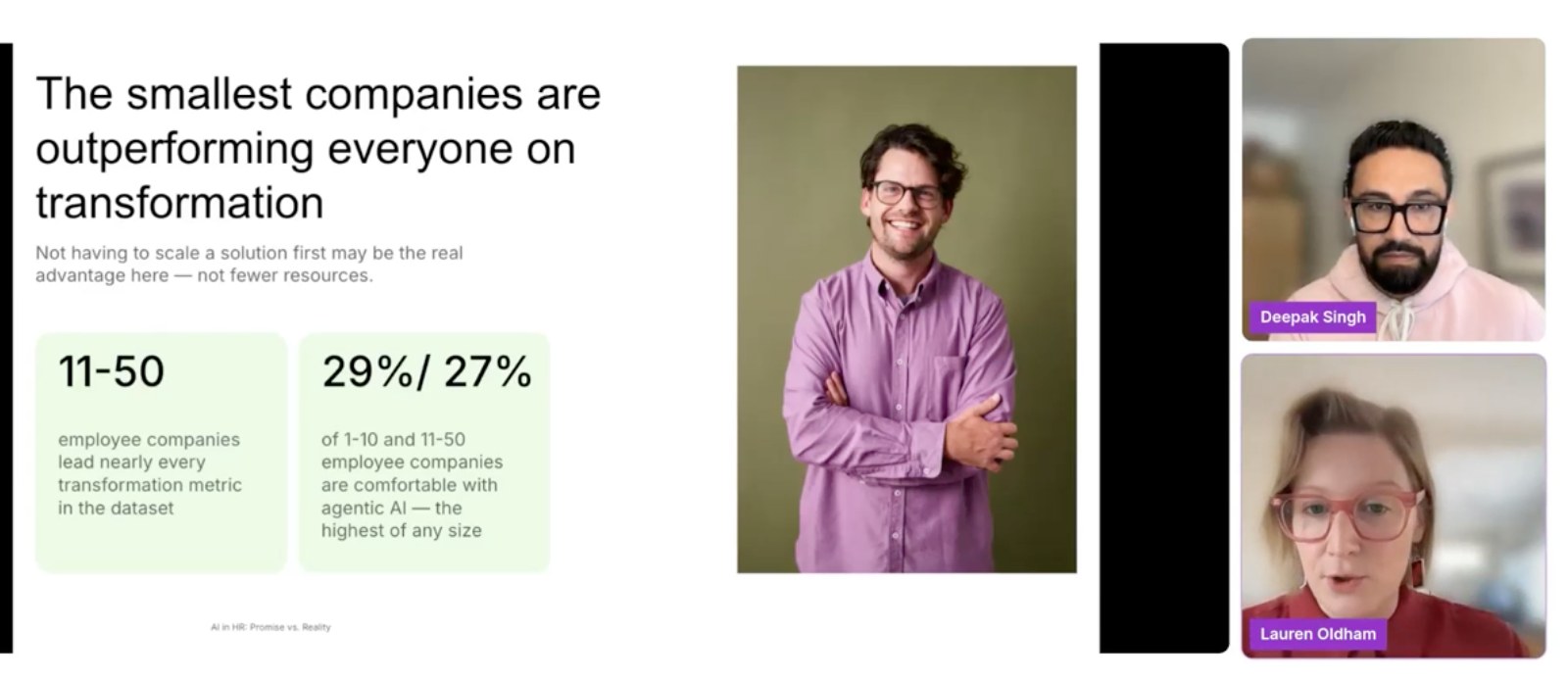
Companies with 11 to 50 employees led nearly every transformation metric in the dataset. On comfort with agentic AI specifically, the smallest brackets came out highest of any size: 29 percent for one to ten employees, 27 percent for 11 to 50, ahead of large enterprises.
Oldham’s read was not that small teams have more resources, because plenty are painfully constrained. It is that they do not have to design something that scales across 10,000 employees and 40 use cases before anyone will let them try it. They can test it on a real process with real stakes now.
Singh agreed once he thought about it. Small organisations rarely have better technology, but they have less distance between the idea and the decision. A leader asks whether something could be done differently, and the next day three people are trying it on real work. When confidence is built by doing, speed of learning beats scale.
The chat filled in the rest. Kirsty James: smaller companies, more agility. Daryl Teo: “Small ship, more agile. Big bulky ship, slower to change direction.” Farzana Khan noted fewer people means fewer processes and policies to disturb, and Sharon Windle said small organisations already have to do more with less, so they go looking for the productivity dividend. Matt Lock reckoned disruption is likely to come from small, and that he is watching leaders in large organisations build their own AI stack at home just to keep up. AFQY’s Ryan Ashton added that 11 to 50 may be the sweet spot: big enough to afford enablement, small enough that a company’s own AI enthusiasts can reach every team member.
Not everyone was starry-eyed. David Schofield asked whether small organisations are also accepting free versions and living with the trade-offs, and Katie Meadows supplied the cautionary tale: “Small companies also create documents for me to check that make me question AI. Fair Work said what? Oh, that was Claude.”
What is actually stopping the fence-sitters
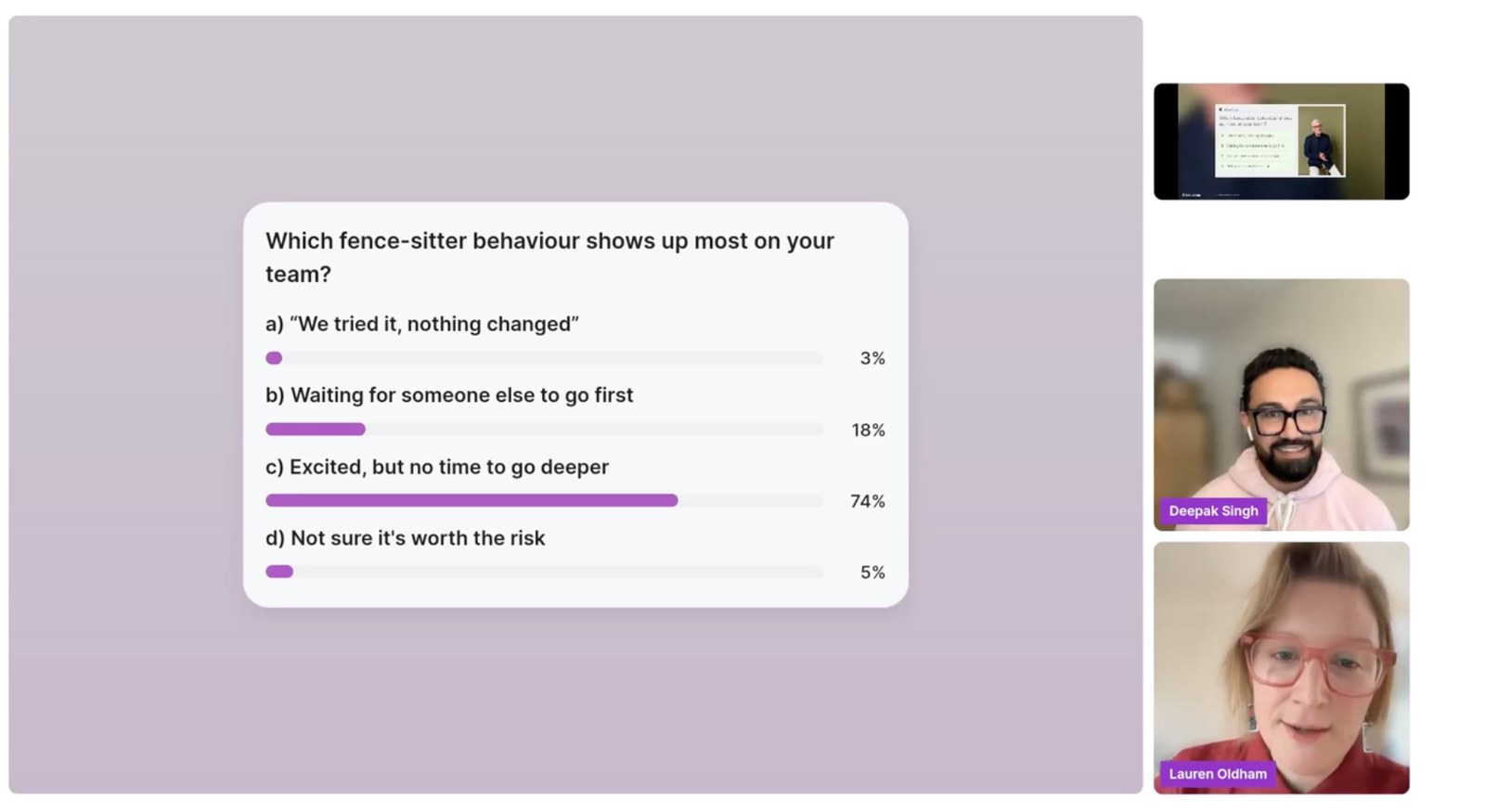
A live poll asked which fence-sitter behaviour shows up most on attendees’ teams. The answer was lopsided. Only 3 percent chose “we tried it, nothing changed” and 5 percent “not sure it’s worth the risk”. Eighteen percent were waiting for someone else to go first. A clear 74 percent picked “excited, but no time to go deeper”.
Oldham recognised it immediately as the HR catch-cry of doing more with less. If you are flat out on business as usual, you have less time to experiment and less time to build a proper case for doing it well. Several in the chat offered a fifth option: Heliena Spray’s “curious but cautious” drew agreement, and Ryan Ashton suggested people are not getting results because they are not using the tool properly, a line Oldham read out to the room.
The reasons stacked up quickly. Rebecca Tromans said her organisation’s policy on what can and cannot go into AI is so strict it puts her off using it. Kelly Rafferty was navigating industrial relations, where even small trials were causing friction with the union. Libby Buick described an appetite for change without the mental capacity to take the perceived risk. Emma Elder pointed at missing guardrails, Kate Greenall at ethical and data safety obligations in a government agency, and Isabelle Carroillon de Villecourt raised the one Patrick Caisley thought was most overlooked: the cost of AI has risen enough to make budgeting genuinely hard. Rachel Mackenzie summed up the gap in four letters: a better WIIFM.
Show them the proof
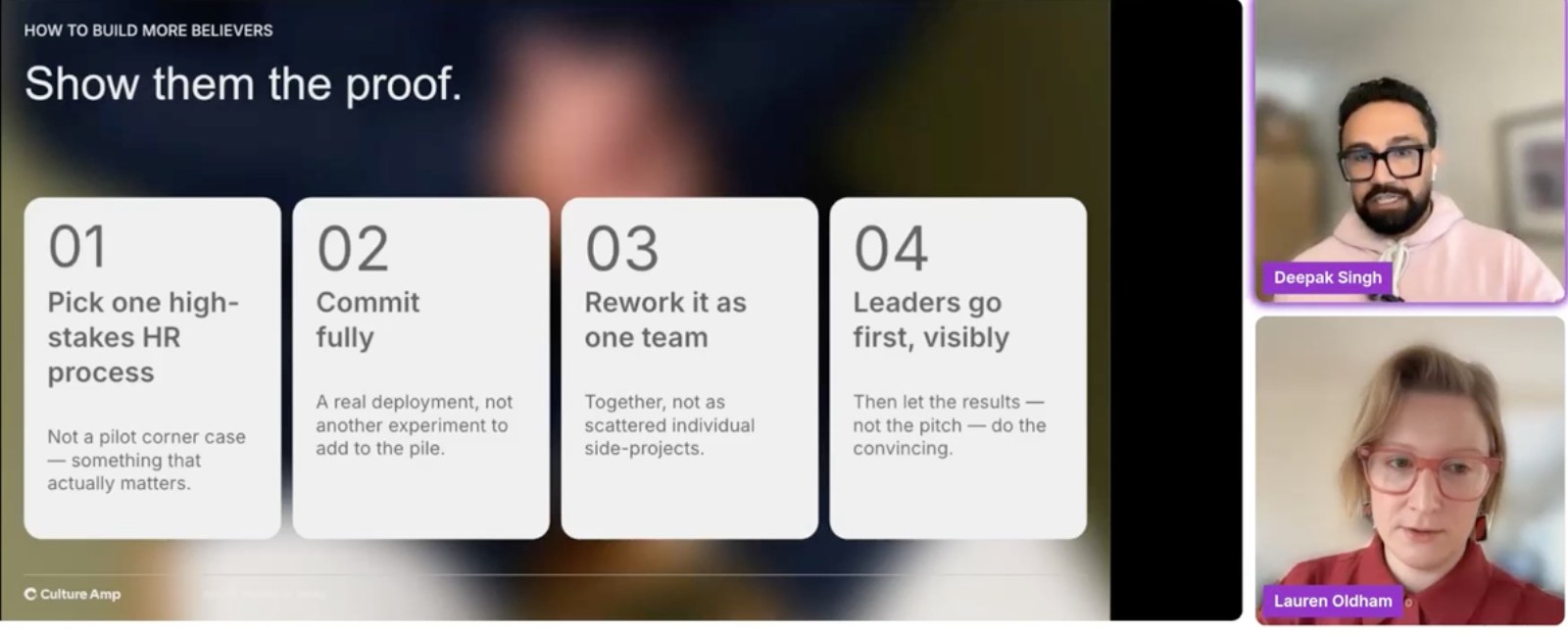
The recommendation was four steps. Pick one high-stakes HR process rather than a safe pilot, something where a real result matters to people. Commit fully, as a real deployment and not another half-finished initiative. Rework it as a team rather than as scattered side projects, so the learning compounds and the win is shared and visible. And leaders go first, not from behind a memo but in front of the team, showing the results whether they are good or messy.
That last step is the mechanism. A leader going first is what hands the fence-sitters one of the three belief drivers directly: lived proof that a core process has actually transformed.
The room had its own proof. Ryan Ashton shared AFQY’s work on an employment process that averaged 20 hours per role across up to 1,500 roles a year, where 12 hours per role were saved. Paige Hughes had built an HRIS carrying the features she had wanted across years of working with other systems, and launched an electronic performance review process with visible data and a repeatable flow, prompting Lisa Thomsen and Georgina Nicholas to ask for details.
Singh’s addition was the question that keeps the whole thing honest.
"What did we do with the capacity we created? Saving 10 hours only matters if those 10 hours become something valuable. That is when usage starts to become impact."
Your values now have two audiences
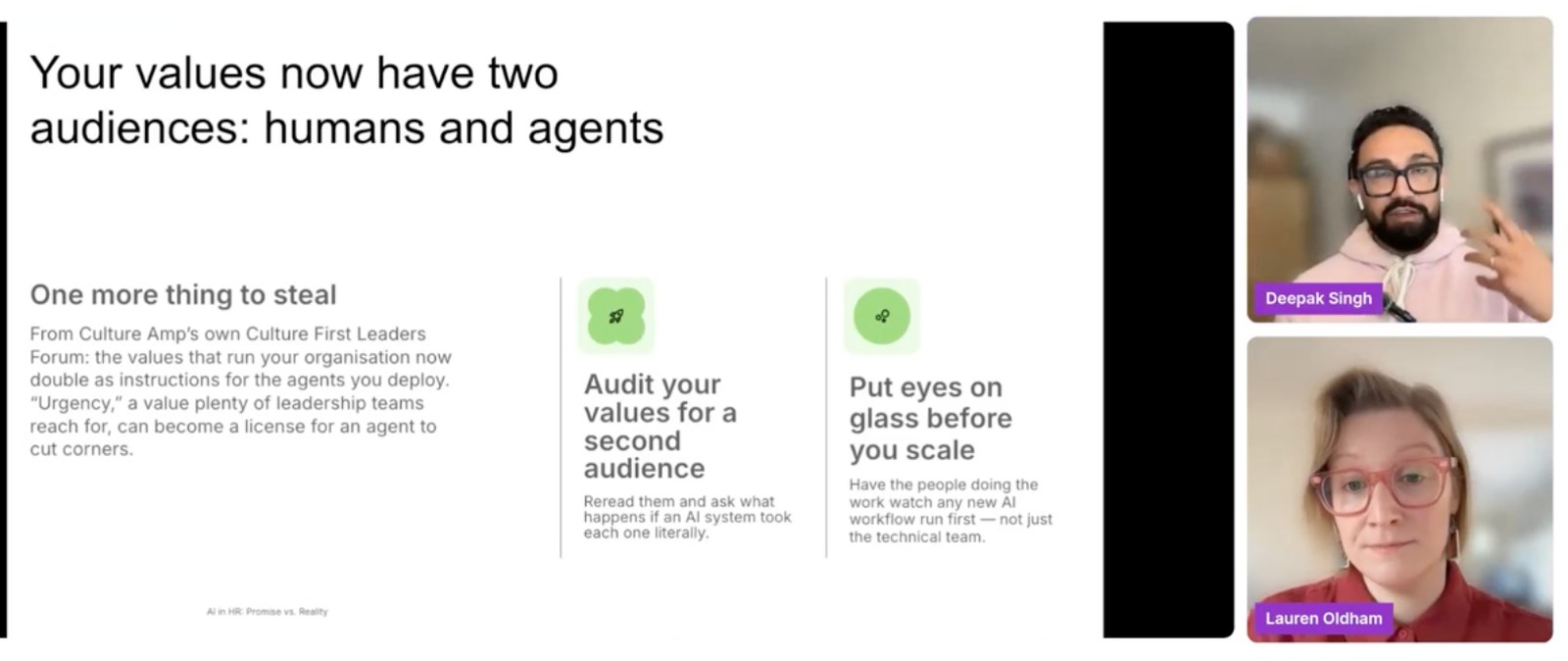
The bonus insight came from Culture Amp co-founder Didier Elzinga at the company’s Culture First Leaders Forum, and it was the moment the chat audibly sat up. Your company values now have two audiences: humans and agents.
The values that run your organisation double as literal instructions for the agents you deploy. Take urgency, a value plenty of leadership teams reach for when they want to move fast. Handed to a human, urgency is a nudge. Handed to an agent, it can become a licence to cut corners, because the agent lacks the judgement about when speed is worth the trade-off.
Two things follow. Reread your values and ask what would happen if an AI system took each one absolutely literally. And, as IT teams say, put eyes on the glass before you scale: have the people who actually do the work watch any new AI workflow run first, not just the technical team who built it.
Singh called it his biggest takeaway, because it moves what feels like a technology conversation straight back into culture. Values need guardrails, decision rights and escalation points, and culture becomes part of the AI architecture rather than a poster near it.
The chat went with him. David Schofield noted that if an agent might interpret your values as instructions, everyone needs to be working from the same definitions of those words. And Kate Greenall raised the one that drew the most warmth in the whole session: “Very tricky when values draw from other cultures, for example Te Ao Māori, as AI will miss that richness and wisdom and nuance.”
The apprenticeship problem
The closing question was about critical thinking. As AI increasingly does the analysis, drafting and problem solving, how do you stop people losing the judgement they need to recognise when AI is wrong?
Singh named it an apprenticeship problem. Judgement does not appear when someone becomes senior. It is built by doing the work, getting things wrong, spotting patterns and challenging assumptions. If the development work is automated away, the path to judgement goes with it.
Oldham agreed and added the systems view: set expectations, build frameworks from your values and principles, add governance, and think about what you reward. Keep rewarding human-only effort as well as the clever builds. Her framing was to decide thoughtfully to use AI rather than defaulting to it, noting that the hard question with earlier technology was how to use it, whereas AI is very good at telling you how it could help, so the real questions now are when and why. She pointed at Culture Amp’s own AI coach as the intent: a coach rather than a spoon feeder, there to probe with questions instead of handing over answers.
Matt Lock’s two-word version in the chat: train and practice critical thinking. Shantal Wallace described designing agents to test her own thinking, challenge her perspective and find gaps, calling it a great blind spotter.
Three things to take back to a team, then. Disillusionment is a signal rather than a dead end. Agentic AI is where comfort predicts transformation. And belief is built, not briefed: pick one process, commit fully, and let the leaders go first where everyone can see.