
Foundations First: How Beca's CFO Decides When AI Is Worth Scaling
4 August 2026· AFQY News
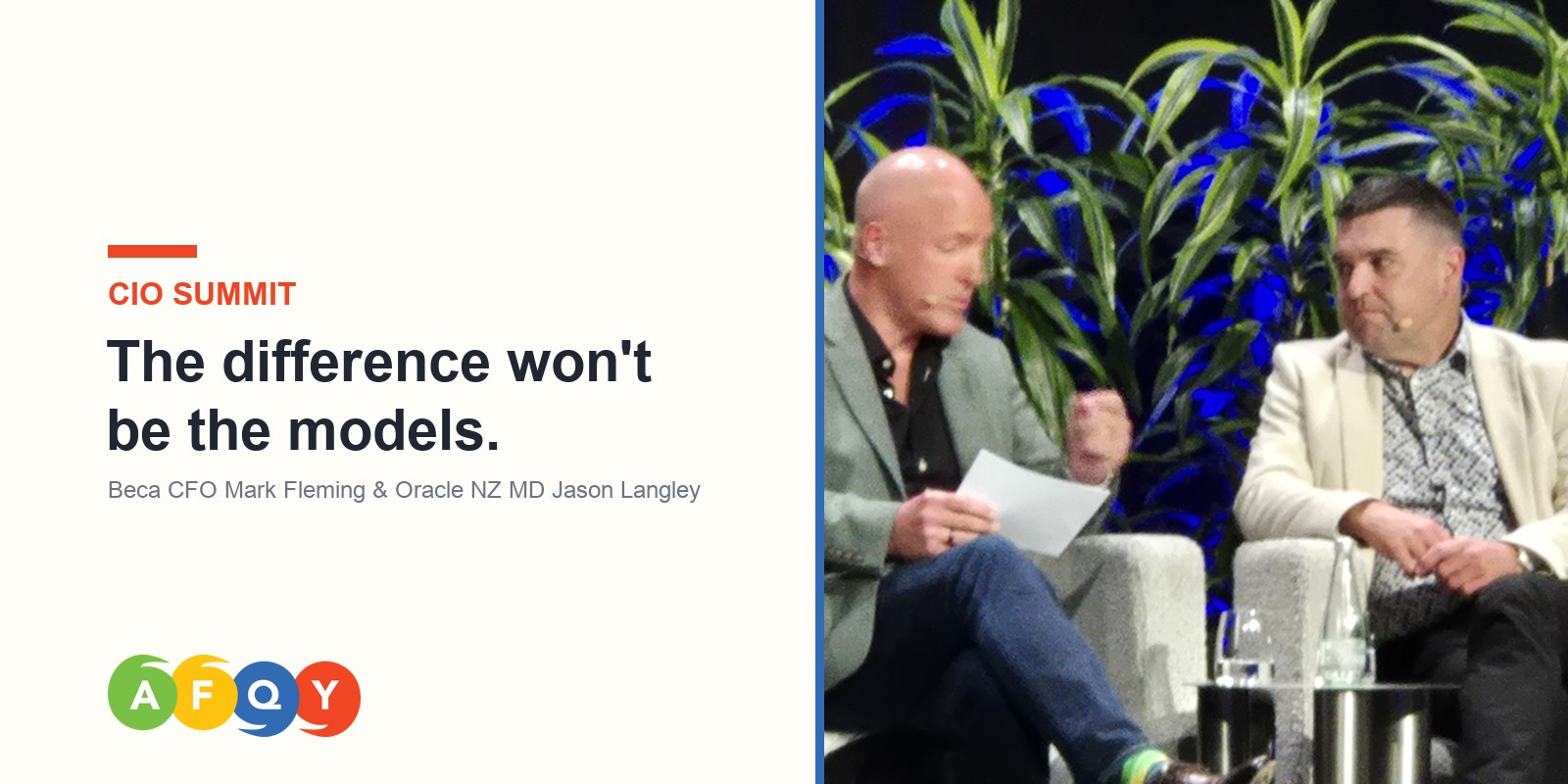
Closing the “Foundations First” session at Auckland’s CIO Innovation Summit, Oracle New Zealand managing director Jason Langley put the AI scaling problem in three parts. Build the platform before you build the pilots: a single gateway to models, built once and consumed by many, because without it an organisation doesn’t get one AI capability, it gets dozens of disconnected things to maintain. Know the economics before you start, not after: pilots get funded by curiosity, production gets funded by a budget line, and unlike a license fee, inference cost scales directly with how much the tool actually gets used, so understand the cost of the work itself before defaulting to the biggest model for every task. And build in the discipline to stop: a fixed review point, a named owner accountable for the call, and a readiness to say no unless the expected value can actually be shown. Platform, economics, and the discipline to stop, he argued, is the real difference between a pile of experiments and enterprise value.
To make the case concrete, Langley brought Beca chief financial officer Mark Fleming on stage. Beca, employee-owned and founded in Auckland in 1920, describes itself as one of Asia-Pacific’s largest independent advisory, design and engineering consultancies, working across buildings, power, water and transport infrastructure from more than 20 offices across the region. Fleming sits on the executive team responsible for bringing technology, data and innovation into that business, alongside running the finance portfolio.

Beca’s most recent AI work sits inside its core Oracle finance system: machine learning and predictive capability embedded in the platform, live for around 18 months, and now a move into more autonomous agents built with Oracle’s product team, including a ledger agent, a cash-processing agent and an expenses agent, aimed at automating the manual work so people can spend their time on higher-value tasks.
The more interesting part of the conversation, for a room full of CIOs, was how Fleming actually judges whether that work is worth it. “Business case” was the first word out of his mouth: clarity on the specific business outcome being targeted, and a measured baseline so improvement can actually be demonstrated rather than assumed. The second test is reputational. Beca has been trading since 1920, and Fleming was blunt that a firm planning to be around for another century treats data governance, security and privacy as a precondition, not a feature: if the team isn’t comfortable those are in place, the project doesn’t go further, full stop.
That governance discipline had a clear starting point. A move to a new ERP platform became the catalyst for a wider data-cleansing exercise and a formal set of data protocols, and Beca now runs data stewards who maintain data quality on an ongoing basis rather than refreshing it periodically, something Fleming described as a discipline the organisation has to keep applying to itself, not a project with an end date.
Asked whether Beca had backed a single large language model, Fleming said the firm has deliberately stayed open, choosing whichever model suits a given solution rather than standardising early. It’s a stance Langley said mirrors Oracle’s own architecture: choice built in at the infrastructure layer, the database layer and the application layer, so an organisation can run the model that actually fits the workload rather than the one it happens to have already committed to. It’s consistent with how Oracle has been positioning its own AI platform more broadly this year, building security and access controls directly into the database layer so an AI agent querying data on a user’s behalf still runs inside that user’s own permissions, rather than layering governance on top after the fact.
Fleming’s closing advice leaned less on technology and more on people. Be clear on the business outcome you’re chasing, and make sure it’s aligned to strategy rather than novelty for its own sake. When you find people with the right capability, hold onto them and keep developing that capability, because it’s what makes the tools useful. And expect change fatigue: every rollout is a change-management exercise, and keeping it consumable for teams, rather than overwhelming, has been one of Beca’s real lessons in scaling this beyond a small group of early adopters into something the whole organisation is expected to use.
Langley’s summary of the session doubled as his summary of the AI moment more broadly: start with the intended outcome, build solid foundations, empower teams with guardrails, and scale only what can actually be trusted and measured. Trusted data gives AI useful context. Secure AI gives the organisation confidence to use it. Choice keeps strategy adaptive. Judgement is what makes it valuable, and human expertise is what makes it useful at scale. Every organisation in the room, he pointed out, has access to roughly the same models. The difference won’t be the models. It’ll be the foundations underneath them, and the judgement applied on top.