
AI Adoption Is a Company Change: Inside the CIO Summit's Collaborative Culture Panel
5 August 2026· AFQY News
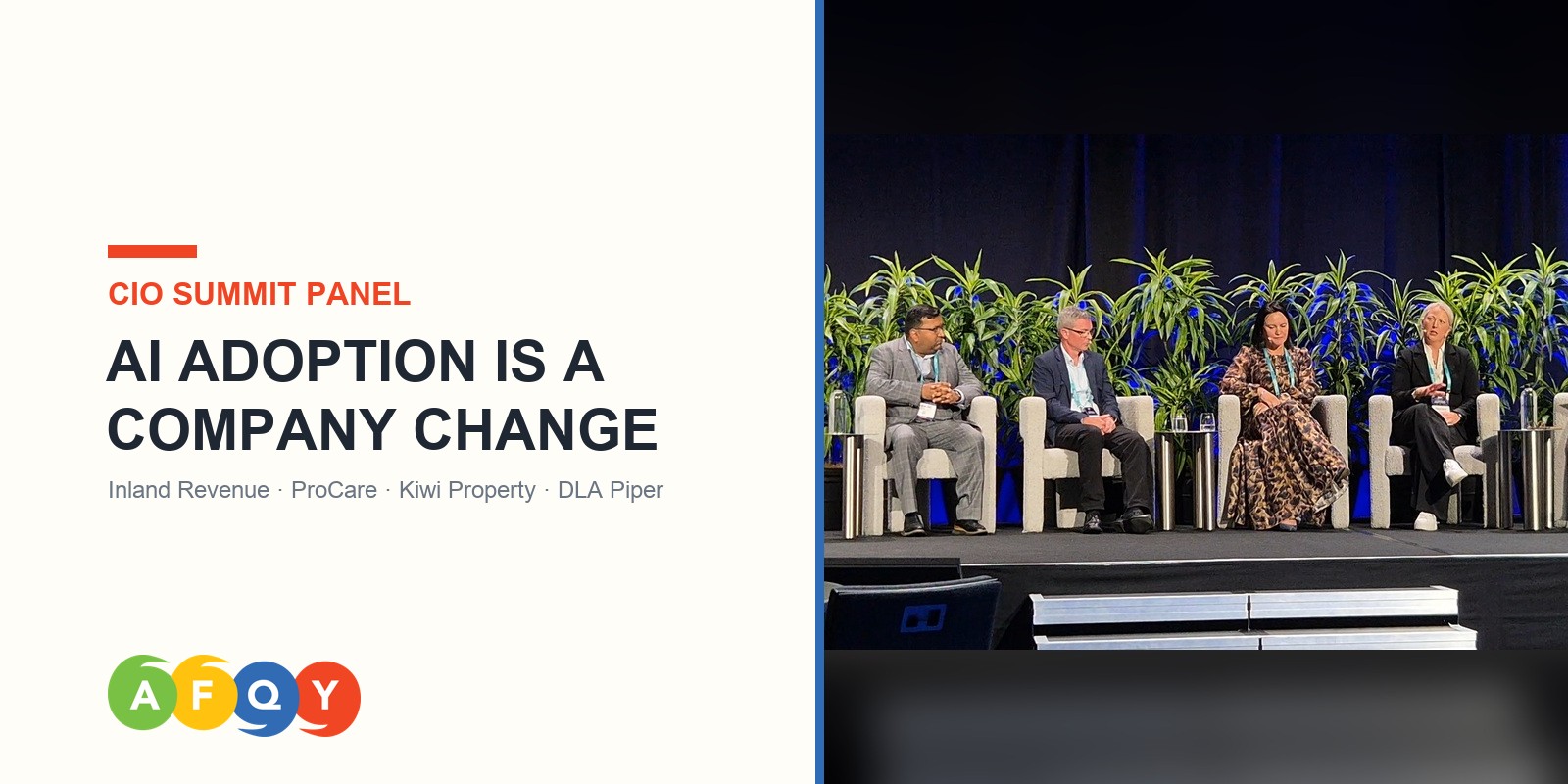
The most revealing part of an enterprise AI rollout may not happen in a strategy meeting, a training room or a model evaluation. It may happen while somebody is making coffee.
That was one of the practical lessons from the CIO Innovation Summit panel on Building a Collaborative Culture Through Technology. Brijesh John of Inland Revenue, Ian Smith of ProCare Health, Emma Burte of Kiwi Property and Natasha Wilson of DLA Piper approached AI from four very different operating environments. Their examples ranged from patient information and legal obligations to property systems and public services, but the same pattern kept returning: people adopt technology through trust, useful work and repeated conversations, not through deployment alone.
The panel’s discussion also exposed why “human in the loop” is too shallow as a culture strategy. Human judgement has to shape the outcome, the process, the controls, the pace of adoption and the way roles evolve. It cannot be added at the final approval screen.
TL;DR
- Start with the outcome and how work needs to change, then choose the technology. Usage is not the same as value.
- Visible executive support gives people permission to experiment, but a deliberately slower rollout can build more confidence than an adoption race.
- Communities of practice create reach, while small-team sessions and informal conversations surface the doubts and failures people will not share in a large forum.
- Governance has to reflect context. A law firm may face different instructions from every client, while healthcare must protect patient information and public services must prove decisions are properly assured.
- Teach people to treat AI as a junior contributor whose work requires checking. As systems become more agentic, move verification and authority controls into the design itself.
- Be honest that work and roles will change. Protect the learning pathways that build future experts, and separate workforce redesign from short-term cost pressure.
Begin with the outcome, not the adoption target
John opened with a distinction between adopting AI and adapting to it. Drawing on his research background and his work at Inland Revenue, he said the mental model should begin with the outcome, then consider how the work needs to change, and only then decide how technology can help.
He described Inland Revenue through a broader lens than tax collection alone. Depending on whom you ask, he said, almost half of its business can also be understood as social services. That changes the test for technology. Productivity matters, but so do people’s confidence in using the tools, the return on investment and what John called the “return on future”: the longer-term effect on society.
John cited a figure that 78% of New Zealand CEOs were seeing little value or little impact from AI. His challenge was not simply that organisations should adopt faster. It was whether weak results show a failure to adopt AI, or a failure to adapt the organisation around it.
"People want to know what the outcome is. You've got to know how work changes, and then you use technology to get there."
That framing became the foundation for the rest of the panel. Whether the organisation was deciding how lawyers research, how clinicians handle information, how finance work is automated or how a public service is assured, the useful question was not “Where can we put AI?” It was “What outcome are we responsible for, and what should the work become?”
Leadership sets the permission and the pace
Burte’s account of Kiwi Property’s organisation-wide rollout began with visible backing from the chief executive. The message arrived before the tools: try it, learn and see what it can do. That sponsorship made experimentation legitimate, but it did not translate into a race for maximum adoption.
Kiwi Property chose to move deliberately. Burte said the slower pace helped avoid some of the costs other organisations later encountered and gave cautious people time to understand what was happening. One-to-one conversations mattered. Some of the people who began with the greatest anxiety became strong advocates after their concerns were heard rather than dismissed.
The timing also mattered because employees had recently come through ERP and CRM transformation. Another highly promoted technology programme risked arriving as pressure rather than possibility. Burte’s response was to lower the temperature, acknowledge the fatigue and make leadership vulnerability visible.
"I feel like going slow is actually working really well for us."
The lesson for CIOs is not that every organisation should slow down. It is that pace should be a leadership choice connected to readiness, risk and the organisation’s recent experience of change. An adoption target can count activated accounts. It cannot show whether people feel safe enough to experiment honestly or challenge a poor output.
Learning is a social system
Smith described ProCare’s response as a community rather than a conventional training rollout. The organisation invited volunteers from across the business to learn about AI, develop ideas and take new skills back into their teams. Interest exceeded the places available in the first cohort.
The group received structured learning and support, but its value was not confined to the curriculum. It created a cross-business network, the beginnings of a centre of excellence and a visible source of energy that other employees wanted to join. Capability began to ripple into teams through trusted colleagues rather than being pushed only from the technology function.
Wilson found the other side of the same dynamic at DLA Piper. Large invitations to share AI experiences produced little. A Teams collaboration space and an ideas page also remained quiet, even when leaders supplied examples. The useful information appeared in smaller, tailored sessions and informal one-to-one conversations in the kitchen.
The turning point was often a leader sharing an AI failure first. Wilson said some of her own failures had been astounding. Acknowledging that made it normal for others to discuss what had gone wrong, which produced better feedback than asking a large group to showcase success.
This is an important distinction for any CIO building AI capability. A community can create reach and momentum, but psychological safety is often local. Organisations need both: a visible network where knowledge travels and smaller settings where people can admit uncertainty without performing confidence.
Governance has to follow the work
DLA Piper’s legal environment makes a single generic permission impossible. Wilson said some clients insist that AI must be used, some prohibit it, and others specify which tools or forms of use are acceptable. The firm moved from exploratory guidelines to a formal global policy and trained everybody on it, but that policy is only the top layer.
Each client engagement carries its own expectations. The partner responsible for the work must make those requirements clear to the team, and firm-wide communications are used when a particular client’s rules need wider visibility. The reason is straightforward: the firm cannot afford ambiguity about whether AI may touch a matter or how it may be used.
Smith described a different boundary in primary healthcare. ProCare supports a network of about 140 practices across Auckland and Northland, and much of the information it processes belongs to patients and practices. The organisation is therefore concentrating much of its automation on administrative and business processes while maintaining tight control over where patient information is processed and stored.
The panel’s examples show why governance should be layered. Enterprise policy defines the common floor. Sector obligations, client instructions, data sensitivity and the consequence of error then determine the controls around each use case. Current New Zealand guidance points in the same direction. The Ministry for Regulation’s responsible-AI guidance treats leadership, people, organisational integration, risk and procurement as connected practices, while the Office of the Privacy Commissioner advises human review before acting on AI outputs to reduce risks from inaccuracy and bias.
Trust moves from the answer to the system
John used the familiar phrase “trust but verify”, then argued that agentic systems change where verification must happen. When a person uses a chatbot to draft an answer, checking the output may be enough for a low-risk task. When software can take actions, the controls have to move upstream into design: permissions, assurance, boundaries and evidence that the system is acting for an authorised purpose.
In a public service, he said, trust includes confidence that the technology will produce the right outcome for New Zealanders. That requires assurance appropriate to each stage, not blind confidence in either the model or the person using it.
Wilson translated the same issue into a memorable working rule for lawyers. AI can help, including through general assistants and legal-specific tools, but prompting and source checking are part of the job. A fluent answer does not earn seniority.
"Everybody basically looks at AI as the most junior person in your team."
The analogy works because it makes human responsibility concrete. If a junior colleague gives three correct answers, a senior professional does not stop exercising judgement. Automation bias can make people less vigilant after a run of plausible results, so the habit of checking needs to be reinforced through training, team meetings and everyday practice.
Burte widened trust beyond the output. Employees need confidence that company data is protected, that leadership has a credible direction and that their roles will evolve fairly. She also pointed to a new form of inefficiency: somebody uses AI to turn a short document into 20 pages, then the recipient uses AI to turn it back into bullet points. More content has moved, but no additional value has been created.
Her answer was strikingly low-tech: conversations. People build trust with people, particularly when leaders are honest about what is known, what is changing and what still requires judgement.
Workforce change cannot be reduced to job loss
The workforce discussion became more specific when the moderator asked what AI might replace. Each sector exposed a different version of the same tension.
Burte described a finance-system upgrade that automated a tedious process. It was not fundamentally an AI story, but it prompted an employee to ask whether their role would be made redundant. The answer was that the role would change and time would move to other work. A year later, she said, that was how it had played out. Her broader point was that AI is highlighting work that can be redesigned, but it is not the only technology capable of changing a job.
For Wilson, the difficult question is the legal profession’s development pipeline. Junior lawyers learn by shadowing senior colleagues, attending meetings, reviewing documents and doing research. AI can now perform parts of that early-career work, but removing the work without replacing the learning would create a future expertise problem. Wilson said DLA Piper continues to invest in graduates because people cannot advise international clients on complex matters later in their careers if they have not learned from the ground up.
Smith said ProCare does not see AI replacing GPs, nurses or clinicians. The opportunity is to reduce administrative load and help them perform their roles, while preserving the human connection and clinical judgement at the centre of healthcare.
"We don't see AI replacing the GPs and nurses and clinicians. It's more enablement to help them do their roles."
John acknowledged that the public-sector question is especially difficult. New Zealand faces fiscal pressure at the same time as a significant technology opportunity. His view was that leaders should resist collapsing those into one conversation. They should first ask how technology changes work, what new problems it can solve and how work should be redesigned, then be transparent about the consequences.
That separation is hard in practice, but valuable. If AI begins as a predetermined headcount answer, employees have little reason to trust invitations to experiment. If leaders deny that roles will change, they lose credibility. The more honest position is that tasks, roles and learning pathways will shift, and that the organisation must design those shifts rather than wait for them to happen.
Guardrails can become part of the product
Smith gave one of the panel’s most practical examples of governance enabling delivery: ProCare has built an internal compliance agent. It helps employees work through the steps a process or project must complete against relevant legislation, with several variants for different subprocesses.
It is not the most dramatic AI use case, he acknowledged, but it is proving useful. The example reverses the usual argument that compliance sits outside innovation and slows it down. When obligations are translated into accessible, repeatable workflow support, the guardrail becomes part of how work gets done.
The same principle appears in current New Zealand public-sector guidance. Responsible AI Guidance for the Public Service recommends human oversight and clear accountability, including keeping a register of AI use. MBIE’s responsible-AI guidance for businesses likewise frames governance as a practical way to manage privacy, cybersecurity, human-rights and workplace risks while organisations pursue value.
The implication is not that every control should be automated. It is that CIOs should look for recurring compliance decisions that can be made easier to understand, consistently applied and visible inside delivery. Governance earns trust when people can use it, not merely when they can find the policy.
Four pieces of advice form one operating model
The panel closed with one recommendation from each leader.
Burte said not to forget the people above, below, inside and outside the organisation. They will make the company or break it. Wilson said leaders need to get out from behind governance checklists and talk with people themselves, swapping stories and asking questions instead of delegating engagement entirely to trainers or knowledge teams.
Smith emphasised consistency about the outcome a project is trying to achieve and transparency about progress. John argued that collaboration should be organised around meaningful outcomes rather than technology. With the noise around AI almost deafening, leaders should stay anchored in their personal and organisational beliefs, give people room to experiment safely, and build digital capability beyond the formal digital team.
Together, those recommendations amount to an operating model for collaborative adoption. Set an outcome people recognise. Make leadership support visible. Build a community that spreads capability. Create smaller spaces where uncertainty can be voiced. Put governance inside the work. Be honest about changing roles. Preserve human judgement at both the point of use and the design of the system.
Agentic AI may arrive through a deliberate programme or quietly inside an enterprise platform release. Either way, the organisation still chooses how it responds. The competitive advantage will not come from pretending adoption is inevitable. It will come from building the trust, capability and clarity that turn available technology into work people can improve together.