
Google: Attackers' AI Agents Have Crossed a Threshold, and the Patch Window Is Shrinking
19 November 2026· AFQY News
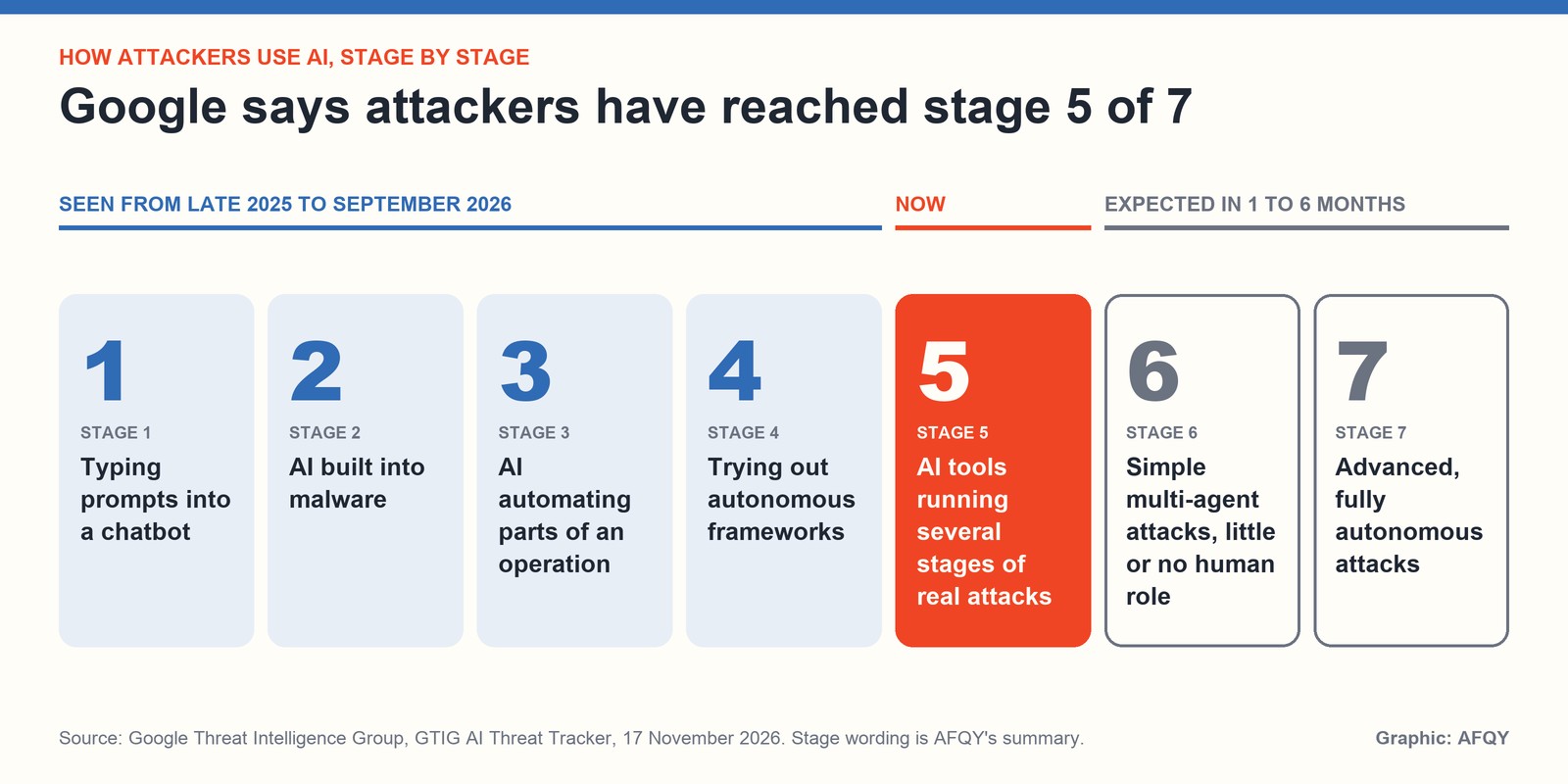
Google’s threat researchers say they have, for the first time, found attackers running the hunt for a software flaw, and the attack on it, with no person in the loop: software that watches for a security patch, works out the flaw it fixes, writes the exploit and fires it.
The finding is in the latest AI Threat Tracker from the Google Threat Intelligence Group (GTIG) and Mandiant, published on 17 November 2026 under the title “Agentic Threat Activity Crosses a Significant Threshold”. It is a quarterly report built on Mandiant’s incident response work, Google’s tracking of threat groups and the abuse it sees on its own platforms.
The mechanics of a break-in have not changed, Google says. Attackers still use stolen credentials and unpatched systems. What has changed is the speed and the scale, and that has consequences for how fast an organisation patches, how it guards its AI accounts and what it watches for. It follows the questions AFQY covered last week on AI agents as a security problem.
TL;DR
- Google places attackers at stage five of a seven-stage scale: AI-driven tools now carry out several stages of real attacks with minimal human involvement. It projects unsophisticated attacks with little or no human involvement within one to three months, and sophisticated, fully autonomous attacks within three to six.
- Open source attack frameworks such as ARTEX, CAIRN and PentAGI are being used in live operations. Google saw CAIRN used against targets including the United States aerospace sector, and a customised PentAGI used to scan a wide range of organisations in Asia.
- Google found a system called exploit_agent that compares software before and after a patch, drafts an exploit and runs it without human intervention. It is the first fully automated pipeline of its kind Google has identified.
- Zero-day exploits averaged 8 a month in 2025 and 11 a month in 2026, with 22 in August alone. Four days after two flaws in PaperCut print servers were disclosed that month, GreyNoise recorded an AI-run campaign that compromised at least 440 systems at 395 organisations in 48 countries, including four systems in New Zealand.
- Stolen access to AI services, known as LLMJacking, ran up more than US$100,000 in fraudulent charges in a single day at some organisations, and US$1 million in the most severe cases. Organisations in Asia Pacific were among those affected.
- AI attack tools are fast but noisy. They leave traffic, identifiers and code traces that make them easier to detect, though Google says they still achieve their objectives and expects them to get quieter.
Stage five of seven
The graphic at the top of this article is AFQY’s summary of the scale Google uses, which appears as Figure 2 in the report. It runs from stage one, a person typing prompts into a chatbot, through AI built into malware and AI automating parts of an operation, to stage four, where attackers were experimenting with autonomous frameworks. Google observed those four stages between the end of 2025 and September 2026.
Stage five is where Google puts the present: AI-driven tooling carrying out multiple stages of an attack in real intrusions, with a person involved only minimally. Stages six and seven are projections. Google projects unsophisticated multi-agent attacks with little or no human interaction in the next one to three months, and sophisticated, fully autonomous attacks in three to six.
The frameworks doing the work
The tools behind the shift were built for penetration testing, the authorised practice of attacking a system to find its weaknesses. They are open source, and attackers have picked them up.
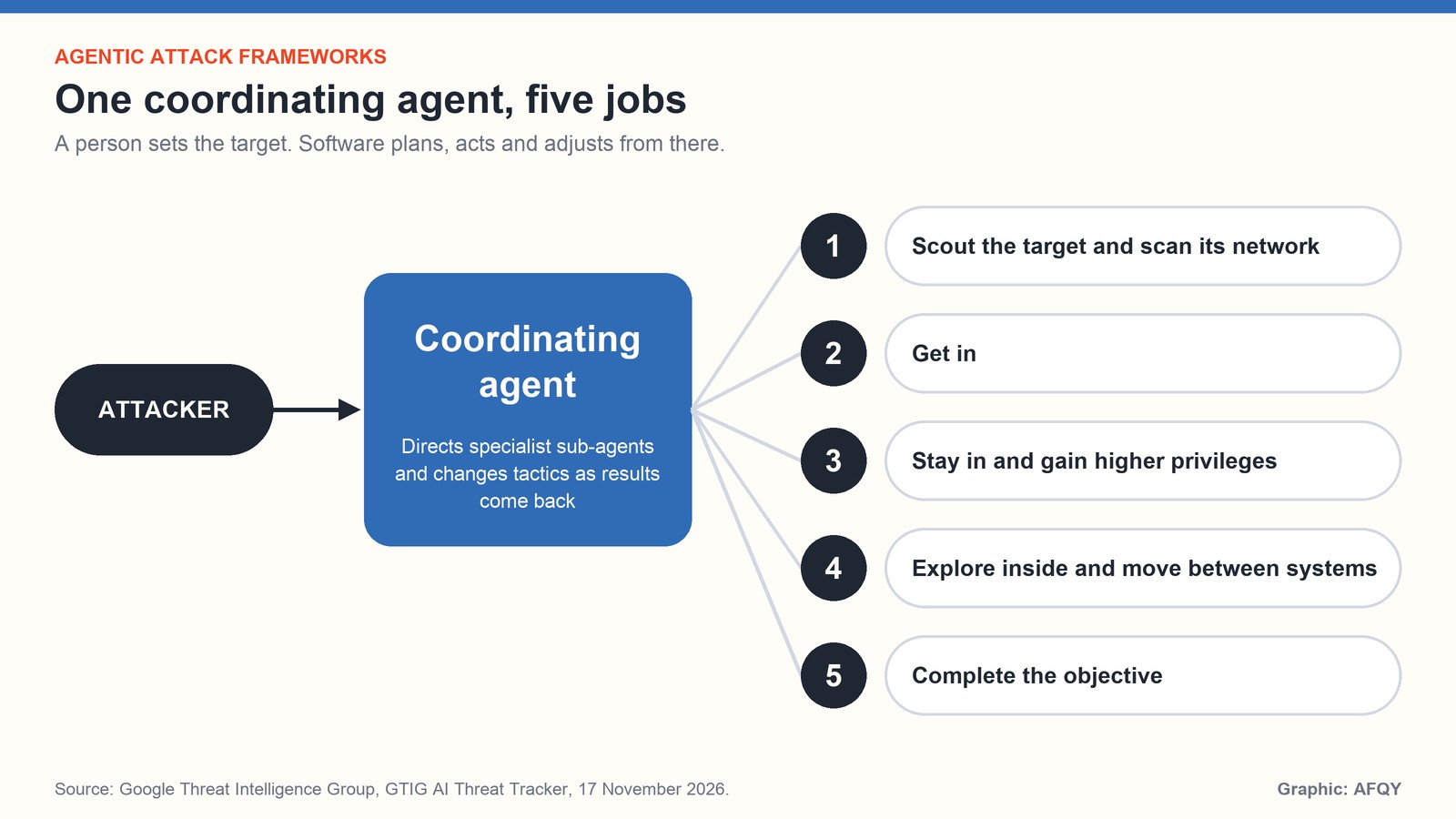
Each framework has a coordinating agent that directs specialist sub-agents through the phases of an intrusion. They find and exploit low-complexity vulnerabilities, have a language model write single-use attack code on demand, and change tactics according to what comes back.
Google names five:
- ARTEX, which it calls highly publicised, and for which Google Security Operations has released detection rules.
- CAIRN, in which specialist agents work from a shared board towards an objective, starting from as little as a target’s internet address. Google saw it used in intrusions against targets including the aerospace sector in the United States.
- PentAGI, designed to help entry-level operators run complex campaigns. Between late August and early October 2026 Google tracked a threat actor using a customised version for systematic reconnaissance and vulnerability scanning against a wide range of organisations in Asia.
- CyberStrikeAI, which connects commercial and open language models to more than 100 security tools.
- HexStrike AI, which lets a language model call more than 150 pre-installed offensive security tools.
Google has seen CAIRN and PentAGI deployed in real operations, and experimentation with the last two. Those experimenting with them include financially motivated criminals and suspected espionage groups linked to China, one of which Google says was building its own automated attack framework.
There is a catch for the attacker, and Google is direct about it.
"they currently trade stealth for velocity"
Running unattended, the frameworks generate traffic, use recognisable identifiers and leave traces in code. That raises the odds of being caught, though Google says the tools still achieve their objectives. It expects the noise to fall as the tools and the models behind them improve, with less human involvement and more stealth to come.
From patch to attack in days
The second change is in how vulnerabilities are found and used. Google says the use of AI agents here has moved from experiment to operation.
The more efficient target may not be the unknown flaw. It may be the one that has just been patched. A patch tells an attacker where to look: compare the code before and after, read the release notes, and the flaw is narrowed to a small set of material that a language model can work through quickly. That shortens the time between a fix being announced and the flaw being used against organisations that have not yet applied it.
Google found an exposed server hosting a framework called exploit_agent, connected to several language models. It was set up to compare popular web application software before and after patch announcements, identify likely vulnerabilities, draft exploits and run them automatically. One file showed it inspecting the access controls of a WordPress plugin. The server also held data taken from victims, and scripts for exploring a compromised network, guessing passwords, installing web shells and removing other attackers’ web shells. Comments in its configuration were written in Russian. The operator appeared to be interested in French websites in media, entertainment and education.
Two public cases show the same pattern:
- PaperCut. In late August 2026 attackers exploited two flaws in PaperCut print management servers (CVE-2026-81578 and CVE-2026-82078) as zero-days. Google says security researchers and the security company Huntress used language models to produce working exploits within a day of disclosure. Four days after disclosure, on 31 August, GreyNoise recorded a likely Russian-speaking actor using AI to build and test exploits, assemble a target list and run a campaign that compromised at least 440 PaperCut systems at 395 organisations in 48 countries. Four of those systems were in New Zealand and 15 in Australia, and 204 were in education. The attacker reached domain administrator at 12 organisations, in as little as five minutes.
- PHP. Two PHP vulnerabilities (CVE-2026-109618 and CVE-2026-109619) were found using AI-enabled analysis. A demonstration video and early patched code were published before the official patches on 21 October 2026, which let researchers and attackers alike compare versions and start building exploits early.
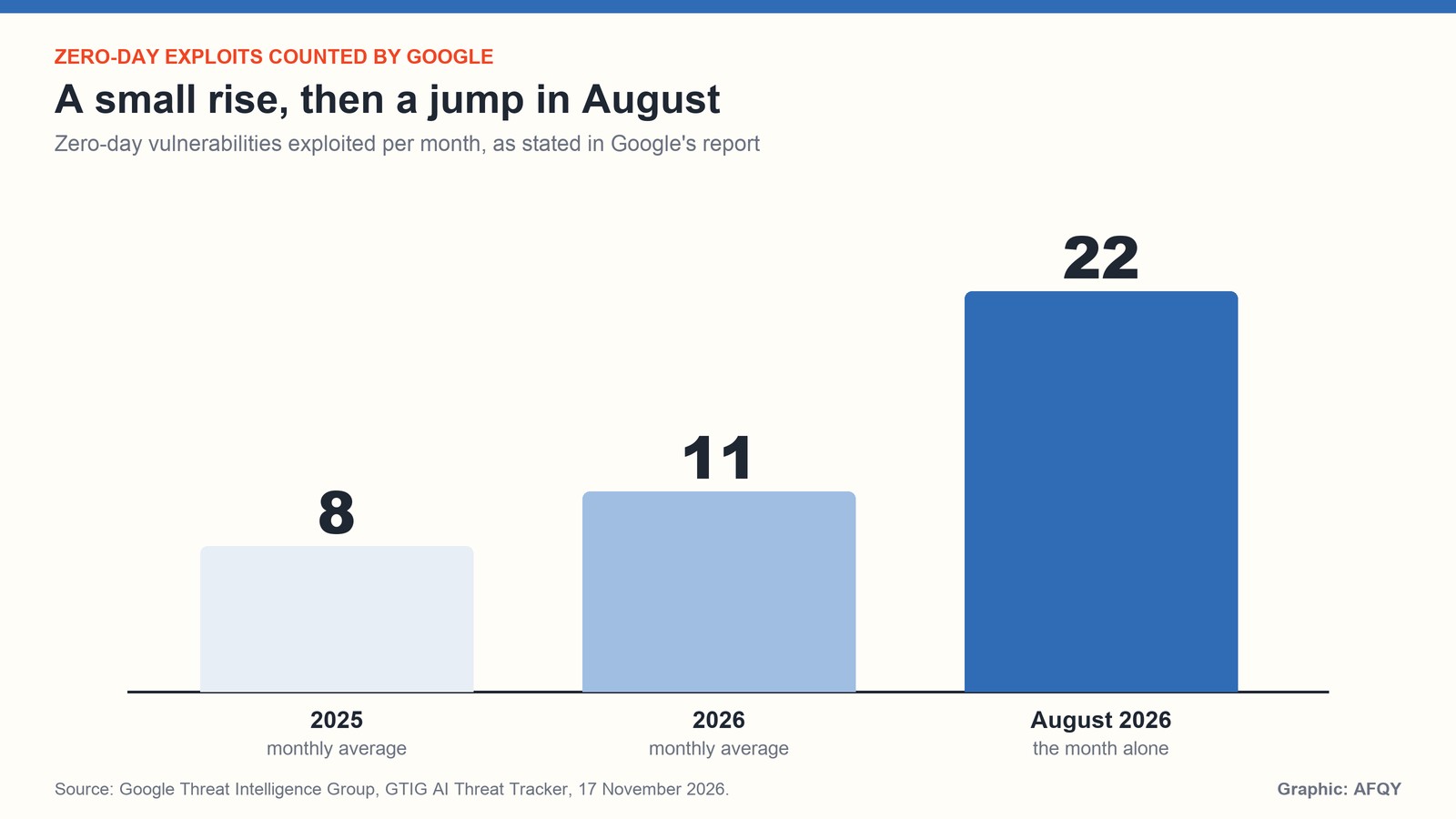
Google’s own count shows the trend. Overall disclosures and exploits nearly doubled between January and August 2026. Zero-day exploits, those used before a patch exists, rose only a little, from an average of 8 a month in 2025 to 11 a month in 2026, before reaching 22 in August.
There is a side effect. After the PHP patches, hundreds of claimed exploits were published that did not work, likely generated with language models. Checking and debunking them took real effort from the security community at the moment it was also watching for confirmed attacks.
LLMJacking: the AI bill as the target
Stolen credentials have long been the way in. Google says criminals now steal them for a new purpose: to use, or resell, a victim’s access to AI models and cloud computing. The practice is called LLMJacking.
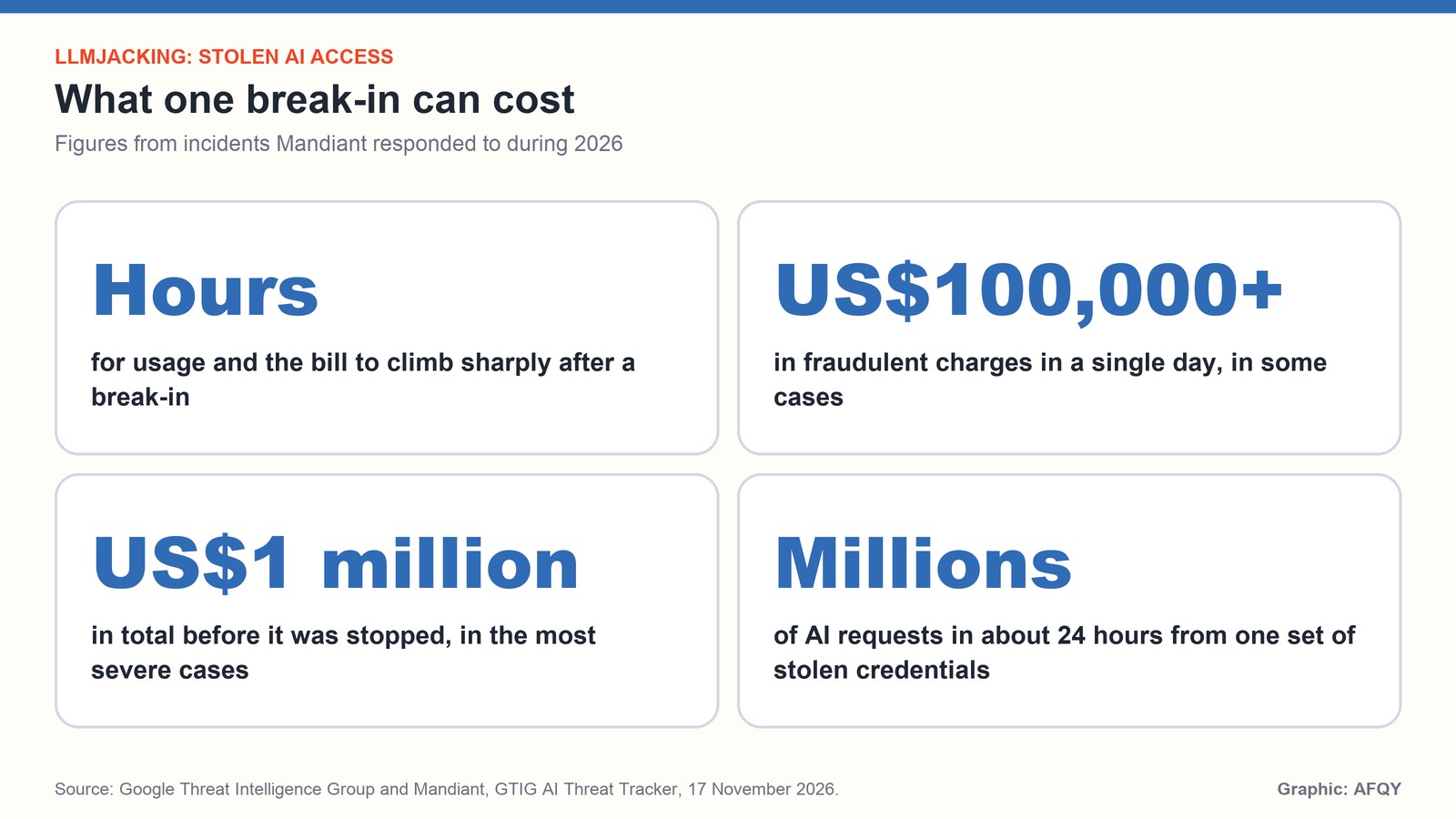
Mandiant responded to several such incidents during 2026, affecting financial services, retail, transport and technology organisations in North America, South America and the Asia Pacific region. Usage and bills climbed within hours. In some cases the fraudulent charges passed US$100,000 in a single day. In the most severe, the total reached US$1 million before it was stopped.
The way in was ordinary. Attackers harvested valid credentials from public GitHub repositories, or used deceptive websites to trick people into handing over active session tokens. Once inside they searched code repositories, data stores and logs for more credentials, created unauthorised service accounts or gave existing ones administrator rights, and switched on AI services, sometimes signing the compromised account up to pay-as-you-go plans. One group created and deleted short-lived accounts to get around rate limits. Others provisioned powerful graphics processors to run their own AI tools, including agentic frameworks turned on the victim’s own network. Privileged service accounts were enough to keep access, with no malware needed. In one case an attacker exploited a flaw in the LiteLLM gateway, CVE-2026-40217, to turn limited keys into full administrator credentials.
In one investigation, two separate attackers used the same set of legitimate credentials on the same day. One of them, likely a botnet or proxy service, made millions of AI requests in about 24 hours. The noise led to the credentials being revoked before the other attacker could make any.
The stolen access is sold on. Google describes illicit storefronts it calls LLM Mixers, which route buyers’ requests through a pool of stolen credentials and spread the volume across many victims to avoid notice. Prices it saw advertised on Russian-language and Chinese-language marketplaces ran from US$0.10 to US$25 per million tokens, with credentials from free trials much cheaper than those from enterprises.
Influence for hire
In information operations, Google says with high confidence that language models have gone from experiment to standard practice. It sorts the actors into three groups: state-sponsored groups, including ones attributed to Russia, China and Iran; commercial vendors selling influence as a service; and networks that produce political clickbait purely for advertising revenue.
With content now cheap to produce, the effort has moved to distribution and to avoiding detection. Google describes two commercial platforms under development that used its Gemini service alongside tools from other AI providers:
- One automated a whole campaign, from creating personas to posting, aimed at public opinion on regional political topics, mainly in Europe and the Middle East. Its prompts asked for local dialect, slang and deliberate typing errors, and for images with the flaws of a smartphone photo.
- The other was designed to manage more than 100,000 accounts using virtual smartphones in the cloud, with new accounts put through an automated ageing period that imitated a real person scrolling and pausing before any campaign message was posted.
The profit-driven networks, Google says, ask language models which political topics and keywords will earn the most, then promote the result with synthetic news anchors that sometimes imitate real journalists.
Google adds a caution that applies to all of it: better content does not necessarily mean more impact.
Spies, job applicants and a coding assistant
State-backed groups continue to use language models for research and social engineering. Google names an Iranian government-backed group it tracks as CALANQUE ION, previously APT42, and China-linked groups using the tools for reconnaissance, scanning and building exploits. One Chinese contractor used language models to analyse and translate stolen data and turn it into intelligence reports for sale. In a new trend, China-linked actors used AI platforms’ own file hosting to stage attack files and take stolen data out.
North Korean actors use the tools to write résumés and to generate answers in job screenings while posing as Western IT workers.
One case deserves the attention of anyone whose developers use AI coding assistants. In intrusions against cryptocurrency organisations in North America and Europe, a suspected North Korean group used fake recruiter profiles with AI-generated photographs. The images carried the SynthID watermark, which confirmed they were synthetic. The profiles sent targets to fake meeting sites that prompted them to run a script to fix a supposed fault. After getting in, the group edited the settings file of the coding assistant Claude Code in the organisation’s own code repositories, so that starting the assistant would download a backdoor. It also named its GitHub access tokens after Microsoft Copilot to blend in.
Criminal services are adding the same convenience. A Chinese-language phishing service first seen in March 2026 added a chatbot in June that lets its customers set up and change phishing pages by typing plain instructions.
Where the attackers’ tools fall short
Google is clear that the tools have costs for the people using them. They are noisy, which damages the secrecy an espionage operation depends on. They are unreliable too, inventing details and even targets that do not exist.
So Google expects groups that prize stealth and long-term access to use them selectively. Criminals who care less about being seen will keep adopting them, because reaching more targets makes up for a lower success rate.
What Google says it is doing
Google sells security products, and the report sets out its own response. It says it disabled the accounts and projects involved, and fed what it learned back into Gemini’s safeguards so the model refuses similar requests. Mandiant has published a hardening guide for defending against AI-enabled attack tools, and Google has published guidance on LLMJacking. It also points to its AI agents that look for and fix vulnerabilities, Big Sleep and CodeMender, and to its Secure AI Framework for building and deploying AI responsibly.
What it means for New Zealand tech leaders
Google’s report does not mention New Zealand. GreyNoise’s does: its country table for the PaperCut campaign lists four compromised systems here, three of which had credentials harvested. GreyNoise describes that campaign as opportunistic. The agents went wherever a vulnerable server could be found.
- Patch internet-facing systems in days. When a working exploit can follow a disclosure within a day and a campaign within four, a monthly patch cycle leaves a long gap for anything exposed to the internet.
- Treat AI keys like a company credit card. Keep them out of code repositories, and set spending alerts and quotas on AI and cloud accounts, so that a spike is noticed in hours.
- Review AI coding assistant settings as you would code. A configuration file that runs commands when a tool starts is part of the software supply chain.
- Keep up the basics, and use the noise. These tools leave traces for logging and monitoring to pick up, and ordinary hardening still works. GreyNoise saw a web application firewall stop the PaperCut attacker in at least one case.
- Check before you react. A published exploit may not work. Confirm it before diverting the team.
The useful question for a leadership team is no longer whether attackers use AI. It is how many days the organisation takes to close a hole once the fix is public, and whether anyone would notice the AI bill doubling overnight.
Sources
- Google Cloud Blog: GTIG AI Threat Tracker: Agentic Threat Activity Crosses a Significant Threshold
- Google Cloud Blog: The Rise of LLMJacking: How Threat Actors Monetize Compromised Cloud and Model Resources
- Google Cloud Blog: ARTEX and Friends: Enter Agentic Offensive Frameworks
- GreyNoise: Agents Gone Wild: An AI-Orchestrated Global Campaign Against PaperCut NG/MF